

The Unyielding Hand: The Role of Punishment in Maintaining Order
From the earliest city-states to our complex modern societies, the concept of punishment has been inextricably linked to the preservation of social order. It is the State's ultimate tool, a stark declaration of boundaries, and a constant subject of philosophical debate. At its core, punishment serves to enforce the Law, compelling individuals towards a collective good and upholding the very fabric of our shared existence.
The Genesis of Order: From Natural State to Civil Society
Before the advent of codified Law and the organized State, human existence was often imagined as a "state of nature" – a realm where individual liberty was absolute, yet perpetually threatened. Philosophers like Thomas Hobbes, whose Leviathan remains a cornerstone of political thought, famously described this state as "solitary, poor, nasty, brutish, and short," a war of "all against all." It was the pressing need to escape this perilous freedom that spurred the formation of civil societies, where individuals willingly ceded certain liberties in exchange for security and stability.
This foundational agreement, often termed the social contract, posits that the State emerges as the ultimate guarantor of peace. With its establishment comes the authority to define acceptable conduct, to legislate Law, and crucially, to impose Punishment upon those who transgress these established norms. Without this power, the contract would be meaningless, and society would inevitably devolve back into the chaos it sought to escape.
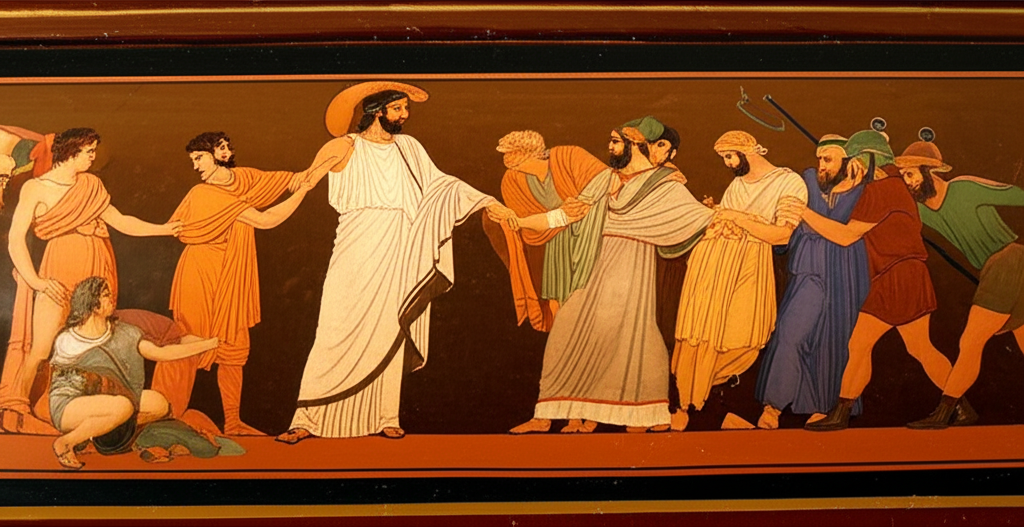
The Pillars of Justice: Exploring the Justifications for Punishment
The philosophical justifications for Punishment are as varied as the societies that implement them, yet they generally coalesce around a few core principles. Understanding these different approaches is crucial to appreciating the multifaceted role Punishment plays in maintaining order.
I. Retribution: Justice as Deserved Suffering
Retributive justice is perhaps the most intuitive justification for Punishment. It posits that offenders deserve to suffer in proportion to the harm they have inflicted. This is the "eye for an eye" principle, found in ancient codes and echoed in the writings of Plato and Immanuel Kant. For Kant, Punishment is a categorical imperative, a moral duty of the State to uphold justice, regardless of any future benefit. The focus is backward-looking, on balancing the scales of justice and affirming the moral order.
II. Deterrence: Preventing Future Harm
The utilitarian perspective, championed by thinkers like Cesare Beccaria in On Crimes and Punishments and Jeremy Bentham, views Punishment primarily as a means to prevent future wrongdoing. This approach focuses on two types of deterrence:
- Specific Deterrence: Aims to prevent the punished individual from re-offending.
- General Deterrence: Seeks to discourage the wider population from committing similar crimes by making an example of the offender.
From this viewpoint, Punishment is justified if its pain outweighs the pleasure or gain derived from the crime, thus rationally dissuading potential transgressors. The severity and certainty of Punishment are key to its effectiveness in maintaining order.
III. Rehabilitation: Reformation for Reintegration
While less directly about maintaining order through immediate enforcement, rehabilitation aims to transform offenders into law-abiding citizens. This approach views crime as a symptom of underlying issues (social, psychological, educational) and seeks to address these through therapy, education, and vocational training. A successfully rehabilitated individual is one who no longer poses a threat to social order, thus contributing to long-term stability.
The State's Authority and the Citizen's Duty
The power to administer Punishment is one of the defining characteristics of the State. It is the ultimate expression of its sovereignty and its commitment to protecting its citizens. This power is not arbitrary; it is exercised through established Law, which ideally reflects the collective will and values of the society.
Citizens, in turn, have a Duty to obey these laws. This Duty stems from the social contract, the implicit agreement to abide by the rules in exchange for the benefits of an ordered society. The acceptance of Punishment for transgressions is part of this Duty. Socrates, in Plato's Crito, famously chose to accept his unjust sentence rather than flee, arguing that to defy the laws of Athens would be to undermine the very foundation of the State that nurtured him. His example underscores the profound philosophical weight placed on the citizen's Duty to the Law and the State.
Challenges and the Enduring Debate
Despite its undeniable role in maintaining order, the application of Punishment is fraught with ethical and practical challenges. Questions persist:
- Is the Law itself just?
- Are punishments always proportionate to the crime?
- Does Punishment truly deter, or does it merely perpetuate cycles of violence and incarceration?
- How do we balance the need for order with the protection of individual liberties?
These questions, debated by philosophers from Aristotle to Michel Foucault, highlight the ongoing tension between the State's need for control and humanity's yearning for justice and freedom. The efficacy and morality of Punishment remain central to our understanding of a just and ordered society.
Conclusion: A Necessary, Though Complex, Instrument of Order
The role of Punishment in maintaining order is fundamental, yet undeniably complex. It serves as the ultimate enforcement mechanism of the Law, a tool wielded by the State to uphold the social contract and protect its citizens from chaos. Whether viewed through the lens of retribution, deterrence, or rehabilitation, Punishment is a constant reminder of our collective Duty to abide by shared norms. As societies evolve, so too must our understanding and application of Punishment, ensuring it remains a just and effective instrument for preserving the delicate balance between individual freedom and the imperative of a stable, ordered world.
**## 📹 Related Video: PLATO ON: The Allegory of the Cave
Video by: The School of Life
💡 Want different videos? Search YouTube for: ""Hobbes Leviathan social contract theory explained""**
**## 📹 Related Video: KANT ON: What is Enlightenment?
Video by: The School of Life
💡 Want different videos? Search YouTube for: ""Kant's Retributive Justice Explained""**