

The Cacophony and Consensus: Opinion's Indispensable Role in Democracy
In the vibrant, often tumultuous, landscape of a democracy, opinion is not merely a byproduct; it is the very oxygen that sustains it. While philosophy often urges us to transcend mere belief in pursuit of immutable truth, the practical functioning of a democratic state fundamentally relies on the diverse, sometimes clashing, viewpoints of its citizens. This article explores the intricate relationship between individual and collective opinion and the democratic process, acknowledging both its vital necessity and its inherent challenges, particularly as highlighted by thinkers within the Great Books of the Western World.
The Democratic Ideal: A Symphony of Voices
At its heart, democracy is an experiment in collective self-governance, a radical notion that places power directly in the hands of the people. From the ancient Athenian agora to modern parliamentary debates, the exchange of opinion has been the foundational mechanism by which societies deliberate, decide, and evolve. Without a multiplicity of viewpoints, without the freedom for each citizen to articulate their perspective, the very concept of popular sovereignty withers.
- Open Discourse: Democracy thrives on the open exchange of ideas, where different opinions are presented, debated, and refined.
- Legitimacy: Decisions made through democratic processes gain legitimacy precisely because they are understood to reflect, to some degree, the collective will or prevailing opinion of the populace.
- Adaptability: The constant flux of opinion allows a democracy to adapt to changing circumstances, correct past mistakes, and incorporate new understandings.
Socrates and the Skeptic's Gaze: Doxa vs. Episteme
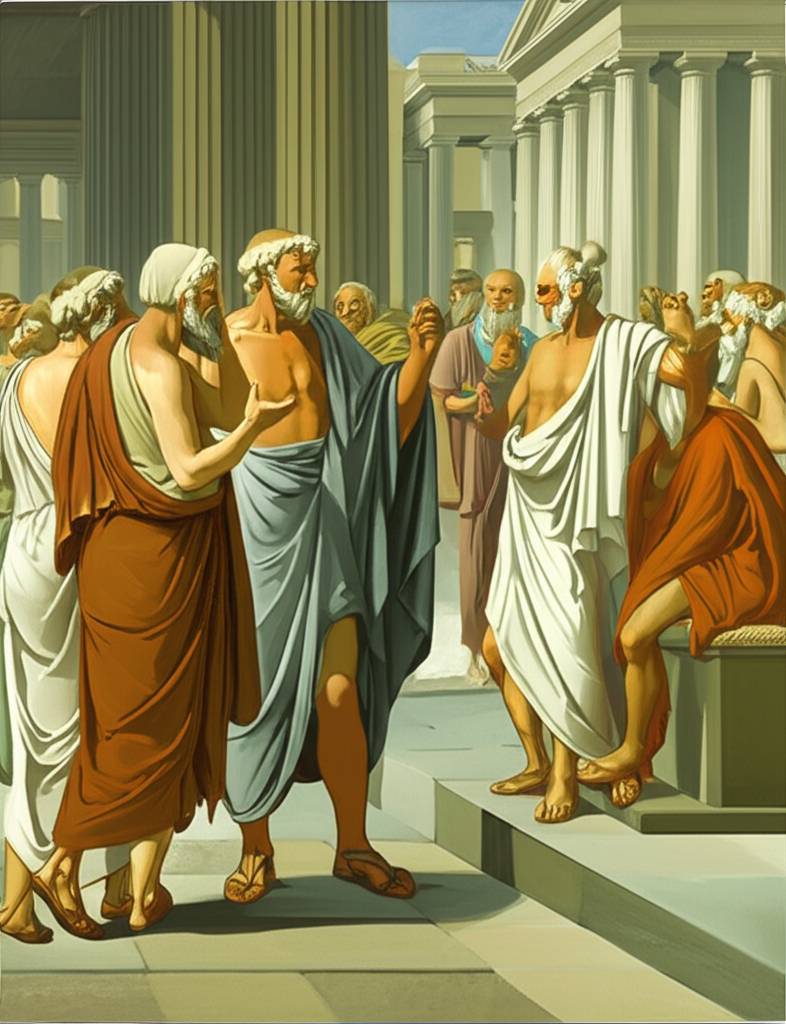
Yet, the philosophical tradition, particularly as articulated in the Great Books, has often cast a critical eye upon mere opinion. Plato, through the voice of Socrates in works like the Apology and the Republic, famously distinguished between doxa (opinion or belief) and episteme (true knowledge). Socrates' relentless questioning aimed to expose the shaky foundations of unexamined opinions, often revealing them to be inconsistent, ill-informed, or even harmful.
For Socrates, the unexamined life, built on unchallenged opinions, was not worth living. This presents a profound tension for democracy: if decisions are based on widely held but potentially flawed opinions, how can a society truly flourish? The Socratic challenge compels us to ask: What is the quality of the opinions that drive our democratic decisions?
The Art of Persuasion: Rhetoric's Double-Edged Sword
If opinion is the currency of democracy, then rhetoric is the language through which it is exchanged, shaped, and influenced. Aristotle, in his seminal work Rhetoric, meticulously dissected the art of persuasion, recognizing its power to move audiences and sway public opinion. He understood that rhetoric, when used ethically, is essential for deliberation and decision-making in a polis. It allows leaders and citizens alike to present arguments, appeal to reason and emotion, and build consensus.
However, rhetoric is a double-edged sword. Its power to persuade can be wielded for noble purposes, illuminating truth and fostering civic virtue, or it can be twisted to manipulate, mislead, and exploit the very opinions it seeks to influence. The demagogue, skilled in exploiting biases and fears, represents the darker side of rhetoric, capable of eroding the rational discourse vital for a healthy democracy.
The Citizen's Crucible: Cultivating Informed Opinion
Given the inherent ambiguities of opinion and the pervasive influence of rhetoric, the burden falls heavily upon the individual citizen to cultivate informed and critically examined beliefs. A robust democracy is not merely a collection of unreflective opinions; it demands active engagement and a commitment to intellectual rigor.
This doesn't mean every citizen must become a philosopher-king, but it does imply a responsibility to:
- Seek diverse perspectives: Engage with ideas that challenge one's preconceptions.
- Evaluate sources critically: Question the origins and motivations behind information.
- Engage in reasoned discourse: Participate in debates with an open mind, willing to be persuaded by sound arguments.
- Understand the limits of one's own knowledge: Acknowledging uncertainty is a hallmark of intellectual humility.
| Qualities of an Engaged Democratic Citizen |
|---|
| Critical Thinking |
| Intellectual Humility |
| Empathy for Diverse Viewpoints |
| Commitment to Deliberation |
| Resistance to Dogmatism |
Navigating the Modern Deluge of Doxa
In our contemporary world, the sheer volume of information and the speed at which opinion can coalesce and spread present unprecedented challenges to democracy. The digital age, with its echo chambers and filter bubbles, often amplifies unexamined doxa and makes the Socratic task of critical self-reflection more urgent than ever. The role of opinion remains central, but the mechanisms by which it is formed and disseminated have grown exponentially complex, demanding even greater vigilance from the democratic citizen.
Conclusion
The role of opinion in democracy is an enduring paradox: it is both the essential fuel and a potential poison. A vibrant democracy requires a free flow of diverse opinions, but it also demands that citizens and leaders alike engage with these opinions critically, informed by reason and a commitment to truth. The philosophical journey from doxa to episteme, initiated by the ancients and echoed through the Great Books of the Western World, remains a vital guide for navigating the complex terrain of public discourse and for ensuring that our collective opinions lead us towards a more just and flourishing society, rather than away from it.
📹 Related Video: PLATO ON: The Allegory of the Cave
Video by: The School of Life
💡 Want different videos? Search YouTube for: ""Plato's Allegory of the Cave explained""
📹 Related Video: ARISTOTLE ON: The Nicomachean Ethics
Video by: The School of Life
💡 Want different videos? Search YouTube for: ""Aristotle on Rhetoric and Persuasion""