

The Echo Chamber of Thought: The Indispensable Role of Memory in Language
Summary: Memory is not merely a faculty for recall but the fundamental scaffolding upon which language is built, shaping our perception, understanding, and the very structure of our minds. This article explores the intricate role of memory in both acquiring and deploying language, arguing that without memory, the mind would be a silent, uncomprehending void, incapable of the rich interplay between recall and imagination that defines human communication.
Introduction: The Unseen Architect of Our Words
From the earliest grunts to the most profound philosophical treatises, language serves as the primary conduit for human thought and interaction. Yet, its very existence and utility are inextricably bound to another, often understated, cognitive process: memory. As we delve into the philosophical underpinnings of this relationship, we find that the giants of Western thought, from Plato to Kant, have grappled with the profound role memory plays in shaping not just our words, but our entire conceptual universe. At planksip.org, we believe in exploring these fundamental connections that define the mind, and few are as crucial as the symbiotic dance between memory and language.
Memory: The Foundation of Meaning
The role of memory in language extends far beyond merely remembering words. It is the very bedrock upon which meaning is constructed. Consider the sheer volume of information our brains must store and retrieve to engage in even a simple conversation. This complex process relies on various forms of memory:
- Semantic Memory: This is our mental dictionary and encyclopedia, storing facts, concepts, vocabulary, and grammatical rules. It allows us to know what "tree" means, how to conjugate a verb, or the definition of "justice." Without semantic memory, words would be empty sounds.
- Episodic Memory: This involves the recall of specific events and experiences, providing context for our language. Remembering a particular conversation, a story told, or the circumstances under which we learned a new phrase enriches our understanding and allows us to share personal narratives.
- Procedural Memory: This is the unconscious "knowing how" to speak – the motor skills involved in articulation, the fluent application of grammatical structures, and the rhythm of speech. It allows us to produce language without consciously thinking about each sound or word choice.
Without these interconnected memory systems, our linguistic abilities would be severely hampered. Semantic memory furnishes the lexicon, episodic memory provides the narrative depth, and procedural memory enables the fluid execution of speech, all indispensable to a functioning mind.
Language Acquisition and the Developing Mind
The journey of language acquisition in the developing mind is a testament to the supreme role of memory. From infancy, the brain actively registers and stores patterns of sound, syntax, and meaning. As John Locke might suggest in his Essay Concerning Human Understanding, the mind, initially a tabula rasa, begins to accumulate 'ideas' through sensory experience. These ideas are then associated with vocalizations and symbols through repeated exposure and reinforcement. A child learns that 'mama' refers to a specific person because that association is remembered and reinforced.
This process isn't passive; it involves constant recall, pattern recognition, and the forging of neural pathways that solidify linguistic competence. Every new word, every grammatical structure, every idiom absorbed is a triumph of memory. The ability to distinguish between phonemes, to grasp the nuances of intonation, and to apply complex grammatical rules all rely on a robust and constantly evolving memory system.
The Symbiotic Relationship: Language as a Mnemonic Device
The relationship between memory and language is not unidirectional; language, in turn, serves as a powerful mnemonic device, organizing and structuring our recollections. Aristotle, in his Categories, demonstrated how language helps us classify and order the world, giving form to our experiences. Naming an object, an emotion, or an event allows us to 'pin it down' in our memory, making it retrievable and shareable.
Narrative, a fundamental aspect of human language, is essentially a memory-organizing tool. When we tell a story, we impose a chronological or thematic structure on a series of remembered events, making them coherent and meaningful. This act of verbalizing strengthens the memories themselves, embedding them more deeply within the mind.
The table below illustrates this crucial two-way street:
| Aspect | How Memory Aids Language | How Language Aids Memory |
|---|---|---|
| Foundation | Stores vocabulary, grammar, concepts, and meanings. | Provides labels and categories for recall. |
| Acquisition | Enables learning through repetition, association, and recall. | Structures experiences into narratives and coherent forms. |
| Expression | Facilitates fluent retrieval of words and sentence structures. | Offers frameworks (e.g., mnemonic devices) for retention. |
| Understanding | Provides context from past experiences to interpret new input. | Clarifies and solidifies abstract thoughts and ideas. |
Memory, Imagination, and the Creation of Meaning
Beyond mere recall, the role of memory interweaves profoundly with imagination in the realm of language. When we speak, we don't just recount the past; we project into the future, construct hypothetical scenarios, and articulate entirely novel ideas. This creative capacity is deeply rooted in our ability to manipulate remembered elements.
Plato, in his theory of Forms, suggested a kind of anamnesis – a recollection of eternal truths. While perhaps not literal recall, it highlights how our minds, drawing on stored concepts and experiences (memory), can transcend the immediate and conceive of ideal states (imagination). Kant, too, in his Critique of Pure Reason, emphasized the 'productive imagination' as crucial for synthesizing sensory input into coherent experience, a process heavily reliant on stored conceptual frameworks.
Language provides the symbols and structures through which this interplay of memory and imagination manifests. We use words remembered from past experiences to describe imagined futures, building new meanings from old foundations. The poet, for instance, draws on a vast lexicon (memory) to craft vivid metaphors and unprecedented imagery (imagination), demonstrating the boundless potential that arises when these faculties converge.
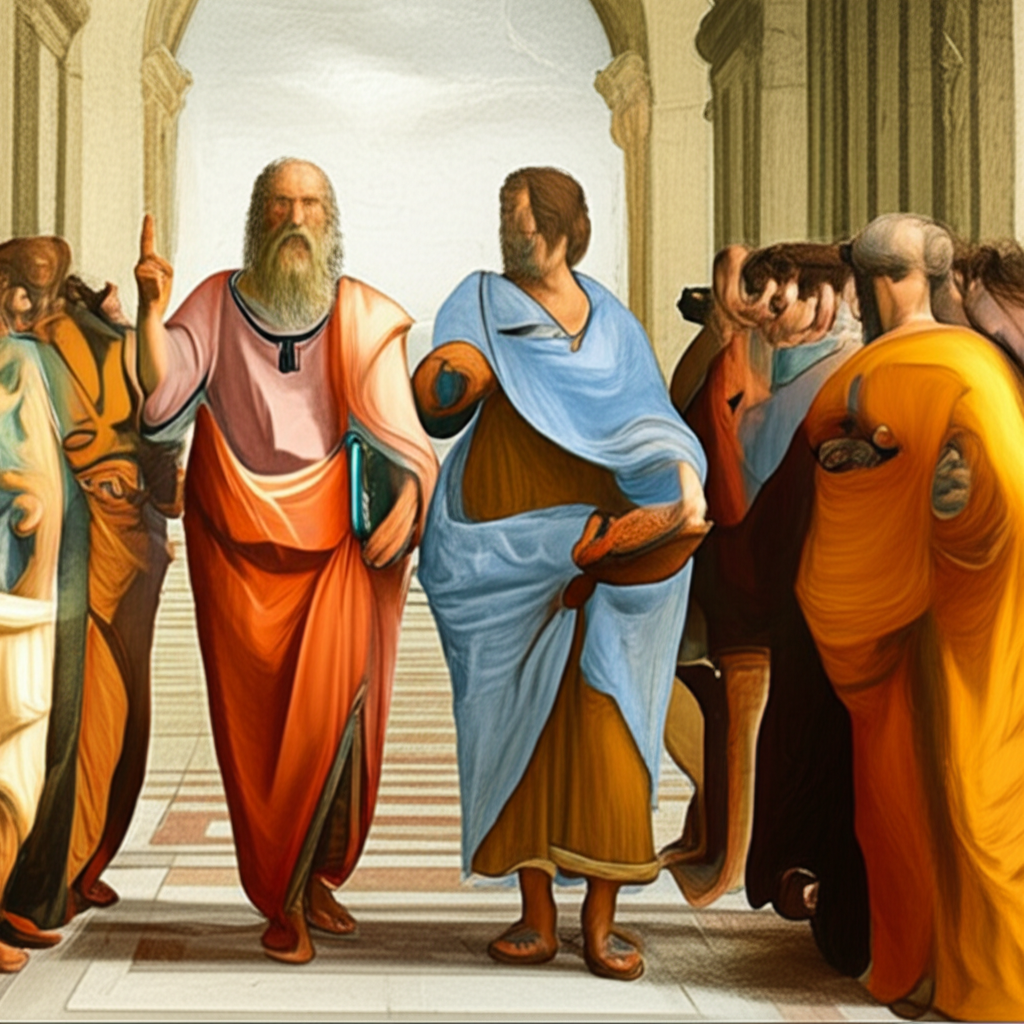 and empirical observation (memory of experience) that informs their philosophical language.)
The Philosophical Dimensions of Linguistic Memory
Throughout the Great Books of the Western World, philosophers have offered profound insights into the role of memory within the mind's linguistic capabilities.
- Plato: His concept of anamnesis implies that learning is a process of recollecting innate knowledge, suggesting a deep, almost primordial, connection between memory and the apprehension of truth, which language then attempts to articulate. The Phaedo and Meno dialogues are prime examples of this exploration.
- Augustine: In Confessions, he describes memory as a vast, inner palace, a 'great power, O Lord, a vast and boundless inner chamber,' where not only images but also the rules of language, the very understanding of words, reside. For Augustine, memory is the storehouse of consciousness, essential for self-reflection and communication with the divine.
- John Locke: Emphasized how simple ideas, derived from sensation and reflection, are stored in memory and then combined by the mind to form complex ideas, which are then represented by words. Language, for Locke, as detailed in his Essay Concerning Human Understanding, is an instrument for conveying these remembered ideas.
- Immanuel Kant: While focusing on the structures of the mind that make experience possible, Kant's transcendental imagination relies on the mind's ability to retain and synthesize sensory data into coherent perceptions, a process akin to a highly active, constructive form of memory, underpinning our ability to form judgments and express them linguistically in his Critique of Pure Reason.
Challenges and Disruptions: When Memory Fails
The crucial role of memory in language becomes starkly apparent when it falters. Conditions like aphasia, which affects language production or comprehension, often have roots in damage to brain regions critical for memory retrieval and processing. Similarly, certain forms of amnesia can impact semantic memory, rendering familiar words meaningless or inaccessible.
These disruptions underscore the fragility and interdependence of these cognitive faculties. A mind without a robust linguistic memory struggles to construct coherent thought, articulate desires, or engage meaningfully with the world, highlighting memory's indispensable contribution to our very humanity.
Conclusion: The Indelible Mark of Memory on Language
In conclusion, the role of memory in language is not merely incidental but absolutely foundational. It is the silent architect building the edifice of our vocabulary, grammar, and narrative structures. From the first word learned to the most complex philosophical discourse, memory provides the raw material and the organizing principles that allow the mind to speak, understand, and create. It is through the intricate dance of memory and imagination, articulated by language, that we construct our realities, share our experiences, and continue the ongoing human conversation, echoing the profound insights gleaned from the Great Books of the Western World.
📹 Related Video: PLATO ON: The Allegory of the Cave
Video by: The School of Life
💡 Want different videos? Search YouTube for: ""Plato Theory of Forms Anamnesis Explained""
📹 Related Video: ARISTOTLE ON: The Nicomachean Ethics
Video by: The School of Life
💡 Want different videos? Search YouTube for: ""John Locke Essay Concerning Human Understanding Summary""