

The Unseen Architecture: Memory's Indispensable Role in Language and the Mind
At the very core of what it means to be human, to think, to communicate, lies an intricate dance between memory and language. Without the former, the latter would be an impossibility, a chaotic jumble of sounds devoid of meaning. This article explores the profound and multifaceted role of memory in shaping, sustaining, and enriching our capacity for language, revealing how these two pillars together construct the very fabric of the mind and enable the boundless reach of imagination. From the acquisition of a simple word to the articulation of complex philosophical thought, memory is the unseen architect, building the structures upon which all linguistic expression stands.
The Foundations of Utterance: Memory as the Scaffolding of Language
The journey into language begins not with conscious effort, but with the quiet, persistent work of memory. Every sound we learn to associate with a meaning, every grammatical rule we implicitly absorb, every syntactical pattern we internalize, is first etched into the vast, intricate chambers of our memory.
- Acquisition and Retention: From infancy, our minds are sponges, soaking up the auditory landscape of our environment. The repetition of words, the context of their use, and the emotional resonance they carry are all stored. This isn't merely rote learning; it's the formation of a complex neural network where sounds, meanings, and rules are interconnected. As Aristotle might suggest, language becomes a habit, a second nature, through repeated exposure and practice, all facilitated by our ability to remember.
- Decoding and Encoding: When we hear a sentence, memory instantly sifts through its vast archives to recognize individual words, recall their meanings, and apply grammatical rules to interpret the overall message. Conversely, when we speak or write, memory provides the vocabulary, syntax, and rhetorical structures necessary to articulate our thoughts coherently. This constant retrieval and application are instantaneous, a testament to memory's efficiency.
The Mind's Lexicon: Semantic, Episodic, and Procedural Memory in Action
Our linguistic prowess isn't reliant on a single, monolithic memory system. Instead, it draws upon distinct yet interconnected forms of memory, each contributing uniquely to our ability to comprehend and generate language.
| Memory Type | Contribution to Language | Philosophical Echoes |
|---|---|---|
| Semantic Memory | Stores facts, concepts, and general knowledge, including word meanings, grammatical rules, and abstract ideas. It's our mental dictionary and encyclopedia. | Plato's Forms (innate concepts), Aristotle's Categories (organizing knowledge). |
| Episodic Memory | Recalls specific events, experiences, and conversations. Crucial for understanding narratives, sharing personal stories, and remembering the context in which language was used. | Augustine's "vast palace of memory" where past events reside. |
| Procedural Memory | Governs learned skills and habits, such as the motor movements for speaking, the unconscious application of syntax, and the fluency of articulation. | Aristotle's emphasis on habituation and practical knowledge. |
Without semantic memory, words would be empty vessels. Without episodic memory, our conversations would lack personal depth and narrative coherence. And without procedural memory, the very act of speaking would be a laborious, conscious effort rather than the fluid expression it is.
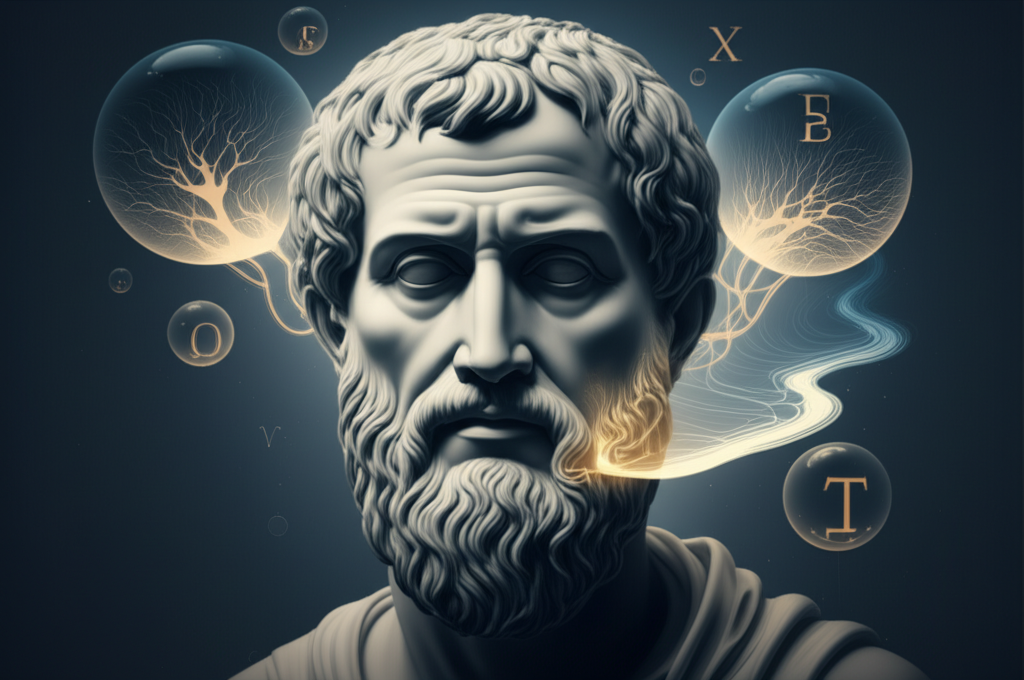
Weaving Worlds: The Interplay of Memory and Imagination in Language
The true magic of language, its capacity to transport us beyond the immediate, lies in its intimate relationship with memory and imagination. Memory provides the raw materials—the stored experiences, concepts, and linguistic structures—upon which imagination builds its new worlds.
- Memory as the Wellspring of Imagination: We cannot imagine what we have not, in some form, encountered or remembered. Even the most fantastical creatures or scenarios are often recombinations or exaggerations of elements drawn from our memory. Language then becomes the tool to articulate these novel constructions, to give form to the formless. Aristotle, in his Poetics, speaks of mimesis, the imitation of reality, which relies on our memory of the world to create compelling narratives, even those that diverge from direct experience.
- Language as the Vehicle for Imagined Realities: Through language, we can describe hypothetical situations, recount dreams, invent stories, and articulate philosophical possibilities that transcend the empirical. The very act of reading a novel or listening to a vivid description relies on our memory to construct mental images and scenarios, fueled by the author's words. Language doesn't just describe reality; it allows us to create, explore, and share imagined realities, pushing the boundaries of the mind.
Language as a Collective Memory: Echoes from the Great Books
Beyond individual cognition, language itself functions as a colossal, shared memory for humanity. The Great Books of the Western World, for instance, are not merely collections of words; they are monuments of collective memory, preserving the thoughts, discoveries, and moral dilemmas of millennia.
- The Living Archive: Every language carries within it the history, culture, and philosophical evolution of its speakers. Idioms, proverbs, myths, and scientific terminology are all encoded memories, passed down through generations. To learn a language is to gain access to a vast, historical memory bank.
- Inherited Wisdom: The enduring power of texts from Plato, Augustine, or Kant lies in their ability to transmit complex ideas across vast stretches of time. Our capacity to read, interpret, and discuss these works is a testament to memory's role in preserving not just individual words, but entire systems of thought, allowing us to engage in an ongoing dialogue with the greatest minds of history. Language, in this sense, is the ultimate mnemonic device for civilization.
The Inseparable Bond: Language as a Manifestation of Memory's Depth
In conclusion, the role of memory in language is not merely supportive; it is constitutive. From the basic act of naming an object to the intricate construction of a philosophical argument or the boundless flight of imagination, memory provides the essential framework, the stored data, and the procedural fluency that make linguistic expression possible. It is through this profound synergy that the human mind not only comprehends the world but also creates and shares new worlds, ensuring that our thoughts, our stories, and our collective wisdom endure.
YouTube Video Suggestions:
-
📹 Related Video: What is Philosophy?
Video by: The School of Life
💡 Want different videos? Search YouTube for: ""Augustine on Memory and Time Philosophy Explained""
2. ## 📹 Related Video: PLATO ON: The Allegory of the Cave
Video by: The School of Life
💡 Want different videos? Search YouTube for: ""Plato's Theory of Recollection Anamnesis Explained""