

The Indispensable Language: Mathematics in Defining Quantity
Summary: Mathematics serves as the bedrock for understanding and defining quantity, transforming an intuitive human perception into a precise, universal, and scientific language. From the simple act of counting to the complex equations governing the cosmos, it is through mathematical frameworks—be they arithmetic, geometry, or calculus—that we imbue the world with measurable meaning, enabling both philosophical inquiry and scientific advancement. Without mathematics, our grasp of "how much" or "how many" would remain perpetually vague, tethered to subjective perception rather than objective, verifiable truth.
The Elusive Nature of "How Much": Initial Explorations of Quantity
Before the advent of formal systems, humanity grappled with quantity in a rudimentary fashion. A hunter knew a larger herd meant more food, a farmer understood more seeds yielded a greater harvest. This initial, intuitive understanding of "more" or "less" forms the primordial soup from which the rigorous definition of quantity emerged. Yet, this intuitive grasp, while practical, lacked the precision required for deeper analysis or communication. How much "more" was it, exactly? How could one compare quantities across different contexts without a common standard? This fundamental human need for exactitude paved the way for the development of mathematics.
Mathematics: The Architect of Precision
Mathematics is not merely a tool for calculation; it is the very architecture by which we construct a coherent understanding of quantity. It provides the definition—the explicit boundaries and relationships—that transforms an amorphous concept into a concrete, measurable reality.
From Abstract Symbols to Concrete Measurement
At its core, mathematics offers a system of abstract symbols and rules that can be applied universally. A number, say '5', represents the same quantity whether it refers to 5 apples, 5 planets, or 5 abstract units. This detachment from specific objects is crucial, allowing for the generalization and comparison of diverse phenomena.
- Counting: The most fundamental application, giving discrete quantities a numerical value.
- Measuring: Applying units (e.g., meters, kilograms, seconds) to continuous quantities, allowing for comparisons and operations.
- Relating: Expressing quantities in relation to one another through ratios, proportions, and functions.
The Great Books of the Western World reveal this journey vividly. Euclid's Elements, for instance, meticulously defines geometric quantities like lines, angles, and areas, establishing an axiomatic system that allowed for irrefutable proofs and measurements. Aristotle, in his Categories, grappled with quantity as one of the fundamental ways in which things exist, distinguishing between discrete numbers and continuous magnitudes like lines or time, laying philosophical groundwork for mathematical formalization.
Defining Quantity: A Framework of Rigor
The role of mathematics extends beyond merely assigning numbers; it provides the very definition of what quantity means within a given context, offering clarity and universality.
| Aspect of Quantity | Mathematical Definition | Example |
|---|---|---|
| Discrete | Natural numbers; countable units | 3 sheep, 10 books, number of atoms |
| Continuous | Real numbers; measurable magnitudes | 1.5 meters of rope, 37.2 degrees Celsius, 2.5 hours |
| Extensive | Quantities that add up (depend on amount) | Mass, volume, length |
| Intensive | Quantities independent of amount (e.g., ratios) | Temperature, density, pressure |
Through these definitions, mathematics provides a robust framework for distinguishing between different types of quantity and for understanding their inherent properties and behaviors. This precision is not just an academic exercise; it is the engine of science.
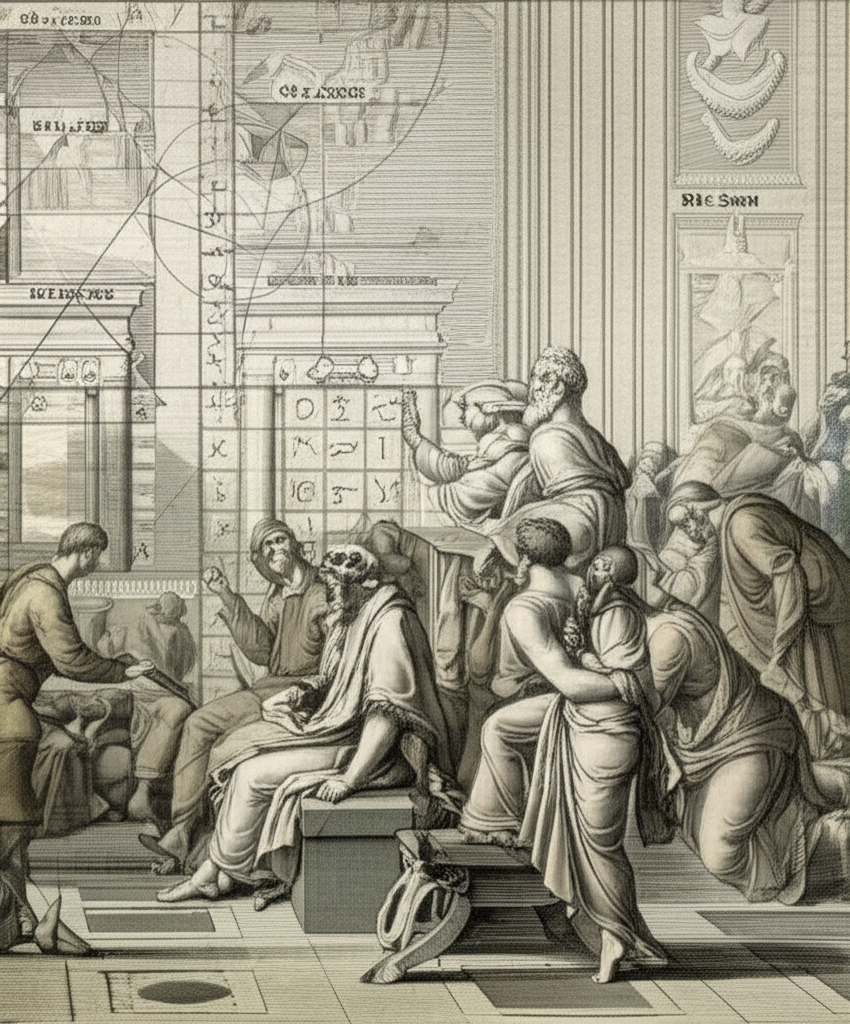
Mathematics: The Unifying Language of Science
The scientific revolution, chronicled within the Great Books, was fundamentally a mathematical revolution. Thinkers like Galileo, Descartes, and Newton understood that to truly understand the natural world, one had to quantify it.
- Physics: Every law of physics—from Newton's laws of motion to Einstein's theory of relativity—is expressed in mathematical terms. Force, mass, acceleration, energy, space, and time are all quantities defined and related through equations.
- Chemistry: The stoichiometry of reactions, the concentration of solutions, the energy changes in chemical bonds—all are quantities precisely defined and manipulated using mathematical principles.
- Biology: While often perceived as less mathematical, modern biology increasingly relies on quantifying genetic sequences, population dynamics, physiological measurements, and statistical analysis to uncover patterns and make predictions.
The very ability of science to predict phenomena, to build technologies, and to formulate universal laws hinges entirely on the rigorous, unambiguous definition of quantities that mathematics provides. Without this mathematical foundation, scientific inquiry would remain descriptive and anecdotal, lacking the predictive power that defines its success.
Philosophical Echoes: The Nature of Mathematical Quantity
The profound role of mathematics in defining quantity naturally leads to philosophical questions. Is quantity an inherent property of reality that mathematics merely describes, as Plato might suggest with his theory of Forms? Or is it a construct of the human mind, a useful tool we impose upon the world to make sense of it, aligning more with an empiricist view?
Regardless of one's philosophical stance, the practical utility and undeniable power of mathematical definitions of quantity are self-evident. They allow us to move beyond mere perception to a realm of shared, verifiable understanding, forming the bedrock of our intellectual and technological progress.
Conclusion: The Indispensable Tool
In essence, mathematics is not merely a method for counting or calculating; it is the fundamental language through which we define quantity in all its myriad forms. It provides the precision, universality, and logical coherence necessary to move from an intuitive grasp of "how much" to a rigorous, scientific understanding. From the philosophical inquiries of antiquity to the cutting-edge research of today, mathematics remains the indispensable tool for giving quantity its definitive shape and meaning, underpinning our entire edifice of knowledge.
📹 Related Video: What is Philosophy?
Video by: The School of Life
💡 Want different videos? Search YouTube for: ""Philosophy of Mathematics: What is Quantity?" and "The History of Numbers and Measurement""