

The Unseen Architect: How Mathematics Defines Quantity
Summary: Mathematics serves as the fundamental language and framework through which we conceive, measure, and understand quantity. Far from being a mere tool for counting, it provides the precise definition necessary for both everyday comprehension and the rigorous demands of science. From the ancient Greeks' pursuit of ideal forms to modern physics, the discipline of mathematics has uniquely shaped our philosophical and practical grasp of "how much" or "how many."
The Philosophical Foundations of Quantity
To speak of quantity is to engage with one of the most fundamental categories of human experience and thought. Before we can measure, compare, or even conceptualize "more" or "less," we must possess a framework that allows for such distinctions. This framework, I contend, is inherently mathematical. It is through the abstract, logical structures of mathematics that we move beyond mere perception to a precise definition of numerical and continuous magnitudes.
From the earliest philosophical inquiries, thinkers recognized the unique power of mathematics to describe the world with an unparalleled certainty. Plato, in his pursuit of ideal Forms, saw mathematical objects as the closest earthly approximations to eternal truths, suggesting that the underlying reality of the cosmos was inherently quantitative. Aristotle, while grounded more in the empirical, categorized quantity as one of the essential predicaments, noting its inherent relationship to number and magnitude.
A Historical Trajectory: Mathematics as the Language of Definition
The journey of mathematics in defining quantity is a rich tapestry woven through the history of thought, profoundly influencing both philosophy and science.
Ancient Insights: Geometry, Number, and Axiomatic Truths
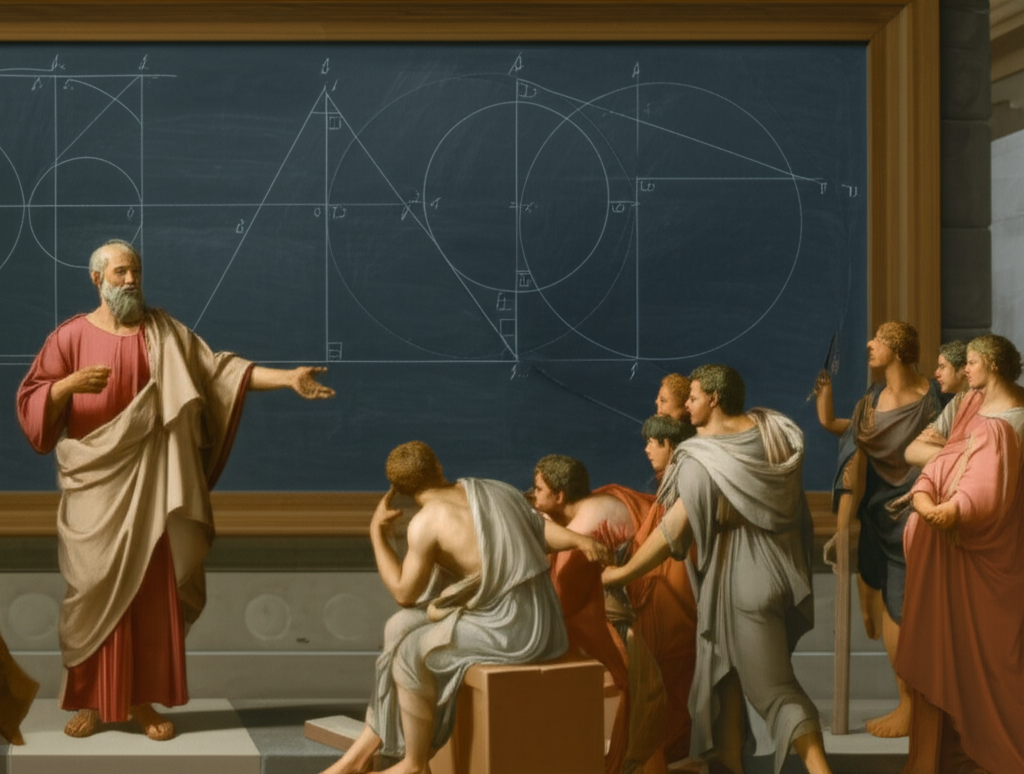
The ancient Greeks laid the groundwork, particularly through geometry, as exemplified by Euclid's Elements. Here, quantity was not just observed but rigorously defined through axioms, postulates, and logical proofs.
- Euclid's Approach:
- Points, Lines, Planes: Fundamental geometric quantities were given precise definitions.
- Axioms and Postulates: Basic truths about quantity (e.g., "the whole is greater than the part") were established as foundations.
- Deductive Reasoning: Complex quantitative relationships were derived from these basic definitions.
This systematic approach demonstrated that quantity could be understood not just empirically, but through an internal, consistent logical structure provided by mathematics.
The Renaissance and the Scientific Revolution: Quantifying Nature
The Scientific Revolution marked a pivotal shift, as mathematics transitioned from primarily a philosophical pursuit to the indispensable language of natural science. Figures like Galileo Galilei famously asserted that the "book of nature is written in the language of mathematics."
Key Contributions to Defining Quantity in Science:
| Philosopher/Scientist | Contribution to Quantitative Definition | Impact on Science |
|---|---|---|
| Galileo Galilei | Applied mathematics to describe motion and mechanics, defining concepts like velocity and acceleration. | Laid the groundwork for modern physics, showing nature's obedience to mathematical laws. |
| René Descartes | Developed analytic geometry, uniting algebra and geometry, allowing for the definition of spatial quantity through equations. | Bridged abstract numbers and concrete space, crucial for coordinate systems and engineering. |
| Isaac Newton | Developed calculus to define continuous change and motion, formulating universal laws based on quantitative relationships. | Revolutionized physics, providing a mathematical framework for gravity and mechanics. |
These thinkers demonstrated that quantity in the physical world—be it distance, time, mass, or force—could be precisely defined and manipulated through mathematical expressions, leading to predictive and verifiable scientific theories.
Mathematics: The Universal Language of Quantity
Whether we consider discrete numbers (how many apples?) or continuous magnitudes (how much water?), mathematics provides the necessary tools for their definition and analysis. It allows us to move beyond vague notions to exact measurements and comparisons.
- Arithmetic: Provides the fundamental definition of discrete quantity through counting, addition, subtraction, and other operations.
- Algebra: Offers a symbolic way to represent and manipulate unknown quantities, allowing for the definition of relationships between them.
- Calculus: Essential for defining and understanding quantity that changes continuously, such as rates of change or accumulated amounts.
- Set Theory: Provides a rigorous mathematical definition of collections of objects, foundational to understanding countable and uncountable infinities.
Without these mathematical structures, our understanding of quantity would remain rudimentary, incapable of supporting the complex technological and scientific advancements we rely upon daily. The very definition of a "unit" (e.g., a meter, a second, a kilogram) is a mathematical act, establishing a standardized quantity against which all others can be measured.
The Philosophical Weight of Mathematical Definition
The role of mathematics in defining quantity extends beyond mere utility; it touches upon profound philosophical questions:
- Objectivity: Does the mathematical definition of quantity reveal an objective truth about the universe, or is it a human construct that merely imposes order? The effectiveness of mathematics in science suggests a deep resonance with reality.
- Abstraction: Mathematics abstracts quantity from its particular instances. A "three" is not inherently tied to three apples or three stars, but represents an abstract quantitative definition applicable to all. This abstraction allows for universal laws.
- Limits of Quantification: While mathematics excels at defining quantity, it inherently struggles with qualitative aspects. The beauty of a sunset, the taste of wine—these resist purely quantitative definition, reminding us of the boundaries of mathematical description.
Ultimately, mathematics provides the bedrock for our intellectual engagement with quantity. It is the lens through which we bring precision, order, and understanding to the measurable aspects of existence, bridging the gap between raw perception and rigorous scientific definition.
YouTube Video Suggestions:
-
📹 Related Video: PLATO ON: The Allegory of the Cave
Video by: The School of Life
💡 Want different videos? Search YouTube for: ""Philosophy of Quantity Mathematics Plato Aristotle""
-
📹 Related Video: ARISTOTLE ON: The Nicomachean Ethics
Video by: The School of Life
💡 Want different videos? Search YouTube for: ""The Unreasonable Effectiveness of Mathematics in Science""