

The Indispensable Language: Mathematics in Defining Quantity
Summary: Mathematics is not merely a tool for counting; it is the fundamental language through which we understand, articulate, and define quantity. From the abstract ideals of ancient philosophy to the precise measurements of modern science, mathematics provides the conceptual framework and rigorous methodology necessary for grasping the very essence of "how much" or "how many." Without its axiomatic structures and symbolic representations, our notion of quantity would remain an ill-defined, chaotic intuition rather than a cornerstone of objective knowledge.
The Inescapable Language of Being
As a student of philosophy, one often grapples with the elusive nature of reality. Yet, even in the most abstract metaphysical debates, a curious certainty persists: the undeniable presence and utility of quantity. Whether we speak of the number of virtues, the expanse of the cosmos, or the duration of an event, we invariably invoke a concept that mathematics has painstakingly brought into sharp focus. It is through the lens of mathematics that quantity transcends mere perception to achieve a precise, universally comprehensible definition.
The Ancient Roots of Quantity's Definition
Our journey to define quantity through mathematics is as old as philosophy itself, deeply embedded in the "Great Books of the Western World."
Plato's Forms and the Ideal Number
For Plato, the world of Forms offered perfect, unchanging archetypes. Within this realm, numbers and geometric figures held a privileged position. A triangle, in its ideal form, was not just any triangle but the perfect concept of triangularity, defined by precise mathematical relationships. This perspective suggested that quantity, in its purest sense, existed independently of physical manifestation, accessible through reason and mathematical contemplation. The number "three" wasn't just a count of objects; it was an eternal, perfect concept, and physical instances merely participated in its ideal definition.
Aristotle's Categories and the Measurable World
Aristotle, ever the empiricist, classified quantity as one of his fundamental categories of being, alongside substance, quality, and relation. For Aristotle, quantity was that which is divisible into constituent parts, each part being one of two kinds: discrete (number) or continuous (magnitude, like lines, surfaces, or time). His approach grounded the definition of quantity in the observable world, yet still relied on mathematical principles to articulate its properties, such as being greater or less, equal or unequal. The very act of categorizing and analyzing these properties implicitly called upon mathematical thought.
Mathematics as the Architect of Precision
The true power of mathematics in defining quantity lies in its capacity for abstraction and precision. It allows us to move beyond simple enumeration to complex analysis.
From Counting Sheep to Calculus: A Leap in Abstraction
Initially, mathematics provided a system for counting – a rudimentary way to manage quantities of objects. However, its evolution brought forth arithmetic, algebra, and geometry, each layer adding new dimensions to our understanding. Euclidean geometry, for instance, didn't just describe shapes; it provided an axiomatic system for defining spatial quantities like length, area, and volume with unprecedented rigor.
With the advent of calculus, the definition of quantity extended to rates of change, accumulation, and infinitesimally small increments. This was a profound philosophical leap, allowing us to quantify dynamic processes and continuous phenomena that defied static counting.
The Scientific Revolution and the Quantification of Nature
The Scientific Revolution stands as a testament to the indispensable role of mathematics in defining quantity for the purpose of empirical investigation. Galileo Galilei famously asserted that the "book of nature is written in the language of mathematics." This wasn't merely a poetic statement; it was a methodological declaration.
The shift from qualitative descriptions to quantitative measurements transformed our understanding of the universe. Consider the following:
- Planetary Motion: Kepler's laws, expressed mathematically, defined the elliptical paths and orbital periods of planets.
- Falling Bodies: Galileo's experiments quantified the acceleration of objects due to gravity.
- Force and Motion: Newton's laws of motion provided mathematical definitions for concepts like force, mass, and acceleration, allowing for predictive science.
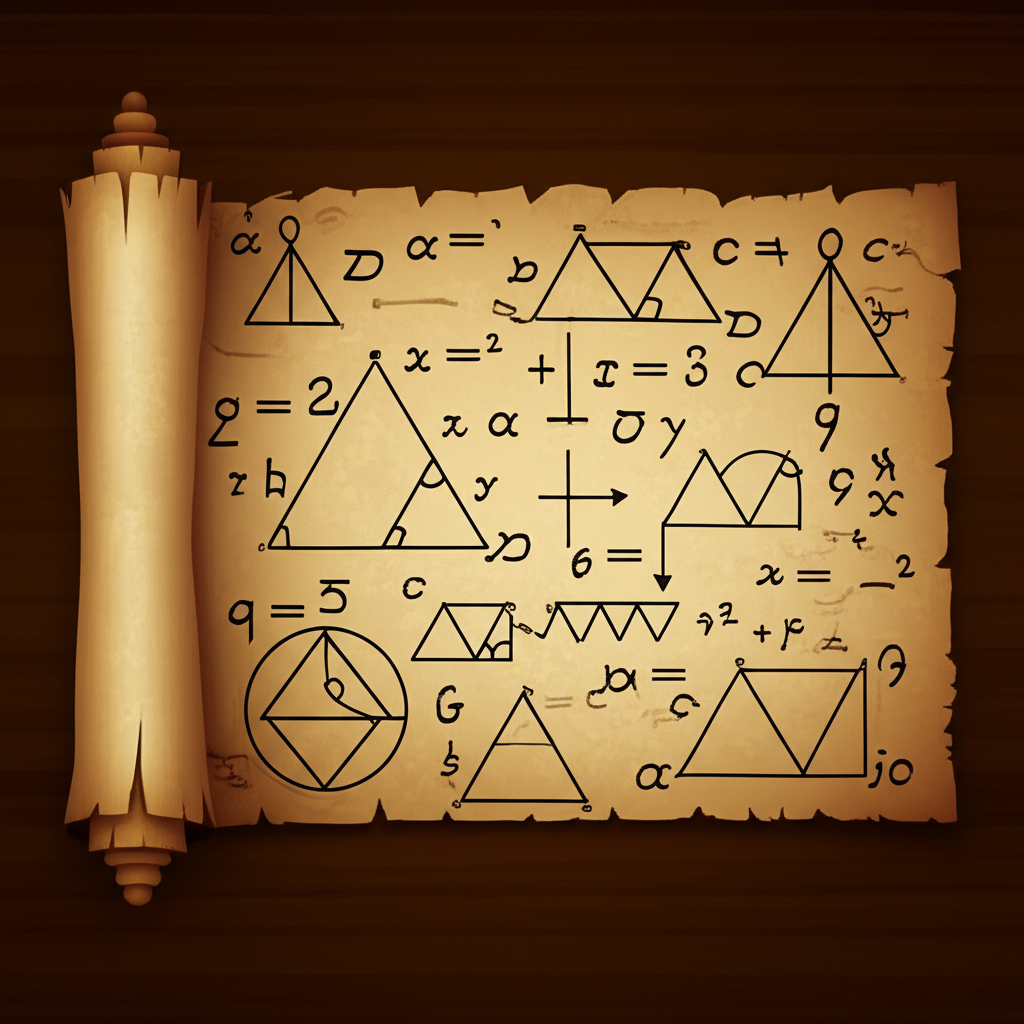 on one side, seamlessly transitioning into modern algebraic equations and calculus symbols (e.g., integrals, derivatives) on the other. In the background, faint ethereal outlines of Plato and Aristotle are seen in contemplative poses, gesturing towards the scroll, symbolizing the continuum of philosophical thought meeting mathematical rigor in the pursuit of defining quantity.)
Quantity in the Modern Philosophical Landscape
Later philosophers continued to explore the profound relationship. Immanuel Kant, for example, argued that quantity is an inherent category of understanding, a way our minds structure experience. He saw mathematics as providing synthetic a priori judgments—statements that are universally true and necessary, yet expand our knowledge—particularly regarding space and time, which are themselves forms of quantity. For Kant, we don't just find quantity in the world; our minds impose a quantitative structure upon it, and mathematics is the language of that imposition.
The Interplay of Mathematics, Quantity, and Science
The relationship between mathematics, quantity, and science is one of profound synergy. Mathematics offers the tools, quantity provides the domain, and science employs both to build knowledge.
- Conceptual Clarity: Mathematics provides unambiguous definitions for quantitative concepts, eliminating vagueness inherent in natural language.
- Measurement Standards: It establishes systems for consistent measurement, allowing for objective comparison and replication in science.
- Predictive Power: Mathematical models allow scientists to predict future states or behaviors of quantitative systems.
- Abstraction and Generalization: It enables the formulation of universal laws from specific observations, moving beyond individual instances to general principles.
This symbiotic relationship underscores that without mathematics, our scientific understanding of the world's quantities would be rudimentary, descriptive, and ultimately, unable to advance with the rigor we associate with modern inquiry.
Conclusion
In conclusion, mathematics is far more than a computational device; it is the essential framework for the definition of quantity. From the philosophical inquiries of the ancients striving to grasp ideal numbers and categories, to the scientific revolutions that demanded precise measurement and predictive models, mathematics has consistently provided the conceptual scaffolding. It transforms the vague notion of "how much" into a precise, analyzable, and universally understood concept, making it an indispensable pillar of both philosophical inquiry and scientific endeavor.
📹 Related Video: What is Philosophy?
Video by: The School of Life
💡 Want different videos? Search YouTube for: ""philosophy of mathematics quantity definition""
📹 Related Video: KANT ON: What is Enlightenment?
Video by: The School of Life
💡 Want different videos? Search YouTube for: ""Kant mathematics synthetic a priori quantity""