

The Unseen Architect: How Mathematics Defines Quantity
Mathematics is not merely a tool for counting or calculation; it is the fundamental language and framework through which we define and comprehend quantity itself. From the earliest philosophical inquiries into the nature of existence to the most advanced scientific theories, the precise definition of quantity has been inextricably linked to the rigorous structures provided by mathematics. This article explores how this essential relationship shapes our understanding of the world, bridging ancient wisdom with modern science.
The Indispensable Role of Mathematics in Defining Quantity
At its core, our ability to understand and interact with the world relies heavily on the concept of quantity—how much, how many, how big, how small. Yet, what is quantity without a system to measure, compare, and articulate it? This is where mathematics steps in, not just as a descriptive language, but as the very architect of quantity's definition. It provides the abstract structures—numbers, ratios, magnitudes, dimensions—that allow us to move beyond vague perceptions to precise, verifiable understanding. Without the formal rigor of mathematics, our grasp of quantity would remain elusive, subjective, and ultimately, undefined.
Ancient Echoes: Plato, Aristotle, and the Genesis of Number
The profound relationship between mathematics and quantity is not a modern revelation but a philosophical cornerstone dating back to antiquity. Thinkers from the Great Books of the Western World grappled with this very concept.
- Pythagoreans: Famously proclaimed "All is number," suggesting that numerical relationships were the ultimate reality and the underlying structure of the cosmos. For them, quantity was inherently numerical.
- Plato: In works like The Republic and Timaeus, Plato elevated mathematics to a divine status, seeing numbers and geometrical forms as reflections of eternal Forms. Understanding quantity, for Plato, was a step towards apprehending these perfect, immutable realities. He posited that true knowledge of quantity came not from empirical observation but from rational insight into mathematical principles.
- Aristotle: While more grounded in empirical observation than Plato, Aristotle, in his Metaphysics and Categories, still recognized quantity as one of the fundamental categories of being. He distinguished between discrete quantities (like numbers, which are countable) and continuous quantities (like lines, surfaces, and bodies, which are measurable). Even in this distinction, the underlying structure for their definition and comparison was inherently mathematical.
These early philosophical explorations laid the groundwork, demonstrating that the very idea of quantity, whether discrete or continuous, required a mathematical framework for its coherent definition.
Euclid's Legacy: Geometric Quantity and Axiomatic Definition
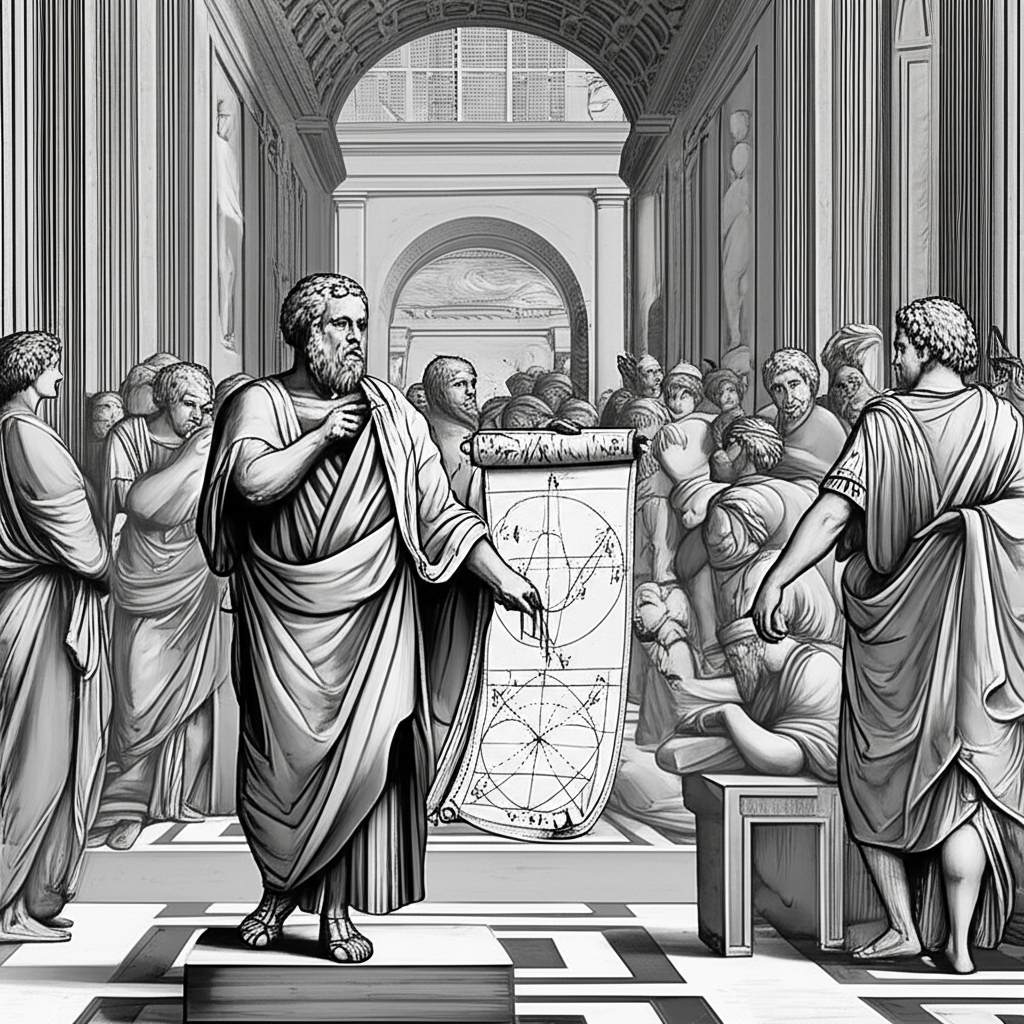
Perhaps no single work better illustrates the power of mathematics in defining quantity than Euclid's Elements. This monumental treatise, a cornerstone of Western thought, didn't just describe shapes; it defined spatial quantities with unprecedented rigor.
Euclid's Approach to Defining Quantity:
- Axiomatic Foundations: Euclid began with a few self-evident truths (axioms and postulates) about points, lines, and planes. From these, he built an entire system.
- Definitions of Magnitude: He meticulously defined concepts like "line," "surface," and "solid" not just as objects, but as specific types of magnitude or quantity.
- A line has length (one dimension of quantity).
- A surface has length and breadth (two dimensions of quantity).
- A solid has length, breadth, and depth (three dimensions of quantity).
- Propositions and Proofs: Through logical deduction, Euclid then proved propositions about these quantities, establishing relationships (e.g., the Pythagorean theorem defines a quantitative relationship between the sides of a right triangle).
Euclid showed that geometric quantities were not just observed but constructed and defined through a rigorous mathematical system. This was a pivotal moment, demonstrating how formal mathematical systems could precisely articulate and explore the nature of quantity.
The Scientific Revolution: Quantifying the World
The advent of the Scientific Revolution dramatically amplified the role of mathematics in defining quantity, transforming it from a philosophical pursuit into the bedrock of empirical inquiry.
- Galileo Galilei: Often considered the father of modern science, Galileo famously declared that the "book of nature is written in the language of mathematics." For him, understanding the physical world meant quantifying its phenomena. Concepts like velocity, acceleration, and force only gained precise definition through mathematical equations.
- René Descartes: In his Discourse on Method and Geometry, Descartes fused algebra and geometry, giving birth to analytic geometry. This allowed geometric quantities to be expressed algebraically, and vice versa, providing a powerful new tool for defining and manipulating quantities across different domains. His work emphasized that clarity and distinctness, essential for true knowledge, came through mathematical rigor.
- Isaac Newton: Newton's Principia Mathematica stands as a testament to the power of mathematics. His invention of calculus provided the necessary tools to define and analyze quantities that change over time, such as instantaneous velocity and acceleration, or the force of gravity. Without calculus, these dynamic quantities would remain vague; with it, they gained precise, calculable definition, enabling the prediction and understanding of celestial and terrestrial mechanics.
These pioneers demonstrated that for science to progress, for its observations to be meaningful and its theories predictive, quantity had to be precisely defined through mathematics.
Modern Frontiers: Beyond Simple Measurement
In contemporary science and mathematics, the role of mathematics in defining quantity has only grown more sophisticated. We now grapple with quantities far removed from simple counting or measuring.
- Probability and Statistics: These branches of mathematics define and quantify uncertainty, risk, and likelihood—quantities that are not directly observable in the same way as length or weight, but are crucial for understanding complex systems from genetics to economics.
- Set Theory and Infinity: Mathematics provides the only means to define and differentiate between different "sizes" of infinity, a concept that defies intuitive grasp but is rigorously defined through set theory.
- Quantum Mechanics: In the subatomic world, quantities like position and momentum are not precisely defined simultaneously. Mathematics (specifically, wave functions and probability distributions) defines the likelihood of these quantities, offering a probabilistic definition of reality itself.
In each instance, from the macroscopic to the infinitesimally small, from the certain to the uncertain, mathematics doesn't just describe quantity; it provides the very definition that makes these concepts intelligible and operable within our scientific and philosophical frameworks.
Conclusion: Mathematics as the Definitive Language of Quantity
From the ancient Greek philosophers who saw number as the essence of reality to the modern physicists grappling with the fabric of spacetime, the role of mathematics in defining quantity has been paramount. It is not merely a descriptive tool, but a foundational epistemology, shaping how we conceive, measure, and understand the "how much" of existence. Without its precise language and rigorous structures, our understanding of quantity would remain mired in ambiguity, forever limiting our philosophical insights and scientific progress. Mathematics truly is the unseen architect, building the very concept of quantity within the edifice of human knowledge.
📹 Related Video: PLATO ON: The Allegory of the Cave
Video by: The School of Life
💡 Want different videos? Search YouTube for: ""Plato's Philosophy of Mathematics" or "Euclid's Elements Explained""