

The Role of Mathematics in Defining Quantity
Summary: Mathematics serves not merely as a tool for measuring quantity, but as its fundamental definition. From the abstract ideals of ancient Greek philosophy to the precise language of modern science, our understanding and articulation of "how much" or "how many" are inextricably bound to mathematical principles. This article explores how mathematics provides the rigorous framework necessary to move beyond vague estimations, offering a universal and unambiguous way to define, categorize, and comprehend the quantitative aspects of reality.
The Philosophical Genesis of Quantity: From Intuition to Definition
The human mind, almost instinctively, grapples with quantity. We perceive "more" or "less," "many" or "few." But how do we transition from these qualitative perceptions to precise, universally understood measurements? This is where mathematics enters the stage, transforming an intuitive sense into a rigorous definition. For millennia, philosophers and thinkers, as chronicled in the Great Books of the Western World, have recognized mathematics as the bedrock upon which any meaningful discourse about quantity must be built. It’s not just about counting apples; it’s about understanding the very essence of "apple-ness" in numerical terms.
Ancient Insights: Plato, Aristotle, and the Dawn of Mathematical Precision
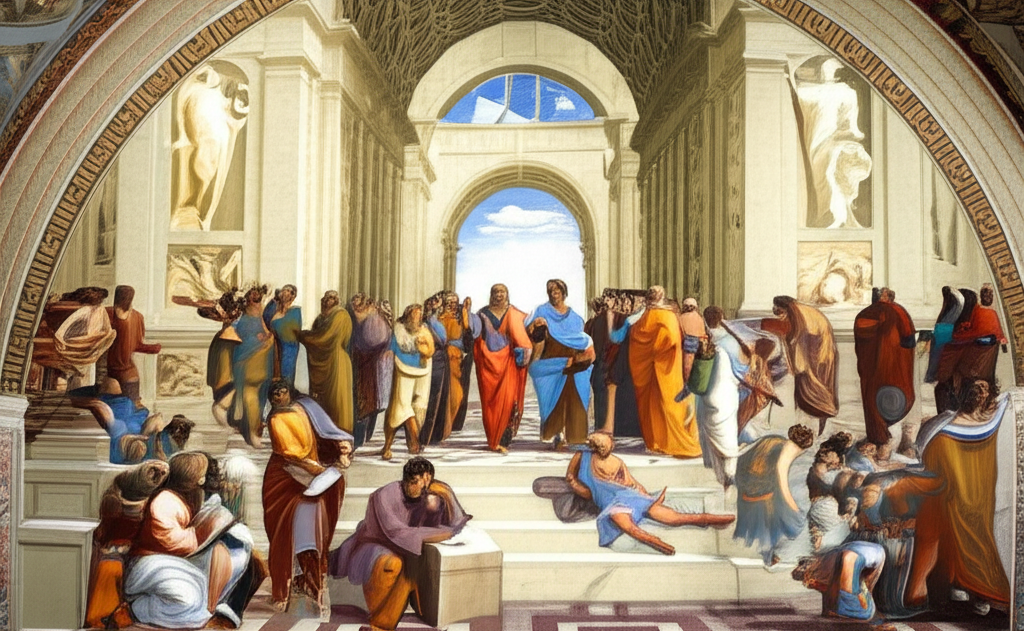
The intellectual giants of antiquity laid the groundwork for understanding the profound connection between mathematics and quantity.
-
Plato, in works like The Republic and Timaeus, posited that mathematical objects—numbers, geometric forms—exist in a realm of perfect Forms, distinct from the imperfect empirical world. For Plato, these mathematical entities were not mere human constructs but eternal, unchanging truths. Thus, when we speak of "two" or "a triangle," we are accessing these ideal Forms. This perspective elevates mathematics beyond a simple counting mechanism; it becomes the very definition of ideal quantity and structure. The perfect circle, for instance, is a mathematical definition that no physical circle can ever perfectly embody.
-
Aristotle, while departing from Plato's Forms, still recognized quantity as one of the fundamental categories of being. In his Categories, he distinguished between discrete quantity (number, which can be enumerated, like "ten horses") and continuous quantity (magnitude, which is divisible, like "a line" or "time"). For Aristotle, mathematics was the study of these quantitative aspects, abstracted from physical objects. It allowed for a precise definition of how much or how many, providing a structured way to understand the measurable attributes of the world.
-
Euclid's Elements stands as a monumental testament to the power of mathematics in defining quantity and spatial relations. Through axioms, postulates, and rigorous proofs, Euclid didn't just describe geometry; he defined it. Concepts like "point," "line," "plane," and "parallel" were given precise definitions that allowed for logical deduction and universal understanding. This systematic approach demonstrated how abstract mathematical definitions could build an entire coherent system for understanding space and magnitude, profoundly influencing science and philosophy for centuries.
Table 1: Ancient Philosophical Views on Mathematics and Quantity
| Philosopher | Key Concept | Role of Mathematics in Defining Quantity |
|---|---|---|
| Plato | Forms | Mathematics defines ideal, perfect quantities and structures that exist independently of the physical world. |
| Aristotle | Categories | Mathematics abstracts and categorizes discrete (number) and continuous (magnitude) quantities from physical reality. |
| Euclid | Axiomatic Method | Mathematics provides rigorous definitions and logical frameworks for understanding spatial quantities and relations. |
The Scientific Revolution: Quantifying Nature
The Scientific Revolution, heavily influenced by thinkers like Galileo Galilei and René Descartes, solidified the role of mathematics as the indispensable language for defining natural phenomena.
-
Galileo Galilei famously asserted that the "book of nature is written in the language of mathematics." His groundbreaking work in physics—from the laws of motion to the study of falling bodies—relied entirely on mathematical definitions of velocity, acceleration, and distance. Without mathematical precision, his observations would have remained mere descriptions; with it, they became verifiable, universal laws.
-
René Descartes, a pivotal figure in both philosophy and mathematics, further cemented this link. His development of analytic geometry (combining algebra and geometry) provided a powerful new tool for defining spatial relationships using numerical coordinates. In his Discourse on Method, Descartes sought to build knowledge on clear and distinct ideas, often finding these in mathematical certainty. For Descartes, the world could be understood as extended substance, whose primary attributes were quantifiable and therefore amenable to mathematical definition.
These developments ushered in an era where science and mathematics became inseparable. To understand something quantitatively was to define it mathematically.
Mathematics: The Precision Engine of Definition
What makes mathematics uniquely suited to defining quantity? It is its unparalleled capacity for precision, abstraction, and universality.
-
Precision: Ordinary language is often ambiguous. What does "a lot" mean? Or "a short distance"? Mathematics provides exact definitions: "10 kilograms," "2.5 meters," "π radians." This precision eliminates subjective interpretation, allowing for consistent measurement and communication across cultures and time.
-
Abstraction: Mathematical concepts—numbers, variables, functions—are abstract. They exist independently of any particular physical manifestation. The number "3" defines a quantity whether it refers to three apples, three ideas, or three dimensions. This abstraction allows mathematics to define quantity in a way that is universally applicable, transcending specific contexts.
-
Universality: Because mathematical definitions are abstract and precise, they are also universal. The Pythagorean theorem holds true whether applied to a field in ancient Greece or a blueprint for a modern skyscraper. This universality is crucial for science, enabling the formulation of laws that apply throughout the cosmos.
The Indispensable Role of Mathematics in Modern Science
In contemporary science, the definition of quantity is almost always a mathematical one.
- Physics: Fundamental quantities like mass, energy, momentum, and charge are defined by specific mathematical equations and units. Science cannot progress without these precise mathematical definitions.
- Chemistry: Stoichiometry, reaction rates, and molecular structures are all quantitatively defined through mathematical relationships, allowing for accurate predictions and experimentation.
- Biology: From population dynamics to genetic sequencing, biological science increasingly relies on mathematical models and statistical definitions to understand complex quantitative processes.
- Economics: Gross Domestic Product (GDP), inflation rates, supply and demand curves are all mathematical definitions of economic quantities, enabling analysis and policy formulation.
In each field, mathematics doesn't just describe; it defines the very nature of the quantities under investigation, providing the bedrock for scientific understanding and progress.
The Abstract Reality of Quantity
The journey from perceiving "more" to defining "five" is a profound philosophical leap. Is quantity an inherent property of reality, or is it a construct of the human mind, made coherent by mathematics? While this debate continues, what is undeniable is that mathematics provides the most robust and consistent framework we have for comprehending and defining it.
The power of mathematics lies in its ability to create abstract structures that can then be mapped onto the physical world, revealing patterns and relationships that would otherwise remain hidden. It allows us to move beyond mere observation to a deep, definitional understanding of how much, how many, and how big.
Conclusion: Mathematics as the Definitive Language of Quantity
From the philosophical inquiries of Plato and Aristotle to the rigorous scientific methodologies of our age, the role of mathematics in defining quantity has been consistently central. It provides the clarity, precision, and universality necessary to move beyond subjective perception, offering an unambiguous language for understanding the measurable aspects of existence. Whether grappling with the ideal forms of numbers or the precise measurements of the cosmos, mathematics remains our ultimate tool—and indeed, our ultimate definition—for comprehending the quantitative fabric of reality.
YouTube Video Suggestions:
-
📹 Related Video: PLATO ON: The Allegory of the Cave
Video by: The School of Life
💡 Want different videos? Search YouTube for: ""Plato's Theory of Forms and Mathematics Explained""
2. ## 📹 Related Video: What is Philosophy?
Video by: The School of Life
💡 Want different videos? Search YouTube for: ""The Philosophy of Mathematics: What is a Number?""