

The very fabric of our understanding of the world, from the mundane act of counting apples to the complex equations describing the cosmos, hinges on the precise Definition of Quantity. This article posits that Mathematics is not merely a tool for measuring existing quantities, but rather the fundamental language and conceptual framework through which Quantity itself is defined, understood, and manipulated, making it indispensable for both philosophy and Science.
The Indispensable Lens: How Mathematics Defines Quantity
At its core, Quantity refers to the "how much" or "how many" of something. Yet, this seemingly simple concept quickly becomes nebulous without the rigorous structure provided by Mathematics. It is through mathematical principles that we move beyond vague impressions to exact measurements, allowing for comparison, analysis, and the construction of coherent models of reality. Mathematics provides the Definition that transforms an abstract notion into a concrete, verifiable attribute, underpinning all empirical Science.
From Intuition to Precision: The Mathematical Genesis of Quantity
Our innate ability to perceive differences in number or magnitude is rudimentary. It is Mathematics that elevates this intuition to a precise, universally communicable understanding. Consider the foundational contributions of Mathematics to the Definition of Quantity:
- Counting and Cardinality: The invention of numbers (integers) provides the primary means to define discrete quantity—the number of distinct items within a collection. This simple act, formalized through sets and counting principles, is the bedrock.
- Measurement and Magnitude: For continuous quantities like length, mass, or time, Mathematics offers units of measurement and the concept of real numbers. This allows for the Definition of magnitude, where quantities can be infinitely divisible, and their relationships expressed with arbitrary precision.
- Relations and Operations: Beyond mere identification, Mathematics defines how quantities interact. Operations like addition, subtraction, multiplication, and division are not just calculations; they are the Definition of how quantities combine, separate, scale, and distribute. These operations are crucial for understanding complex systems in Science.
Echoes of Antiquity: Great Thinkers on Quantity and Number
The profound connection between Mathematics and Quantity has been a central theme in Western thought, explored deeply within the Great Books of the Western World.
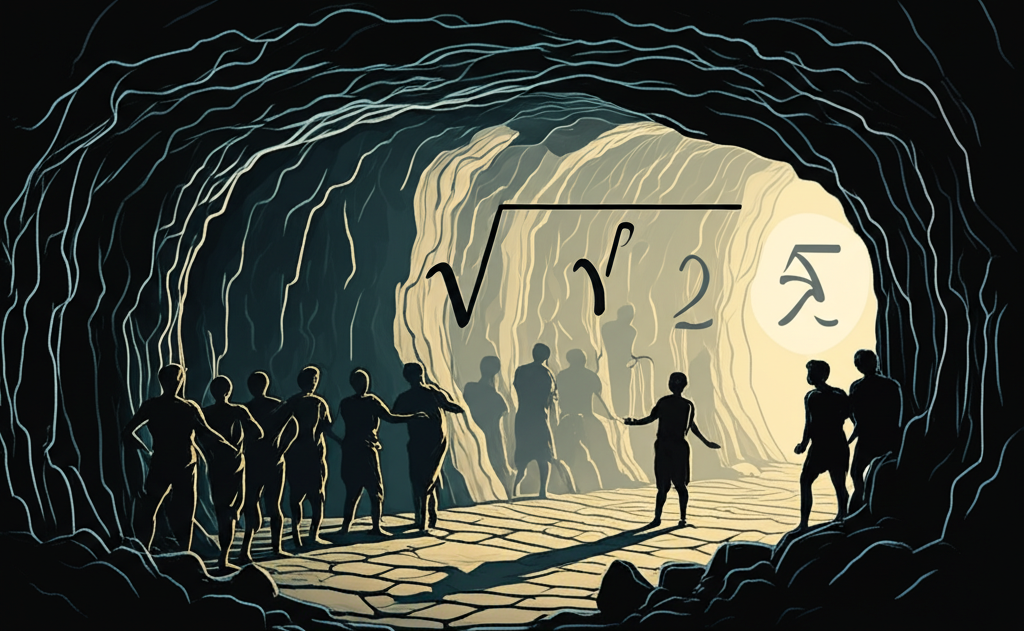
- Plato's Ideal Forms and Numerical Harmony: For Plato, the world of Mathematics—numbers and geometric forms—represented a higher reality, a realm of unchanging, perfect Forms. He believed that the observable world only imperfectly imitated these mathematical ideals. Thus, Quantity, in its truest Definition, resided not in the empirical, but in the abstract, mathematical realm. The harmony of the cosmos, as described in texts like the Timaeus, was fundamentally mathematical.
- Aristotle's Categories: Discrete vs. Continuous: Aristotle, in his Categories, classified Quantity as one of the ten fundamental ways things can be said to be. He meticulously distinguished between discrete quantity (number, which is separable into distinct units) and continuous quantity (magnitude, which is divisible into parts that share a common boundary, such as lines, surfaces, and bodies, or time). His philosophical Definition provided a foundational framework for understanding the nature of numerical and spatial extent.
- Euclid's Axiomatic Purity: Euclid's Elements stands as a monumental work in the Definition of geometric Quantity. By starting with fundamental axioms and postulates, Euclid rigorously defined concepts like points, lines, and planes, and then logically derived complex propositions about length, area, and volume. This axiomatic approach demonstrated how mathematical Definition could build an entire, consistent system of quantitative understanding from first principles, influencing scientific thought for millennia.
The Scientific Imperative: Quantifying the Cosmos
The advent of modern Science in the Renaissance and Enlightenment periods saw the full embrace of Mathematics as the indispensable language for describing and understanding the natural world. Figures like Galileo, Descartes, and Newton championed the idea that the book of nature is written in the language of Mathematics.
- Measurement and Precision: In Science, the Definition of Quantity is inextricably linked to measurement. Whether it's the speed of light, the mass of a particle, or the temperature of a gas, these quantities are defined by how they are measured and expressed mathematically. Without the precise Definition provided by mathematical units and scales, scientific observations would lack comparability and rigor.
- Modeling and Prediction: From classical mechanics to quantum physics, mathematical models are the primary tools used to describe physical phenomena. These models define the relationships between various quantities, allowing scientists to predict outcomes, test hypotheses, and deepen our understanding of the universe. The very success of Science is a testament to the power of Mathematics in defining and manipulating Quantity.
Beyond the Count: Expanding the Definition of Quantity
The evolution of Mathematics has continually expanded our capacity to define and understand Quantity beyond simple counting or basic measurement.
| Type of Quantity | Mathematical Representation | Philosophical Implication | Scientific Application |
|---|---|---|---|
| Discrete | Natural Numbers, Sets | Individuality, Enumeration | Population counts, Particle numbers |
| Continuous | Real Numbers, Functions | Infinitude, Gradation | Time, Distance, Temperature |
| Vector | Vectors, Tensors | Direction, Magnitude, Relationship | Force, Velocity, Stress |
| Complex | Complex Numbers | Abstract structures, Phase | Quantum mechanics, Signal processing |
Calculus, for instance, allows us to define and analyze quantities that change continuously, providing the tools to understand rates of change and accumulation. Vector algebra defines quantities that possess both magnitude and direction, crucial for physics and engineering. The abstract structures of modern Mathematics continue to forge new ways to define and explore Quantity in dimensions far removed from our everyday experience.
The Philosophical Resonance: Is Quantity Discovered or Constructed?
The enduring partnership of Mathematics and Quantity raises profound philosophical questions. Is Quantity an inherent feature of reality, merely unveiled by Mathematics? Or is it, to some extent, a construct of the human mind, a category we impose on the world through the lens of mathematical thought? Immanuel Kant, in his Critique of Pure Reason, suggested that Quantity is a pure concept of the understanding, a way our minds necessarily structure experience. Regardless of one's stance on this debate, it is undeniable that Mathematics provides the definitive framework through which we engage with and articulate the concept of Quantity.
Conclusion: The Enduring Partnership of Mathematics and Quantity
In conclusion, Mathematics is far more than a tool for calculating or measuring; it is the very language and system through which Quantity is Defined. From the foundational concepts of counting to the intricate models of modern Science, Mathematics provides the precision, rigor, and conceptual depth necessary to transform an intuitive notion into a robust and verifiable aspect of our reality. Without Mathematics, our understanding of "how much" and "how many" would remain forever vague, limiting both philosophical inquiry and scientific progress.
📹 Related Video: PLATO ON: The Allegory of the Cave
Video by: The School of Life
💡 Want different videos? Search YouTube for: ""Plato's Philosophy of Mathematics" and "Aristotle's Categories Quantity""