

The Unassailable Architect: Mathematics in the Definition of Quantity
The journey from a vague perception of "more" or "less" to a precise, universally understood measure of quantity is one of humanity's most profound intellectual achievements. At the heart of this transformation lies mathematics. Far from being merely a tool for counting, mathematics is the very language and framework through which we conceive, articulate, and ultimately define quantity in all its myriad forms. It provides the rigorous structure necessary for both philosophical inquiry and scientific advancement, allowing us to move beyond mere observation to a deep, analytical understanding of the world.
From Intuition to Invariant Measure: The Genesis of Quantity
Before the advent of formal mathematics, early humans undoubtedly possessed an intuitive grasp of quantity. A hunter knew if there were "many" deer, a gatherer if there were "few" berries. Yet, this qualitative understanding lacked precision and universal communicability. The conceptual leap occurred when societies began to abstract this intuition into enumerable units.
- Early Abstraction: The recognition that "two stones" and "two hands" shared a common property of 'twoness' was the first step. This abstraction, as explored by philosophers from Plato to Aristotle in the Great Books of the Western World, laid the groundwork for the concept of number.
- The Problem of Definition: How do we define "how much"? Is it an inherent property of objects, or a construct of the mind? Mathematics offers a powerful answer by providing a system independent of the specific objects being quantified.
This shift from subjective perception to objective, shared definition is where mathematics truly begins its indispensable role.
Mathematics: The Precision Engine for Defining Quantity
What makes mathematics uniquely suited to defining quantity? It is its inherent capacity for precision, universality, and abstraction.
- Numbers as Definitional Units: Integers, rational numbers, real numbers, complex numbers – each provides a specific lens through which to define discrete units, continuous magnitudes, or even multi-dimensional quantities. Without numbers, "length" remains a vague descriptor; with them, it becomes "3.14 meters."
- Operations as Relational Definitions: Addition, subtraction, multiplication, division – these operations allow us to define quantities in relation to one another. They articulate how quantities combine, separate, scale, or distribute, moving beyond simple enumeration to dynamic relationships.
- Set Theory and Cardinality: Modern mathematics provides foundational concepts like set theory, which rigorously defines the quantity of elements within a collection (cardinality), even for infinite sets, a concept unimaginable without its specialized language.
In essence, mathematics doesn't just describe quantity; it constitutes its very definition in a way that no other discipline can.
The Indispensable Alliance: Mathematics, Quantity, and Science
The scientific revolution, a cornerstone of modern thought, would have been impossible without the rigorous application of mathematics to define quantity. Figures like Galileo and Newton, whose works are foundational to the Great Books, famously declared that the book of nature is written in the language of mathematics.
How Mathematics Empowers Science:
| Aspect of Science | Role of Mathematics in Defining Quantity
This quantification allows science to build predictive models, test hypotheses, and uncover universal laws that govern the natural world. From defining the quantity of energy in a system to the quantity of genetic information in a chromosome, mathematics provides the indispensable framework.
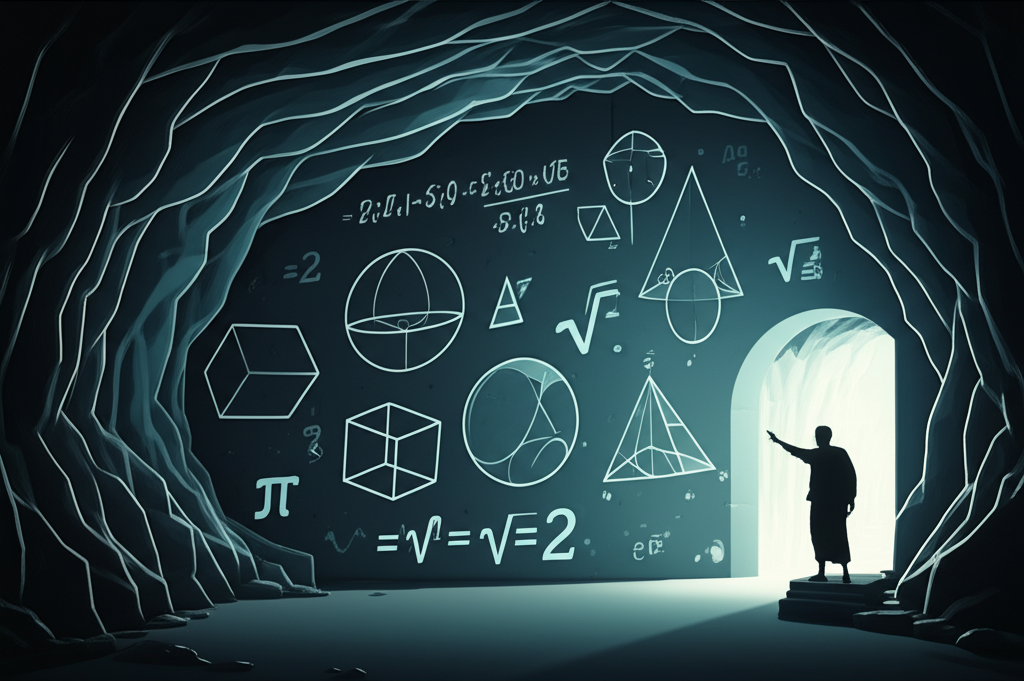
Philosophical Underpinnings: Is Quantity an Inherent Reality or a Mathematical Construct?
The relationship between mathematics and quantity is not without its profound philosophical questions. Is quantity an inherent property of the universe, existing independently of human consciousness, which mathematics merely describes? Or is quantity itself, in its precise definition, a construct of the human mind, made coherent and useful through mathematical frameworks?
- Platonic Realism: For some, following Plato, mathematical entities (and thus quantities) exist in an ideal realm, and our mathematics is merely our attempt to grasp these eternal forms. The definition of "three" is thus an immutable truth.
- Aristotelian Empiricism: Aristotle, however, viewed numbers and quantities as properties abstracted from physical objects. We don't encounter "threeness" in isolation, but "three apples." Mathematics helps us categorize and define these observed properties.
- Kantian Constructivism: Immanuel Kant proposed that space and time, and thus our apprehension of quantity, are fundamental intuitions of our minds, shaping how we perceive reality. Mathematics, then, is the formalization of these innate structures.
These debates, central to the history of philosophy, underscore that the definition of quantity is not just a scientific or mathematical problem, but a deeply philosophical one, with mathematics serving as the primary lens through which these questions are posed and explored.
Beyond Simple Counting: Advanced Mathematical Definitions of Quantity
The power of mathematics extends far beyond merely counting discrete units. It allows us to define and manipulate far more complex aspects of quantity.
- Continuous Quantities: Calculus, for instance, provides the mathematical definition for instantaneous rates of change, accumulated totals, and the properties of continuously varying quantities – essential for understanding motion, fluid dynamics, and electromagnetic fields.
- Vector and Tensor Quantities: In physics and engineering, mathematics introduces vectors to define quantities that have both magnitude (how much) and direction (where). Tensors further generalize this to represent complex relationships of quantity in multi-dimensional spaces, crucial for general relativity and material science.
- Probability and Statistics: These branches of mathematics provide the means to define and quantify uncertainty, likelihood, and the distribution of quantities within populations, profoundly impacting fields from genetics to social science.
Mathematics, therefore, is not static; it continually evolves, offering increasingly sophisticated ways to define and understand the multifaceted nature of quantity.
Conclusion: Mathematics, The Keystone of Quantity's Definition
In conclusion, the role of mathematics in defining quantity is not merely significant; it is foundational. From the earliest human attempts to categorize "how much" to the most advanced scientific theories describing the universe, mathematics has provided the indispensable framework for precision, abstraction, and universal understanding. It allows us to transition from vague perceptions to rigorous definitions, enabling both profound philosophical insights into the nature of reality and the practical advancements of science. Without mathematics, quantity would remain an elusive concept, forever tethered to imprecise observation rather than elevated to a realm of universal and verifiable truth.
📹 Related Video: PLATO ON: The Allegory of the Cave
Video by: The School of Life
💡 Want different videos? Search YouTube for: ""Plato's Philosophy of Mathematics" or "The Unreasonable Effectiveness of Mathematics in the Natural Sciences""
📹 Related Video: PLATO ON: The Allegory of the Cave
Video by: The School of Life
💡 Want different videos? Search YouTube for: ""What is Quantity? A Philosophical Exploration""