

The Enduring Equation: Mathematics as the Architect of Quantity's Definition
Summary: Mathematics is far more than a mere tool for measurement; it is the very language and framework through which Quantity is conceived, articulated, and understood. From ancient philosophical inquiries into the nature of existence to the rigorous demands of modern Science, Mathematics provides the essential Definition that allows us to differentiate, compare, and operate with quantities, shaping our perception of reality itself. Without its foundational principles, our understanding of 'how much' or 'how many' would remain an indeterminate blur.
The Inescapable Link: Mathematics and the Fabric of Quantity
From the moment we perceive more than one apple or note the differing lengths of two shadows, we are engaging with the concept of Quantity. It is a fundamental category of existence, an intrinsic aspect of the world around us. Yet, to move beyond a vague apprehension of "more" or "less" to a precise, communicable understanding requires a conceptual leap — a leap facilitated, and indeed often necessitated, by Mathematics.
For millennia, philosophers and thinkers, many whose works form the bedrock of the Great Books of the Western World, have grappled with the essence of Quantity. Is it an inherent property of objects, or a construct of the mind? Regardless of one's ontological stance, the consensus remains that Mathematics provides the definitive means by which quantity is not just described, but fundamentally defined.
Mathematics: Defining Quantity's Essence
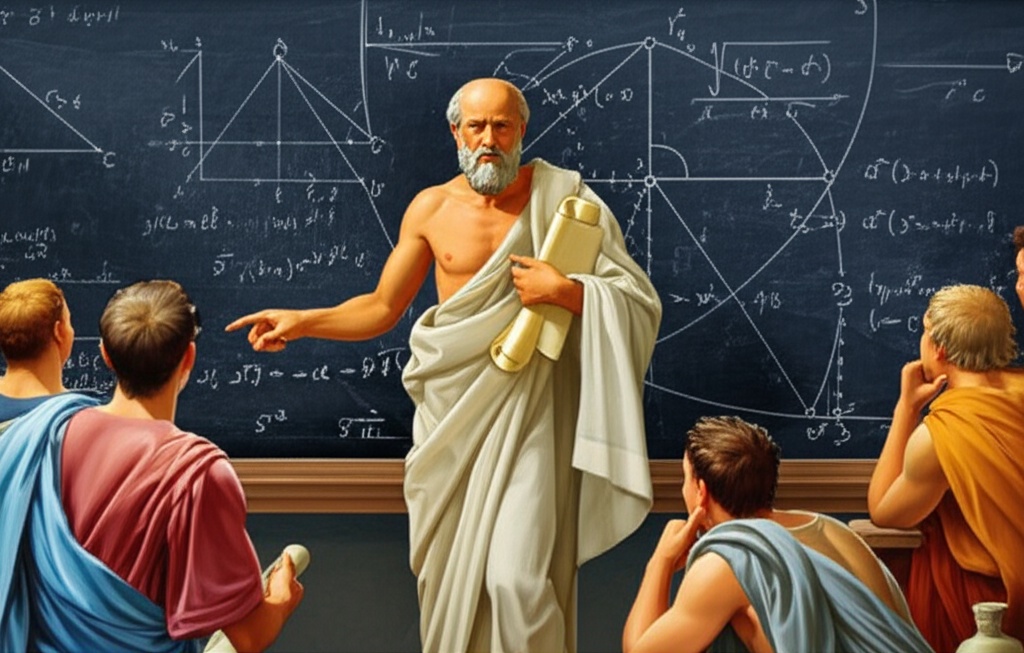
Consider the earliest philosophical inquiries. Pythagoras and his followers believed that "all is number," positing Mathematics not merely as a description, but as the very essence of reality and, by extension, Quantity. Plato, in his Republic, champions the study of arithmetic and geometry as essential for training the mind to grasp eternal truths, for these disciplines deal with pure Quantity and form, abstracted from the messy particulars of the sensible world.
It is through mathematical constructs that we give Definition to what would otherwise be an amorphous concept. What is "three"? It is not merely a collection of three objects, but an abstract numerical entity that can be applied universally. This abstract Definition, provided by the number system, allows us to quantify anything from sheep to stars, irrespective of their individual qualities.
- Discrete Quantity: Defined by natural numbers (1, 2, 3...) – countable items.
- Continuous Quantity: Defined by real numbers (including fractions, irrationals) – measurable magnitudes like length, time, volume.
This distinction, itself a mathematical one, allows for precise discourse and forms the bedrock of all quantitative Science.
From Abstract Principles to Scientific Rigour
The power of Mathematics to define Quantity truly blossomed with the rise of empirical Science. Before the scientific revolution, observations were often qualitative. "This object is heavy," or "that journey is long." But with figures like Galileo and Newton, the demand for precise, quantitative Definition became paramount.
Newton's laws of motion, for instance, are not merely descriptions; they are mathematical Definitions of how force, mass, and acceleration relate quantitatively. Without the calculus, a sophisticated branch of Mathematics, such precise Definitions of continuous quantities like instantaneous velocity or rates of change would be impossible. The very success of modern Science hinges on its ability to translate qualitative observations into quantitatively defined phenomena, allowing for prediction, experimentation, and technological application.
Key Contributions of Mathematics to Defining Quantity in Science:
- Precision: Moving beyond "many" or "few" to exact numerical values.
- Universality: Providing a common language for Quantity across diverse phenomena.
- Structure: Offering frameworks (algebra, geometry, calculus) to model and manipulate quantities.
- Prediction: Enabling the calculation of future states based on current quantitative Definitions.
The Philosophical Weight of Mathematical Definition
The reliance on Mathematics to define Quantity has profound philosophical implications. It suggests that our most fundamental understanding of the world, particularly its measurable aspects, is mediated by abstract mathematical structures. Descartes, in his Discourse on Method and Meditations, sought to build knowledge on clear and distinct ideas, finding geometry and arithmetic to be the most certain. His analytical geometry, linking numerical equations to spatial figures, profoundly deepened the Definition of spatial Quantity.
This enduring connection between Mathematics and the Definition of Quantity underscores a central tenet of scientific inquiry: to understand something deeply, we often seek to quantify it. And to quantify it, we must first allow Mathematics to provide its Definition.
YouTube:
- "Plato's Philosophy of Mathematics"
- "The Unreasonable Effectiveness of Mathematics in the Natural Sciences"
📹 Related Video: What is Philosophy?
Video by: The School of Life
💡 Want different videos? Search YouTube for: "The Role of Mathematics in Defining Quantity philosophy"