

The Enduring Significance of Work: The Role of Labor in the Life of Man
Summary: From antiquity to the modern age, labor has been far more than mere toil; it is a fundamental force shaping human existence, identity, and society. This article explores the multifaceted role of labor in the life of man, examining how philosophical thought, from ancient Greece to contemporary theory, has grappled with its meaning, its connection to our very being, and its profound implications for our journey between life and death. We will delve into how work defines us, creates value, and serves as a crucial interface between individual aspiration and the collective human project.
The Foundational Role of Labor: More Than Just Subsistence
The concept of labor, at its most basic, refers to purposeful activity undertaken to create something of value or to meet a need. Yet, its philosophical significance extends far beyond simple survival. For millennia, thinkers have pondered how labor shapes not just the world around us, but also our inner world, our sense of self, and our place in the cosmos.
- Early Views: Necessity and Burden: In ancient civilizations, particularly among the Greeks, manual labor was often seen as a necessary but ignoble pursuit, largely relegated to slaves or lower classes. Plato and Aristotle, drawing from the Great Books of the Western World, emphasized leisure (schole) as essential for philosophical contemplation and civic participation, viewing productive labor as a means to an end, not an end in itself for the free citizen. This perspective underscored a division where the life of the mind was elevated above the life of physical exertion.
- Biblical Perspectives: Curse and Redemption: The Judeo-Christian tradition, notably in Genesis, introduces labor as a consequence of the Fall – a curse upon humanity. "By the sweat of your brow you will eat your food." However, it also carries redemptive potential, offering discipline, purpose, and a means to contribute to God's creation.
- The Enlightenment: Value and Property: With thinkers like John Locke, labor began to acquire a new dignity. Locke argued that by mixing one's labor with nature, one establishes a rightful claim to property. This idea profoundly influenced Western political and economic thought, asserting labor as the origin of value and a cornerstone of individual rights.
Labor as a Crucible of Identity and Self-Realization
The act of labor is not merely an external process; it is deeply internal, shaping who we are and how we perceive ourselves.
Table: Philosophical Perspectives on Labor and Identity
| Philosopher/Tradition | Core Idea Regarding Labor & Identity |
|---|---|
| Hegel | Self-consciousness achieved through transforming nature; the Master-Slave dialectic where the slave, through labor, gains self-awareness and independence. |
| Marx | Labor is man's essence, his species-being. Alienated labor, however, distorts this, separating man from his product, his process, his species-essence, and other men. |
| Existentialists | Labor as a choice, a project through which individuals define themselves and create meaning in an otherwise absurd world. |
| Adam Smith | While focusing on economic efficiency, the division of labor also shapes individual skills and roles within society, contributing to a collective identity. |
Through our work, we externalize our thoughts, skills, and creativity, leaving a tangible mark on the world. This process of creation and transformation is crucial for developing a sense of competence, purpose, and belonging. The farmer sees the fruit of his toil, the artisan admires their craft, the scholar contributes to the collective knowledge – each act solidifies their identity.
The Intertwined Nature of Labor, Life, and Death
The connection between labor, life, and death is profound and often overlooked. Our working life defines much of our waking existence, dictating our routines, our social circles, and our economic standing.
- Meaning in Mortality: For many, labor provides a sense of purpose that transcends individual mortality. The structures we build, the knowledge we impart, the art we create – these are legacies that persist long after our death. A doctor's healing, a teacher's lessons, an engineer's bridge; these contributions extend the reach of their lives beyond their physical presence, impacting future generations.
- The Quality of Life: The conditions and nature of our labor significantly impact the quality of our lives. Fulfilling work can bring joy, growth, and connection, contributing to a rich and meaningful existence. Conversely, exploitative, alienated, or meaningless labor can diminish human flourishing, leading to suffering and a sense of wasted life. The philosophers of the Great Books, particularly those critical of industrial society, highlighted how certain forms of labor could strip man of his dignity.
- Preparing for the End: The accumulation of resources through labor often serves to provide security for old age and for dependents after one's passing. More existentially, a life well-labored, where one feels they have contributed meaningfully, can bring a sense of peace and completion when contemplating the end of life.
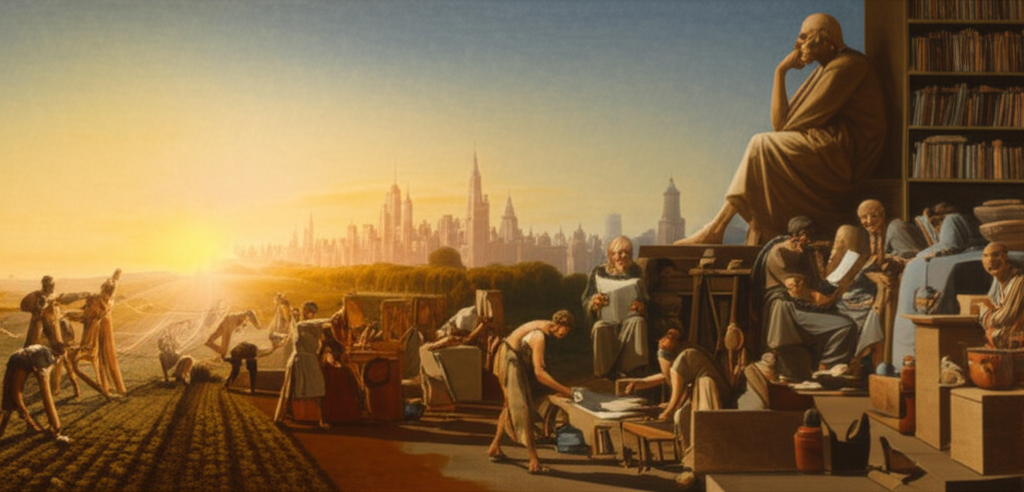
Modern Challenges and the Enduring Relevance of Labor
In an era of increasing automation, globalized economies, and shifting social structures, the role of labor continues to evolve. Questions about the future of work, the ethics of artificial intelligence, and the distribution of wealth challenge our traditional understanding. Yet, the fundamental human need to contribute, to create, and to find meaning through purposeful activity remains.
- Reclaiming Purpose: Many contemporary movements seek to reclaim labor from mere economic necessity, emphasizing its potential for personal growth, community building, and social good. The pursuit of "meaningful work" reflects an enduring desire for labor to be an expression of our authentic selves.
- The Dignity of All Work: Recognizing the inherent dignity in all forms of honest labor, from the care economy to complex intellectual pursuits, is crucial for fostering a just and equitable society. Every contribution, however seemingly small, weaves into the intricate tapestry of human civilization.
Ultimately, the role of labor in the life of man is complex, dynamic, and deeply philosophical. It is through our work that we engage with the world, define our values, build our societies, and leave our indelible mark on the continuum of life and death. It is a testament to our capacity for creation, resilience, and the relentless human drive for purpose.
📹 Related Video: What is Philosophy?
Video by: The School of Life
💡 Want different videos? Search YouTube for: "The Philosophy of Work | Crash Course Philosophy #38"
📹 Related Video: KANT ON: What is Enlightenment?
Video by: The School of Life
💡 Want different videos? Search YouTube for: "Marx's Theory of Alienation Explained"