

The Unyielding Hand: Exploring the Role of Labor in the Life of Man
The role of labor in the life of man is far more profound than mere economic activity; it is a fundamental aspect of human existence, shaping our identity, culture, and very understanding of purpose. From the earliest struggle for survival to the complex demands of modern society, labor has been both a burden and a blessing, a source of alienation and a path to self-realization. This article delves into the multifaceted dimensions of labor, examining its historical interpretations, its impact on individual and collective flourishing, and its intrinsic connection to the grand narratives of human life and death.
The Ancient Roots of Toil and Creation
For much of antiquity, the concept of labor was often viewed with a degree of disdain, particularly manual or repetitive tasks. Philosophers of the Hellenic world, whose ideas resonate through the Great Books of the Western World, frequently distinguished between poiesis (making, production) and praxis (action, ethical conduct). While praxis was elevated as the domain of the free citizen, allowing for self-governance and intellectual pursuit, poiesis was often relegated to slaves or those deemed less noble.
- Ancient Greek Perspective:
- Emphasis on leisure (schole) as essential for philosophical contemplation and civic participation.
- Manual labor often associated with necessity, not virtue.
- Artisanal skill, while valued, was distinct from the higher pursuits of the mind.
- Biblical Narrative:
- Labor introduced as a consequence of the Fall (Genesis 3:17-19: "By the sweat of your brow you will eat your food").
- Yet, it also carries dignity and is presented as a means of stewardship over creation.
This initial framing—labor as a necessary evil or a divine punishment—began to shift dramatically over centuries, particularly with the rise of new religious and economic philosophies.
Labor as a Defining Human Endeavor
The trajectory of human thought eventually led to a re-evaluation of labor. Thinkers from the Enlightenment onwards, building on earlier theological reflections, began to see labor not just as a means to an end, but as central to human nature and societal development.
Bold: John Locke's philosophy, for instance, articulated how labor mixes with nature to create property, thereby establishing individual rights and contributing to the common good. His ideas laid foundational stones for understanding man's relationship with the material world through his efforts.
Italic: The Protestant work ethic, as explored by Max Weber, further elevated labor to a moral and spiritual calling, linking diligent work and worldly success to divine favor. This perspective deeply influenced the burgeoning capitalist societies and underscored the role of individual effort in both personal salvation and economic progress.
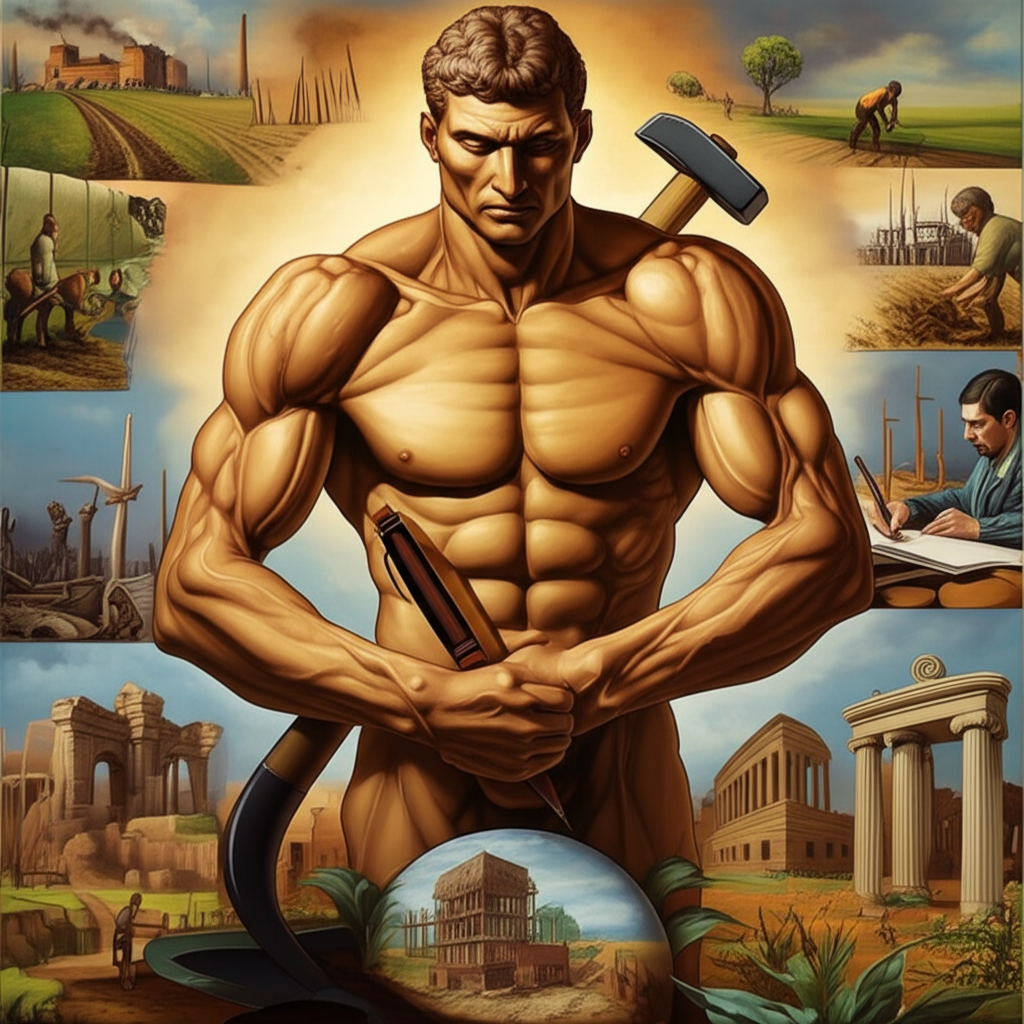
The Existential Weight: Life, Death, and Meaning
The role of labor extends beyond economic or social utility; it grapples with the very essence of life and death. For many, labor is the primary means of survival, a constant struggle against scarcity and the ravages of nature. The need to work, to produce, to sustain oneself and one's family, is a fundamental drive that connects us directly to our mortality.
- Labor as Survival: The most basic form of labor is the effort to secure food, shelter, and safety – a primal dance with death itself.
- Labor as Legacy: Through our work, we build, create, and contribute to something larger than ourselves. This can be seen as a form of immortality, a way to leave a lasting mark beyond our individual life span. Consider the pyramids, the cathedrals, the great works of art and science – all products of immense human labor, enduring through generations.
- Labor as Alienation: Karl Marx, a towering figure in the Great Books, critically examined labor under industrial capitalism. He argued that when workers are separated from the fruits of their labor, from the process of creation, and from their fellow man, they become alienated. This alienation can strip life of its meaning, turning work into a soul-crushing burden rather than a fulfilling activity.
The tension between labor as a source of meaning and labor as a source of suffering is a perpetual philosophical inquiry. It forces us to confront the question: What kind of work truly enriches human life?
Labor and the Fabric of Society
Beyond the individual, labor is the bedrock upon which all societies are built. It is the collective effort that transforms raw materials into civilization, ideas into reality, and individual needs into communal resources.
| Aspect of Society | Role of Labor |
|---|---|
| Economy | Production of goods and services, wealth creation, distribution of resources |
| Culture | Creation of art, literature, music, craftsmanship, traditions |
| Infrastructure | Building of roads, cities, communication networks, public services |
| Knowledge | Research, education, innovation, transmission of wisdom |
| Governance | Administration, defense, justice, collective decision-making |
The division of labor, a concept explored by thinkers from Adam Smith to Émile Durkheim, highlights how specialization can increase efficiency but also create complex interdependencies. This intricate web of human effort defines our collective existence and shapes the opportunities and challenges faced by every man.
The Future of Work: A Continuing Dialogue
As technology advances and the nature of labor evolves, particularly with automation and artificial intelligence, humanity is once again confronted with fundamental questions about the role of work in our life. Will technology liberate us from toil, allowing for greater leisure and philosophical pursuit, reminiscent of ancient ideals? Or will it exacerbate alienation, creating new forms of economic disparity and existential crisis?
These are not merely economic questions; they are deeply philosophical inquiries into what it means to be human, to find purpose, and to live a meaningful life in the face of inevitable death. The dialogue initiated by the great thinkers of the past continues, urging us to thoughtfully navigate the future of labor and its enduring impact on the man.
📹 Related Video: What is Philosophy?
Video by: The School of Life
💡 Want different videos? Search YouTube for: ""Great Books Western Philosophy Labor Meaning""
📹 Related Video: ARISTOTLE ON: The Nicomachean Ethics
Video by: The School of Life
💡 Want different videos? Search YouTube for: ""Marx Alienation of Labor Explained""