

The Enduring Alchemy: How Labor Forges Wealth
The quest for understanding wealth often begins and ends with numbers, markets, and capital. Yet, before any currency exchanged hands or ledger balanced, there was Man, and there was Labor. This article delves into the profound philosophical truth that wealth, in its most fundamental and enduring sense, is not merely accumulated assets, but the tangible manifestation of human effort transforming the raw potential of the world. It is through the sweat of the brow, the ingenuity of the mind, and the persistent application of energy that true value is created, forming the bedrock upon which civilizations are built and sustained.
The Genesis of Value: Labor as Transformation
At its core, wealth is not found; it is made. The earth offers us raw materials – ore, timber, fertile soil – but these remain dormant potential until human Labor intervenes. John Locke, in his Second Treatise of Government, articulates this beautifully, asserting that when a man "mixes his Labour with" something from nature, he makes it his property, thereby adding value that was not present before. This act of mixing labor is the primordial act of wealth creation.
Consider a tree in a forest. It has natural value, certainly, but it is through the lumberjack's felling, the carpenter's shaping, and the builder's assembly that it becomes a home, a tool, or a piece of furniture – objects of use and enduring value. This transformation, from potential to utility, from raw material to finished good, is the very essence of Wealth generation, directly attributable to human Labor.
The Active Hand of Man
It is crucial to recognize the active role of Man in this process. Unlike animals, whose actions are largely instinctual, human labor is imbued with intention, foresight, and a capacity for complex problem-solving. It is this unique human faculty that allows for:
- Innovation: Finding new ways to apply labor more efficiently or create new forms of value.
- Skill Development: Mastering techniques that enhance the quality and quantity of output.
- Planning and Organization: Orchestrating complex tasks that require multiple individuals and stages of production.
These elements elevate human labor beyond mere exertion, positioning it as the primary engine of economic and societal advancement.
From Individual Effort to Collective Prosperity
While individual labor is the spark, the true conflagration of Wealth occurs when human efforts are combined and specialized. Adam Smith, in The Wealth of Nations, famously explored the division of labor, demonstrating how specialized tasks dramatically increase productivity. A single Man might struggle to make a few pins a day, but ten men, each specializing in a different part of the pin-making process, could produce thousands.
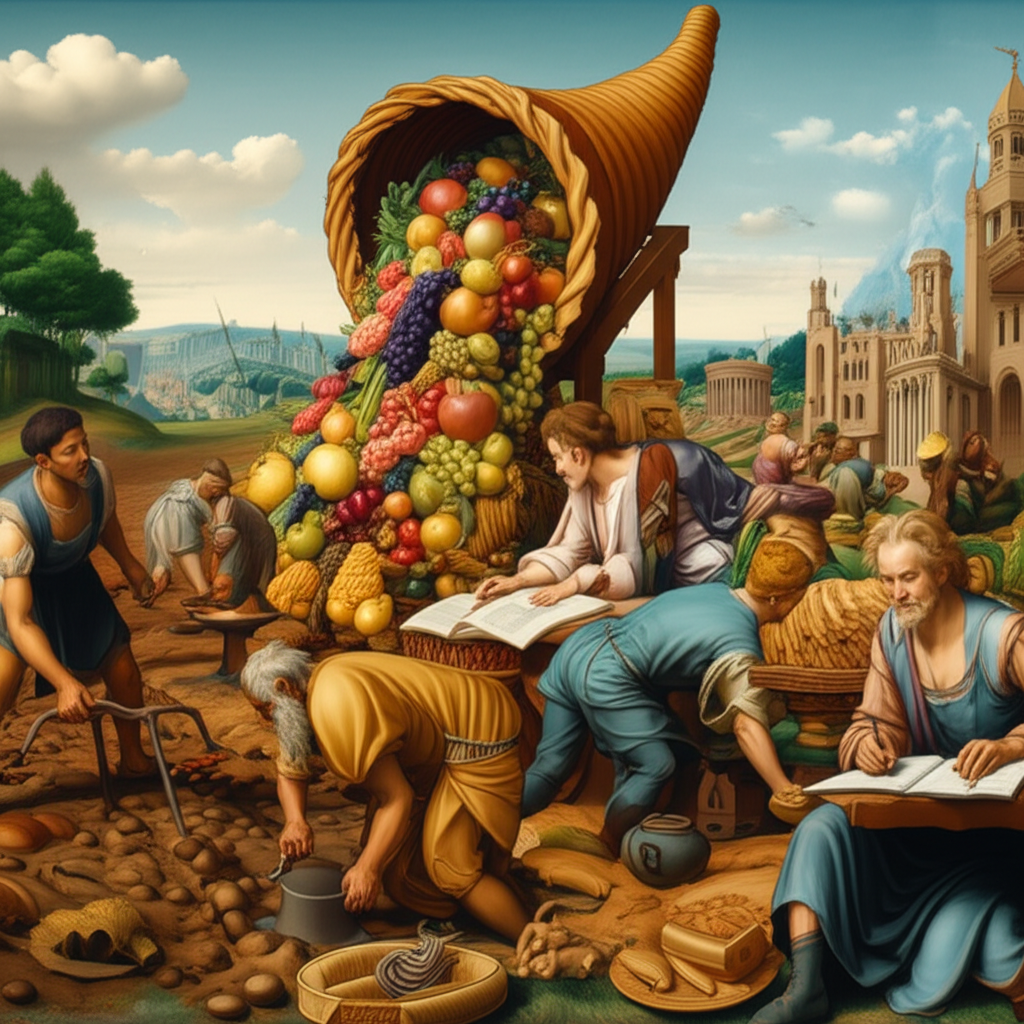
This concept extends beyond manufacturing to every aspect of society. The farmer labors to produce food, the weaver to produce cloth, the scholar to produce knowledge. Each individual's specialized Labor contributes to a collective pool of goods and services, enabling a society to achieve a level of Wealth far beyond what any individual could amass alone. This interconnectedness highlights that societal wealth is not merely the sum of individual fortunes, but the product of a complex web of cooperative, specialized labor.
The Multiplier Effect of Cooperation
| Aspect of Labor | Individual Impact | Collective Impact |
|---|---|---|
| Specialization | Deepens individual skill | Increases overall productivity |
| Innovation | Solves specific problems | Spurs economic growth for all |
| Exchange | Provides personal needs | Facilitates societal interdependence |
| Knowledge | Enhances personal efficiency | Drives collective advancement |
The Philosophical Dimensions of Labor
Beyond its economic function, Labor holds profound philosophical significance for Man. It is often through our work that we define ourselves, interact with the world, and realize our potential. G.W.F. Hegel, in his Phenomenology of Spirit, touched upon how labor transforms not just the external world, but also the laborer himself, making him aware of his own capabilities and shaping his consciousness. Through labor, man imposes his will upon nature, externalizing his ideas and thereby recognizing himself in the transformed object.
This perspective elevates labor from a mere means to an end (acquiring goods) to an end in itself – a path to self-actualization and the expression of human freedom. The ability to conceive, plan, and execute a task, to see the fruits of one's Labor, provides a sense of accomplishment and identity that is fundamental to human flourishing.
The State and the Fruits of Labor
The relationship between Labor, Wealth, and the State is a perennial concern in political philosophy. The role of the State often involves protecting the fruits of Labor (property rights), regulating its conditions, and sometimes redistributing the Wealth it generates. Philosophers from Plato to Aristotle grappled with questions of justice in distribution, the common good, and how the organization of society impacts the productive efforts of its citizens.
Is the purpose of the State to merely safeguard the accumulation of Wealth, or does it have a deeper obligation to ensure that the benefits of collective Labor are shared equitably? This question underpins debates about taxation, social welfare, and economic policy. A just State, many argue, must strike a balance: fostering an environment where Man is incentivized to labor and create, while also ensuring that the resulting Wealth contributes to the overall well-being and stability of the community. Without the stability and order provided by a functional state, the fruits of labor can be easily plundered, diminishing the incentive to create.
Conclusion: An Unbreakable Bond
The intricate dance between Labor and Wealth is more than an economic equation; it is a fundamental aspect of the human condition, deeply explored throughout the Great Books of the Western World. From the earliest philosophical inquiries into property and justice to modern economic theories, the active engagement of Man with his environment through Labor remains the irreducible source of all Wealth. Understanding this profound connection reminds us that true prosperity is built not on abstract financial instruments alone, but on the tangible, transformative power of human effort, shaped and mediated by the structures of the State.
📹 Related Video: ARISTOTLE ON: The Nicomachean Ethics
Video by: The School of Life
💡 Want different videos? Search YouTube for: ""John Locke labor theory of property explained""
📹 Related Video: KANT ON: What is Enlightenment?
Video by: The School of Life
💡 Want different videos? Search YouTube for: ""Adam Smith division of labor philosophical implications""