

The Genesis of Prosperity: Unpacking the Role of Labor in Creating Wealth
Summary: From the earliest philosophical inquiries to modern economic theory, labor stands as the fundamental wellspring of wealth. This article explores how philosophers from the Great Books tradition—including Locke, Smith, Marx, Plato, and Aristotle—have grappled with Man's transformative interaction with nature, the societal structures that amplify this effort, and the role of the State in governing its fruits. We will delve into how labor not only creates material value but also shapes human identity and collective prosperity, examining both its generative power and its potential for exploitation.
The Primordial Act: Labor as the Foundation of Value
The notion that labor is the ultimate source of wealth is not merely an economic principle but a profound philosophical insight, deeply embedded in the Western intellectual tradition. Before the complex mechanisms of markets or finance, there was the raw effort of Man transforming his environment.
A. Locke's Proviso: Mixing Labor with Nature
John Locke, in his Second Treatise of Government, articulated a powerful argument for the inherent right to property stemming directly from labor. He posited that while nature might be held in common, "every Man has a Property in his own Person. This nobody has any right to but himself. The Labor of his Body, and the Work of his Hands, we may say, are properly his." When a Man mixes his labor with something from the common stock of nature—be it land, fruit, or timber—he imbues it with his essence, removing it from the common state and making it his own. This act of labor is, for Locke, the original title to wealth, establishing a direct link between individual effort and rightful possession. It is the very act of exerting oneself that creates value where none existed before, or at least, makes existing value useful and appropriable.
B. Aristotle's Household and the Pursuit of the Good Life
Long before Locke, Aristotle, in his Politics and Nicomachean Ethics, explored the practical aspects of wealth creation within the context of the household (oikos). For Aristotle, labor was essential for Man's sustenance and for the flourishing of the polis. He distinguished between natural forms of acquisition (such as farming, hunting, and crafts), which produce necessary goods and contribute to the good life, and unnatural forms (like usury), which he viewed as less noble, focused solely on monetary gain rather than genuine wealth or well-being. The labor of the farmer, the artisan, and the craftsman was foundational, providing the material basis upon which the higher pursuits of philosophy and civic life could be built. This perspective highlights labor not just as a means to accumulate, but as an activity intrinsically tied to human purpose and the State's capacity to support its citizens.
From Individual Endeavor to Societal Prosperity: The Division of Labor
While individual labor creates value, its true power to generate expansive wealth becomes apparent when organized and specialized within a community or State.
A. Adam Smith's Pin Factory: Specialization and Efficiency
Adam Smith, often considered the father of modern economics, famously demonstrated the transformative power of the division of labor in The Wealth of Nations. His vivid example of a pin factory illustrates how breaking down a complex task into many simpler, specialized operations dramatically increases productivity.
Smith observed:
- "One Man draws out the wire, another straights it, a third cuts it, a fourth points it, a fifth grinds it at the top for receiving the head..."
- Through this specialization, ten men could produce tens of thousands of pins in a day, whereas if each worked independently and performed all operations, they "certainly could not each of them have made twenty, perhaps not one pin in a day."
This exponential increase in output means a far greater amount of goods and services—true wealth—can be produced with the same amount of human effort. The division of labor, therefore, is not merely about efficiency; it's about unlocking unprecedented levels of collective wealth for the State and its citizens.
B. Plato's Republic: A Blueprint for Collective Effort
Even in ancient philosophy, the concept of specialized labor for the common good was recognized. Plato, in his Republic, envisioned an ideal State where citizens were assigned roles based on their natural aptitudes: farmers, artisans, soldiers, and philosopher-kings. This division of labor was not merely for economic efficiency but for the harmonious functioning and justice of the entire State. Each Man contributing his specialized skill ensured that the needs of the polis were met, and that the collective wealth (in its broadest sense, including well-being and stability) was maximized. Plato's ideal State inherently acknowledged that no single Man could be self-sufficient, and that organized, specialized labor was essential for societal coherence and prosperity.
Key Philosophical Perspectives on Labor and Wealth
| Philosopher | Core Idea on Labor & Wealth | Relationship to Man & State |
|---|---|---|
| John Locke | Labor mixes with nature to create property and value. | Justifies individual property rights; limits State intervention. |
| Aristotle | Labor for sustenance and good life; distinguishes natural/unnatural acquisition. | Essential for household & polis; virtue tied to economic activity. |
| Adam Smith | Division of labor increases productivity and national wealth. | Drives economic growth; benefits the State through market forces. |
| Plato | Specialized labor for societal harmony and efficiency. | Integral to the ideal State's structure and justice. |
| Karl Marx | Labor is the sole source of value; potential for exploitation. | Labor defines Man's essence; State (or capital) can alienate Man. |
The Philosophical Contestation: Labor, Value, and Exploitation
While labor's capacity to create wealth is undeniable, its nature and implications have been subjects of intense philosophical debate, particularly concerning value, ownership, and equity.
A. Marx's Critique: Labor as the Source of All Value (and Alienation)
Karl Marx, building upon classical economists, argued vehemently in Das Kapital that labor is the sole source of all economic value. For Marx, the value of a commodity is determined by the "socially necessary labor time" required for its production. However, Marx also critiqued the capitalist system, contending that while labor creates all wealth, the Man who performs the labor does not receive the full value of his effort. Instead, capitalists appropriate "surplus value"—the difference between the value created by labor and the wages paid to the worker. This, for Marx, leads to the alienation of the Man from his labor, the product of his labor, his fellow Man, and ultimately from his species-being. The State, in this view, often serves to uphold this exploitative system, protecting the interests of capital over the laborer.
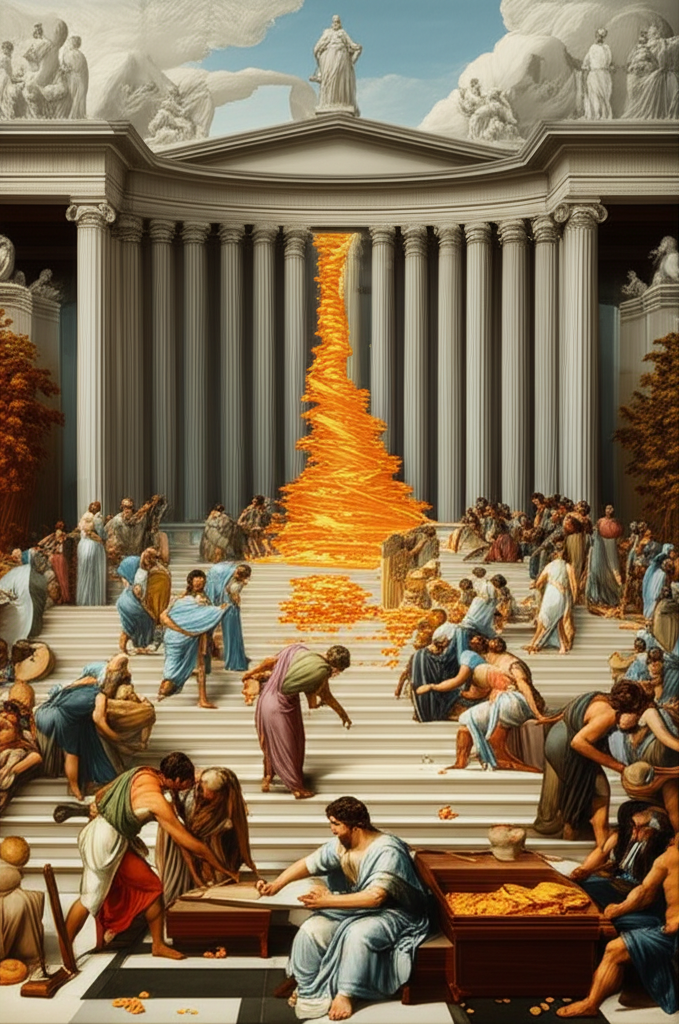
B. The State's Role in Regulating Labor and Wealth
The relationship between labor, wealth, and the State has been a recurring theme in political philosophy. Hobbes, in Leviathan, saw the State's primary role as maintaining order, without which Man's labor would be "solitary, poor, nasty, brutish, and short." The State provides the security necessary for productive labor to occur. Rousseau, in his Discourse on Inequality, lamented how the institution of private property, initially secured by labor, led to inequality and the need for a social contract to protect both the rich and the poor, albeit often imperfectly. The State thus becomes a crucial arbiter, regulating not only the conditions of labor but also the distribution of wealth it generates, attempting to balance individual liberty with collective welfare. The ongoing debate about taxation, social welfare programs, and labor laws all reflect this enduring tension regarding the State's responsibility in a wealth-generating society.
Modern Reflections: The Evolving Nature of Labor and Wealth
Today, as technology advances and economies globalize, the definition of labor and its role in creating wealth continues to evolve. Intellectual labor, automation, and the digital economy present new challenges and opportunities. Yet, the foundational insights from the Great Books remain pertinent. Whether it's the code written by a software engineer, the research conducted by a scientist, or the artistic creation of a designer, the transformative act of human effort—the labor—remains the initial spark for value and prosperity. Understanding these philosophical underpinnings is crucial for navigating the complexities of modern economic life and for shaping a future where wealth serves the flourishing of every Man within the State.
YouTube: "Adam Smith Division of Labor explained"
YouTube: "Marx Labor Theory of Value simplified"
📹 Related Video: What is Philosophy?
Video by: The School of Life
💡 Want different videos? Search YouTube for: "The Role of Labor in Creating Wealth philosophy"