

The Role of Induction in Generalization
The ability to generalize from specific observations is a cornerstone of human understanding, and at the heart of this process lies induction. This supporting article explores the fundamental role of induction in transforming individual experiences into broader principles, thereby expanding our knowledge of the world. We will delve into how this form of reasoning bridges the gap between the particular and the universal, forming the very fabric of scientific inquiry and everyday learning, while also acknowledging its inherent philosophical challenges.
Understanding Induction: From Particulars to Universals
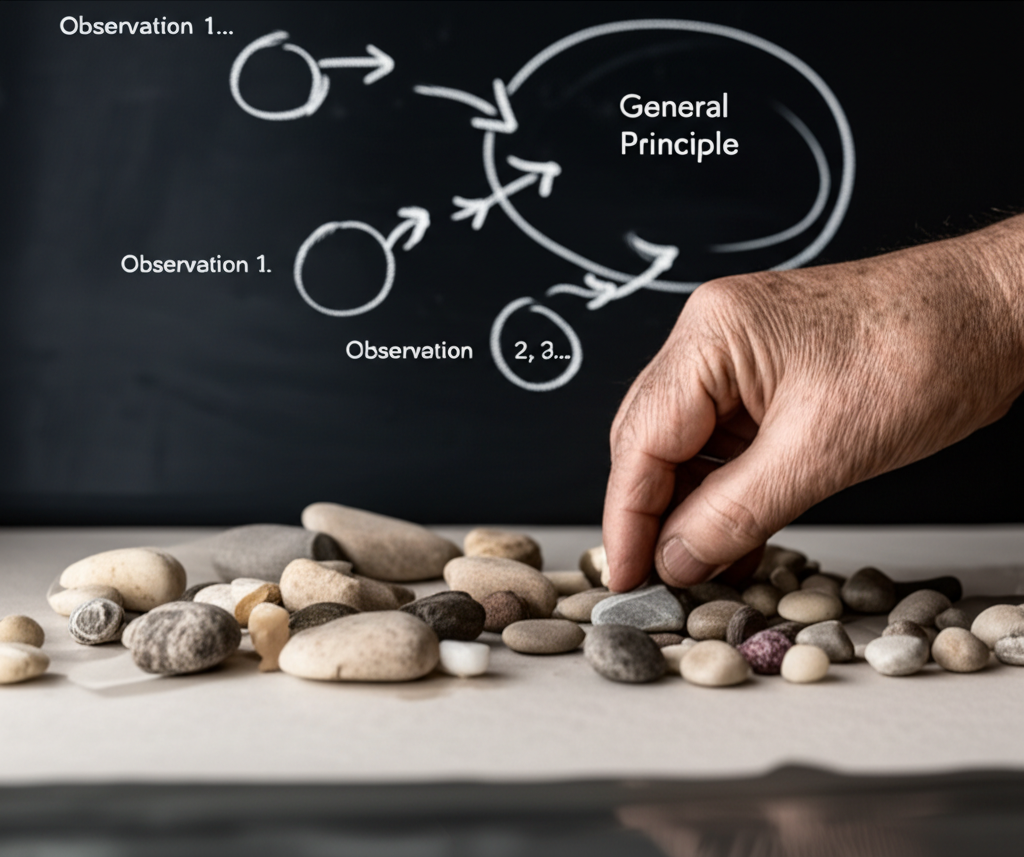
Induction is a form of logical reasoning that moves from specific observations to a general conclusion. Unlike deduction, which starts with a general premise and predicts specific outcomes, induction begins with a series of particular instances and infers a universal rule or pattern. It's the intellectual leap we make when we observe that the sun has risen every morning of our lives, and conclude that it will rise tomorrow morning.
- Particular Observations: We gather data from individual experiences or experiments.
- Pattern Recognition: We identify recurring themes or relationships within these observations.
- Universal Generalization: We formulate a broader statement, hypothesis, or theory that applies beyond the observed instances.
This process is indispensable for forming generalizations, allowing us to predict, explain, and navigate our environment. Without induction, every new experience would be entirely novel, and we would be unable to learn from the past.
The Indispensable Engine of Knowledge
From the earliest philosophical inquiries recorded in the Great Books of the Western World to modern scientific breakthroughs, induction has been the driving force behind the accumulation of knowledge. Aristotle, for instance, recognized the importance of moving from individual perceptions to universal concepts in forming definitions and understanding essences. While his primary logical tool was deduction (the syllogism), the initial gathering of data and the identification of common properties often relied on an inductive process.
Consider the development of scientific laws:
- Observation of Particulars: Isaac Newton observed particular apples falling, and the particular motion of celestial bodies.
- Inductive Leap: He generalized these particular events into a universal law of gravitation, stating that all objects with mass exert a force of attraction on each other.
- Formation of Knowledge: This generalization became a foundational piece of scientific knowledge, allowing for predictions and further inquiry.
This illustrates the profound role induction plays in constructing our understanding of the cosmos, moving us beyond mere anecdote to coherent systems of thought.
Navigating the Landscape of Generalization
The practical application of induction is ubiquitous, guiding both our complex scientific theories and our simplest daily decisions.
- Everyday Life:
- Tasting several sweet apples leads to the generalization that "apples are sweet."
- Observing that touching a hot stove causes pain leads to the generalization that "hot stoves burn."
- Noticing that a particular friend is always late leads to the generalization that "this friend is unreliable."
- Scientific Method:
- Observing that all tested metals expand when heated leads to the generalization that "metals expand when heated."
- Collecting data on numerous patients with a certain disease leads to identifying common symptoms and proposing a general treatment protocol.
- Philosophy:
- Socrates' method of questioning often involved examining particular examples of virtues or concepts to arrive at a more universal definition. While aiming for essences (often deductive in its final form), the initial gathering of examples is inductive.
These examples highlight how induction allows us to create mental models and theories that help us make sense of the world and anticipate future events.
The Philosophical Quandary: Hume's Challenge
Despite its undeniable utility, the role of induction in justifying universal generalizations has long been a subject of philosophical debate. David Hume famously articulated the "problem of induction," questioning the rational basis for assuming that the future will resemble the past. Just because the sun has risen every day so far doesn't logically guarantee it will rise tomorrow. Hume argued that our belief in induction is not based on reason, but on custom and habit.
This challenge reveals a profound tension:
- The Utility of Induction: It is undeniably successful in generating practical knowledge and guiding our actions.
- The Justification of Induction: There appears to be no purely logical, non-circular way to prove that inductive reasoning itself is valid. We rely on induction to justify induction (e.g., "induction has worked in the past, therefore it will work in the future"), which is problematic.
This philosophical insight, while not negating the practical necessity of induction, compels us to acknowledge the inherent assumptions underlying our generalizations and the provisional nature of much of our empirical knowledge.
Conclusion: Embracing the Inductive Leap
The role of induction in generalization is nothing short of foundational. It is the essential cognitive mechanism that allows us to build knowledge from the ground up, transforming isolated particulars into coherent universal principles. From the empirical observations of natural philosophers to the sophisticated theories of modern science, induction provides the framework for understanding patterns, making predictions, and expanding our grasp of reality. While Hume's challenge reminds us of the leap of faith inherent in every generalization, it is a leap we must continuously make to learn, evolve, and navigate the intricate tapestry of existence.
📹 Related Video: ARISTOTLE ON: The Nicomachean Ethics
Video by: The School of Life
💡 Want different videos? Search YouTube for: ""Problem of Induction Explained""
📹 Related Video: What is Philosophy?
Video by: The School of Life
💡 Want different videos? Search YouTube for: ""Inductive vs Deductive Reasoning Philosophy""