

The Indispensable Bridge: The Role of Induction in Generalization
Summary: Induction plays a fundamental and indispensable role in our ability to form generalizations, serving as the cognitive bridge that allows us to move from specific observations and particular experiences to broader, universal claims about the world. This process is crucial for the acquisition of empirical knowledge, enabling us to predict, understand, and navigate our environment, despite the inherent philosophical challenges to its certainty.
The Leap of Faith in Understanding the World
From the moment we observe a single leaf falling to understanding the universal law of gravity, human cognition is constantly engaged in the intricate dance between what is directly experienced and what can be inferred about the world at large. This transition, from the observed to the unobserved, from individual instances to overarching principles, is where induction takes center stage. It is the very mechanism that allows us to generalize, to draw conclusions about entire categories or future events based on a limited set of past or present observations. Without it, our capacity for knowledge would be severely constrained, trapped in a perpetual state of isolated particulars.
What is Induction? Bridging the Known to the Unknown
At its core, induction is a type of reasoning that moves from specific observations to a general conclusion. Unlike deduction, which guarantees the truth of its conclusion if its premises are true, induction offers conclusions that are probable, not certain. It's the process by which we infer that because something has happened repeatedly in the past under certain conditions, it is likely to happen again in the future, or that because a sample of a population exhibits a certain characteristic, the entire population likely shares that characteristic.
Here are some key characteristics of inductive reasoning:
- Probabilistic Nature: Conclusions are likely, not guaranteed.
- Expansion of Knowledge: It allows for new information and insights beyond what is strictly contained in the premises.
- Empirical Foundation: Heavily reliant on observation and experience.
- Risk of Falsity: Even with true premises, the conclusion can be false.
From Particular Instances to Universal Truths: The Core Role of Induction
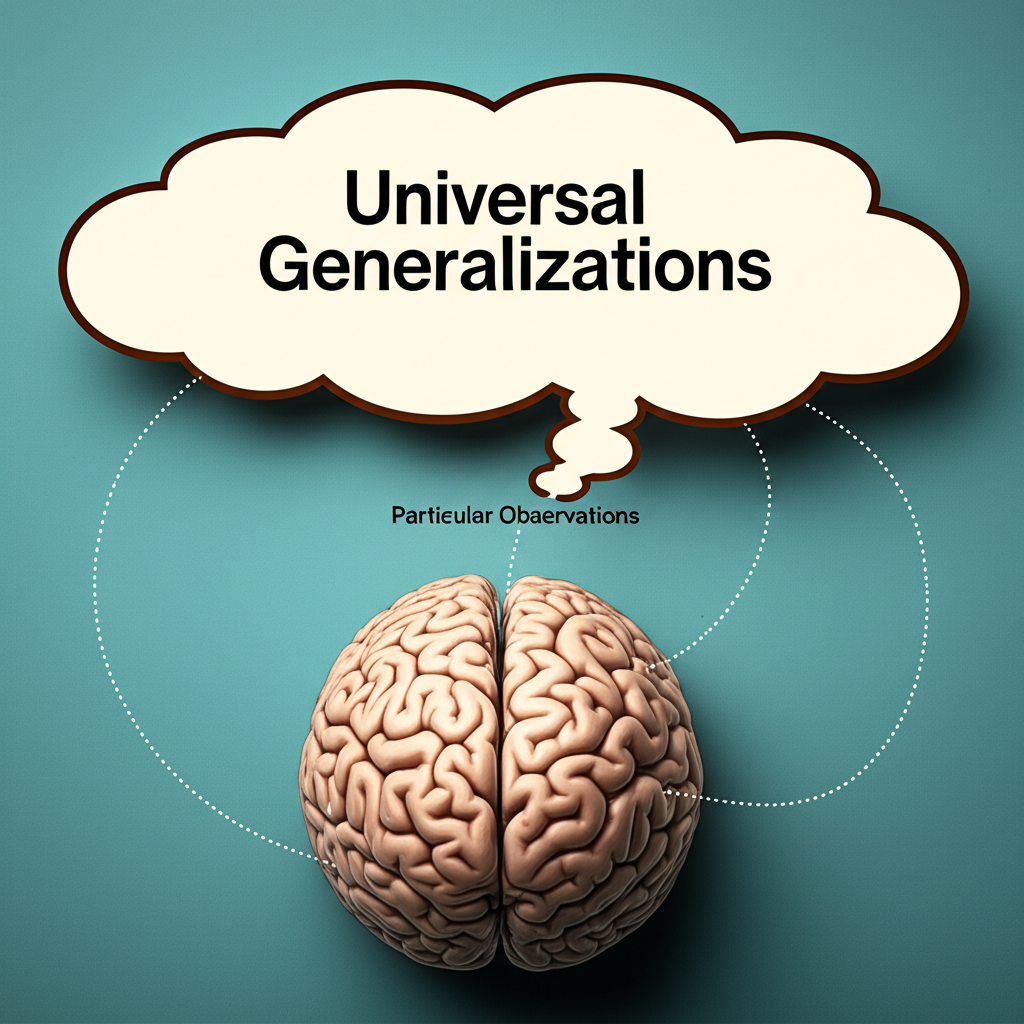
The profound role of induction lies in its capacity to connect the particular with the universal. We encounter countless individual instances: this swan is white, that swan is white, every swan we've ever seen is white. Through induction, we generalize from these particular observations to the universal claim: All swans are white. While this specific example famously proved fallible with the discovery of black swans in Australia, it perfectly illustrates the cognitive leap induction enables.
Consider the following examples of inductive reasoning in action:
| Particular Observations | Inductive Generalization (Universal Claim) |
|---|---|
| Every morning, the sun rises in the east. | The sun will rise in the east tomorrow. |
| All observed metals expand when heated. | All metals expand when heated. |
| This apple falls to the ground when dropped. | All apples (and objects) fall to the ground when dropped (gravity). |
| Every human I've met has required food and water to live. | All humans require food and water to live. |
These generalizations, though not logically necessary, form the bedrock of our understanding of natural laws, scientific principles, and everyday expectations. They allow us to predict, to plan, and to build complex systems based on assumed regularities.
Induction as the Foundation of Empirical Knowledge
The scientific method itself is deeply rooted in induction. Scientists gather data from numerous experiments and observations (particulars) and then use induction to formulate hypotheses and theories (universals) that explain these observations and predict future phenomena. This process is how we build knowledge about the natural world. From the early empirical philosophers like Francis Bacon, who championed inductive reasoning as the path to scientific discovery, to the modern scientific enterprise, induction is the engine driving the accumulation of empirical understanding.
Without the ability to generalize from past experiences, we would be unable to learn from our mistakes, apply lessons from one situation to another, or develop any coherent understanding of cause and effect. Our knowledge would be fragmented and incapable of growth beyond the immediate sensory input.
The Philosophical Quandary: Hume's Challenge to Inductive Reasoning
Despite its practical necessity, the philosophical justification of induction has been a contentious issue. David Hume, a prominent figure in the Great Books tradition, famously articulated the "problem of induction." He argued that there is no rational, non-circular way to justify the assumption that the future will resemble the past. Our belief in inductive reasoning, Hume suggested, is based not on logic, but on habit and custom. We assume the uniformity of nature because it has always been uniform, but this assumption itself is an inductive one. This philosophical challenge highlights that while induction is indispensable for forming generalizations and building knowledge, it operates on a pragmatic assumption rather than absolute logical certainty.
The Enduring Role of Induction in Generalization
In conclusion, the role of induction in generalization is paramount. It is the cognitive mechanism that transforms discrete observations into coherent principles, allowing us to build a framework of knowledge about the world. While philosophers continue to debate its ultimate justification, our daily lives, scientific progress, and very ability to learn and adapt depend entirely on our capacity to make these inductive leaps from the particular to the universal. It remains the indispensable bridge between what we have seen and what we can reasonably expect.
📹 Related Video: ARISTOTLE ON: The Nicomachean Ethics
Video by: The School of Life
💡 Want different videos? Search YouTube for: ""Problem of Induction Explained" or "David Hume Induction""
📹 Related Video: What is Philosophy?
Video by: The School of Life
💡 Want different videos? Search YouTube for: ""Inductive vs Deductive Reasoning Philosophy""