

The Unseen Architect: Imagination's Indispensable Role in Scientific Discovery
The conventional view of science often emphasizes logic, empirical observation, and rigorous experimentation, sometimes sidelining the very spark that ignites these processes: imagination. Yet, a closer look reveals that imagination is not merely a whimsical diversion but a fundamental, driving force in scientific advancement, an essential precursor to the hypothesis and the very expansion of human knowledge. From forming initial theories to envisioning unseen phenomena, the capacity for memory and imagination is crucial for any truly groundbreaking discovery.
Memory and Imagination: The Wellspring of Scientific Insight
Far from being a mere flight of fancy, imagination in science is a sophisticated cognitive process, deeply intertwined with memory. Our ability to recall past observations, learned facts, and existing knowledge provides the raw material for the mind to synthesize, reconfigure, and project new possibilities. As explored by thinkers within the Great Books of the Western World, from Aristotle's concept of phantasia (the mind's capacity to form images) to Locke's ideas on complex ideas being built from simple ones, the human mind does not simply record reality but actively constructs it.
This constructive power is where imagination shines. It allows us to:
- Synthesize disparate pieces of information: Connecting seemingly unrelated facts to form a coherent new picture.
- Extrapolate beyond existing data: Predicting what might happen under new conditions or in unobserved realms.
- Visualize abstract concepts: Making the invisible visible, such as fields of force or subatomic particles.
Without this imaginative capacity, our scientific endeavors would be limited to mere cataloging, unable to leap towards novel explanations or revolutionary paradigms.
From Vision to Hypothesis: The Birth of Scientific Ideas
Every scientific hypothesis begins as an imaginative construct. Before it can be tested, a scientist must first imagine a possible explanation, a potential relationship, or a new way of understanding a phenomenon. This is the crucial bridge between observation and experimentation.
Consider the following stages:
- Observation: Noticing a pattern or anomaly.
- Imaginative Leaping: Forming an intuitive, often non-linear, idea about why or how this pattern exists. This is where memory and imagination work in tandem, drawing on prior knowledge to propose something new.
- Formulation of Hypothesis: Translating the imaginative leap into a testable statement.
- Experimentation: Designing and conducting tests to validate or refute the hypothesis.
- Refinement of Knowledge: Integrating the results, leading to new or refined knowledge.
This sequence underscores that the hypothesis, the very bedrock of the scientific method, is born from an act of creative imagination.
Great Minds, Great Leaps: Historical Perspectives
Throughout history, many of the most significant scientific breakthroughs have been attributed to moments of profound imaginative insight, often described as "thought experiments" or sudden revelations.
| Scientist | Field | Imaginative Contribution |
|---|---|---|
| Albert Einstein | Physics | His famous "thought experiments," such as imagining what it would be like to ride on a beam of light, were crucial in developing the theory of relativity. He didn't just analyze data; he imagined scenarios that challenged conventional physics. |
| August Kekulé | Chemistry | The discovery of the benzene ring structure is famously attributed to a dream where he saw a snake biting its own tail, symbolizing a cyclic structure. This vivid imaginative experience led directly to a groundbreaking hypothesis. |
| Isaac Newton | Physics | While often portrayed as purely logical, Newton's ability to imagine a universal force governing both falling apples and orbiting planets required a significant imaginative leap, connecting disparate phenomena under a single theoretical framework. |
| Charles Darwin | Biology | Darwin's theory of natural selection required him to imagine vast spans of time and subtle, cumulative changes across generations, far beyond direct observation, synthesizing countless observations into a coherent narrative of evolutionary change and the origin of species. |
These examples illustrate that the greatest strides in science are not just about collecting facts but about the imaginative capacity to see what others cannot, to hypothesize relationships that are not immediately apparent, and to construct new conceptual frameworks that expand our knowledge.
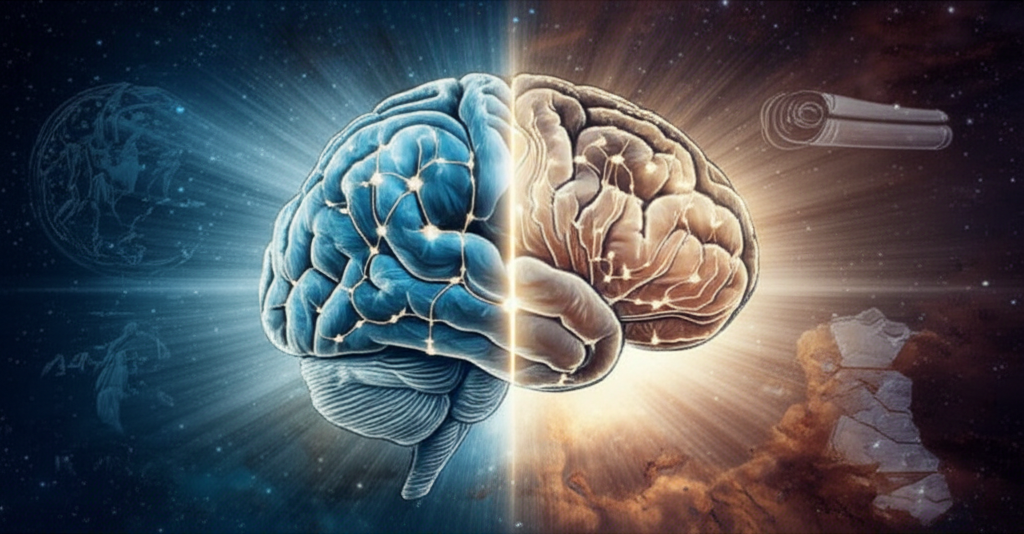 are visible, while on the other, modern scientific symbols (like atomic models or DNA strands) emerge, all connected by a central, glowing thread representing imagination.)
Beyond the Obvious: Cultivating Imaginative Knowledge
The role of imagination extends beyond the initial hypothesis formation; it is also vital in interpreting data, designing experiments, and even in recognizing the implications of results. When faced with unexpected data, it is imagination that allows scientists to conceptualize alternative explanations or to imagine new experiments to probe deeper. This iterative process of memory and imagination, hypothesis, testing, and refinement continually pushes the boundaries of knowledge.
Ultimately, the truly innovative scientist is not merely a logician but a visionary. They possess the ability to step outside established paradigms, to question assumptions, and to imagine entirely new realities. This creative faculty, often nurtured by a broad base of knowledge and a deep engagement with philosophical inquiry (as found in the Great Books), is what transforms mere data into profound understanding, continuously shaping and expanding our collective knowledge of the universe.
📹 Related Video: What is Philosophy?
Video by: The School of Life
💡 Want different videos? Search YouTube for: ""The Role of Imagination in Scientific Discovery Philosophy""
📹 Related Video: ARISTOTLE ON: The Nicomachean Ethics
Video by: The School of Life
💡 Want different videos? Search YouTube for: ""Albert Einstein Thought Experiments Imagination Science""