

The realm of science is often perceived as a bastion of cold, hard facts, empirical data, and rigorous logic. Yet, to truly understand scientific progress, we must look beyond the purely rational and acknowledge the profound, often overlooked, role of imagination. Far from being a mere flights of fancy, imagination is the crucible in which new ideas are forged, hypotheses are born, and our understanding of the universe expands, ultimately leading to new knowledge. It is the bridge between what we know and what we aspire to discover, an indispensable faculty that allows us to envision possibilities beyond the immediate scope of our senses and existing data.
The Unseen Architects of Discovery: Imagination's Genesis
At its core, scientific discovery is not solely about observing the world, but about making sense of it, proposing explanations, and envisioning what could be. This is where imagination steps onto the stage. Before an experiment can be designed, or a theory formulated, there must be an initial flash of insight, a conceptual leap that transcends the known. It's the ability to see patterns where none are obvious, to connect disparate pieces of information, and to construct mental models of phenomena that are invisible, too vast, or too minute for direct observation.
Consider the very act of forming a hypothesis. A hypothesis is not simply derived; it is conceived. It is an educated guess, certainly, but one that requires a creative synthesis of existing knowledge and an imaginative projection into the unknown. As thinkers throughout the "Great Books of the Western World" have explored, the mind's capacity to synthesize and project is fundamental. Aristotle, while emphasizing observation, also acknowledged the role of phantasia (imagination) in forming concepts from sensory experience. It's this faculty that allows us to move beyond mere perception to understanding.
Memory, Imagination, and the Foundations of Hypothesis
The power of imagination in science is inextricably linked to memory. Our memory provides the raw material – the observations, the data, the established principles, the successes and failures of past experiments, and the accumulated knowledge of generations. But it is imagination that acts upon this material, rearranging it, combining it in novel ways, and extrapolating from it to create something entirely new.
This dynamic interplay is crucial for scientific innovation:
Table: The Synergy of Memory and Imagination in Science
| Faculty | Role in Scientific Discovery |
|---|---|
| Memory | Stores existing knowledge, empirical data, observational records, and established theories. |
| Imagination | Synthesizes and rearranges memory's contents, forms new connections, projects future possibilities, and conceives novel hypotheses. |
Without memory, imagination would lack the grounding in reality necessary for scientific relevance. Without imagination, memory would merely catalogue the past without inspiring future discovery. This symbiotic relationship allows scientists to build upon the shoulders of giants, not just by replicating their work, but by imaginatively extending it. Thinkers like John Locke, in his Essay Concerning Human Understanding, explored how complex ideas are built from simpler ones, a process that inherently involves the mind’s capacity to combine and relate, which is a form of imaginative construction.
Bridging the Gap: From Concept to Knowledge
The journey from a nascent idea to established knowledge in science is a rigorous process, yet imagination remains a constant companion. Once a hypothesis is imaginatively conceived, it must be tested. This testing phase itself requires imagination – to design experiments that can accurately probe the hypothesis, to anticipate potential outcomes, and to devise novel methods of measurement.
When experiments yield unexpected results, it is imagination that helps scientists re-evaluate their assumptions, reformulate their hypotheses, and interpret anomalies. The history of science is replete with examples where a sudden, imaginative leap allowed a scientist to reframe a problem or interpret puzzling data in a revolutionary new light. Consider the famous "Eureka!" moment of Archimedes, a flash of insight that imaginatively connected water displacement to volume measurement. Or Kekulé's dream of a snake biting its own tail, leading to the cyclic structure of benzene. These are not merely anecdotes; they highlight the deep cognitive processes where unconscious memory and conscious imagination converge to unlock profound knowledge.
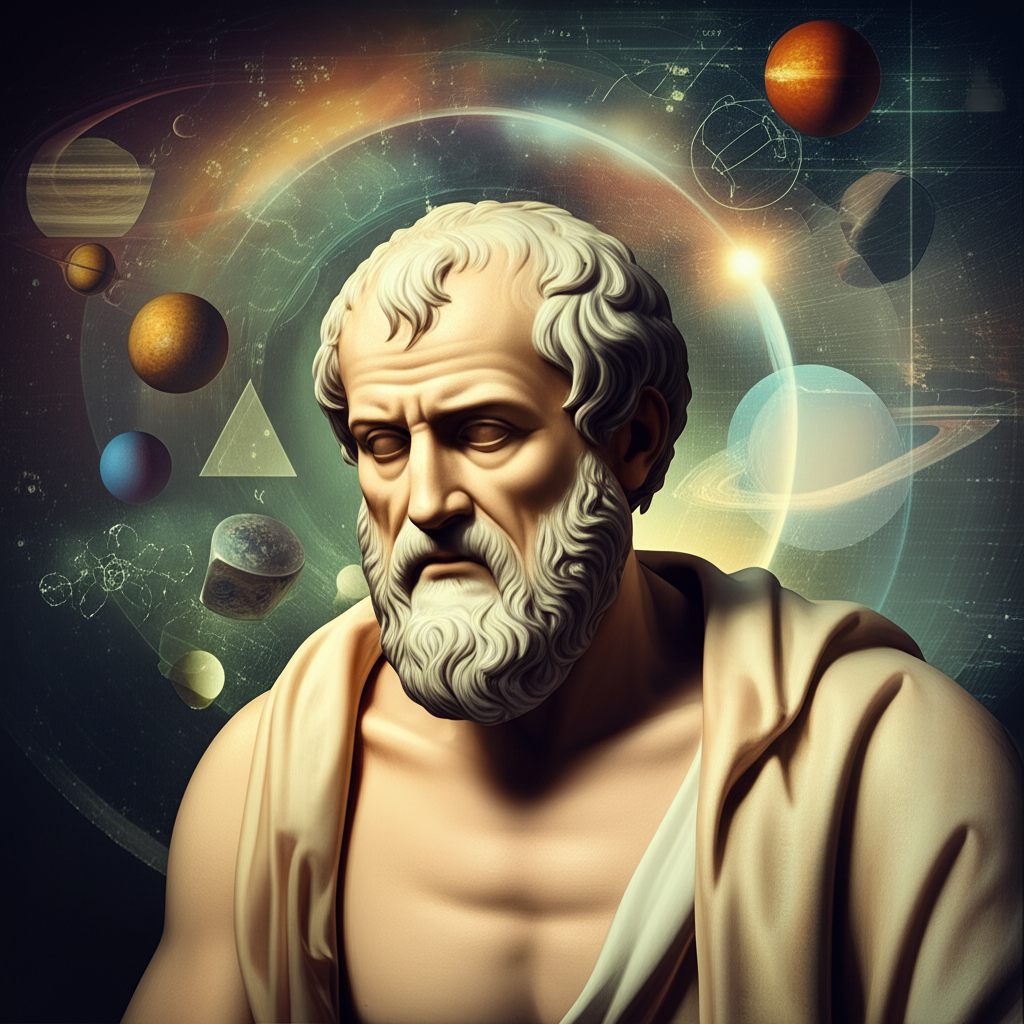
The Great Books and the Imaginative Imperative
The philosophical lineage articulated in the "Great Books of the Western World" consistently underscores the importance of faculties beyond pure empiricism for true understanding. Plato's Allegory of the Cave, for instance, can be interpreted as a call for an imaginative leap beyond mere sensory perception to grasp the Forms, or true knowledge. Descartes, in his Meditations, systematically doubted all sensory input, yet relied on a powerful imaginative capacity to reconstruct knowledge from the bedrock of his own existence, demonstrating that even in the most rigorous forms of reasoning, imagination plays a foundational role in conceiving of certainty and order.
Indeed, the very act of philosophical inquiry, which underpins science, begins with a question, a wonder, an imaginative projection of what could be, rather than merely what is. This imaginative imperative is what drives us to seek deeper explanations, to push the boundaries of our current understanding, and to constantly refine our picture of the universe.
Conclusion: The Enduring Spark
In conclusion, to dismiss imagination as merely the domain of art or fantasy is to profoundly misunderstand its crucial role in scientific discovery. It is the spark that ignites the initial hypothesis, the guiding hand that navigates the complexities of experimentation, and the illuminating flash that transforms data into profound knowledge. By fostering our capacity for memory and imagination, we not only honor the rich philosophical tradition that values speculative thought but also empower the next generation of scientists to envision a future filled with discoveries yet unimagined. The greatest scientific breakthroughs have always been, and will continue to be, acts of profound creative imagination.
📹 Related Video: PLATO ON: The Allegory of the Cave
Video by: The School of Life
💡 Want different videos? Search YouTube for: ""Role of imagination in scientific discovery philosophy" or "Plato's Allegory of the Cave explained""