

The Unseen Engine: Imagination's Indispensable Role in Scientific Discovery
Imagination, often relegated to the realm of artists and dreamers, is in fact the silent architect of scientific progress. It is the faculty that enables us to transcend mere observation, forming bold hypotheses that push the boundaries of existing knowledge and pave the way for revolutionary breakthroughs in science. Far from a flight of fancy, imagination, intertwined with memory, is the crucible where new theories are forged, allowing us to envision what is not yet seen, understood, or even believed possible.
Beyond the Visible: Imagination as the Genesis of Scientific Inquiry
While the scientific method is lauded for its emphasis on empirical data and logical deduction, the initial spark – the moment of conceiving a new problem or a radical solution – almost invariably originates in the imagination. Before an experiment can be designed or data collected, there must be a hypothesis, a testable proposition that dares to suggest an alternative reality or a deeper truth. This is where imagination takes center stage.
Consider the heliocentric model, for instance. For centuries, the geocentric view was the accepted knowledge, supported by everyday observation. It took an immense imaginative leap for Copernicus and later Galileo to envision a universe where the Earth was not stationary at the center, but rather a planet orbiting the sun. They had to mentally reconfigure the cosmos, challenging deeply ingrained perceptions and established scientific paradigms. This isn't just logical inference; it's a profound act of imaginative reconstruction.
The Symbiotic Dance: Memory, Imagination, and Knowledge
The power of imagination in science is not about creating something from nothing; rather, it’s a sophisticated process of reconfiguring and extending existing knowledge. This is where the crucial interplay of memory and imagination comes into play. Our memories provide the raw materials – the observations, facts, theories, and experiences we've accumulated. Imagination then acts as the architect, rearranging these components, identifying gaps, and constructing novel patterns or scenarios that were previously unconsidered.
How Memory Fuels Imagination in Scientific Discovery:
- Pattern Recognition: Memory stores vast amounts of data, allowing the imagination to spot subtle patterns or anomalies that hint at deeper principles.
- Analogical Reasoning: Scientists often draw parallels between seemingly unrelated phenomena. This ability to see "like" in "unlike" is a hallmark of imaginative thinking, fueled by stored memories of diverse concepts.
- Mental Simulation: Before a complex experiment is run, it's often "run" mentally. This imaginative simulation, drawing on memories of physical laws and material properties, helps refine the hypothesis and predict potential outcomes.
- Identifying Gaps: By remembering what is known, imagination can highlight what is not known, pinpointing areas ripe for inquiry and new knowledge creation.
This collaborative effort allows scientists to go beyond incremental adjustments to existing theories, enabling truly transformative leaps. Einstein's thought experiments, such as imagining himself riding a beam of light, were not empirical observations but imaginative constructs that paved the way for his theories of relativity. Similarly, August Kekulé's famous dream of a snake biting its own tail led to the imaginative visualization of the benzene ring structure.
Picturing the Unseen: From Thought Experiments to Theoretical Frameworks
Much of modern science deals with phenomena that are not directly observable – subatomic particles, gravitational waves, the curvature of spacetime, or the distant past of the universe. In these realms, imagination is not just helpful; it's absolutely essential. Scientists must build mental models, conceptual frameworks, and abstract representations to understand these unseen forces and structures.
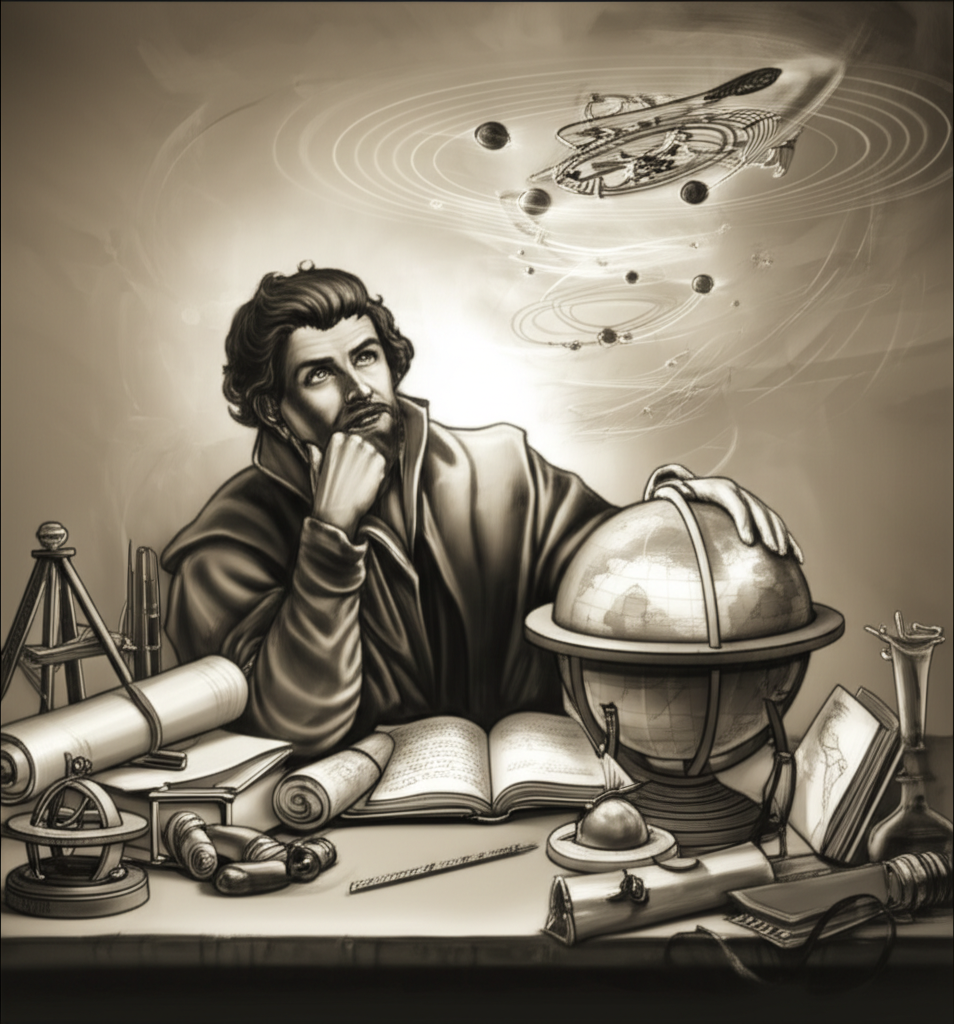
Thought experiments, a cornerstone of theoretical physics, are purely imaginative exercises. They allow scientists to explore the implications of a hypothesis in idealized conditions, pushing the boundaries of logical possibility without the constraints of physical experimentation. These mental constructs refine our understanding and often lead to new, testable predictions, ultimately expanding our collective knowledge.
A Philosophical Legacy: Imagination in the Great Books
The profound connection between imagination and the pursuit of knowledge is not a modern discovery. Throughout the "Great Books of the Western World," thinkers have grappled with the nature of imagination and its role in human understanding. Plato, in his allegory of the cave, implies a journey of the mind from shadows (perceptions) to true forms (ideas), a journey requiring an imaginative leap beyond immediate sensory input. Aristotle, while emphasizing empirical observation, also recognized the mind's ability to form images (phantasmata) as a basis for thought and reasoning. Later, Descartes, in his meditations, used imaginative doubt to strip away preconceived notions, ultimately arriving at foundational knowledge. These philosophical inquiries underscore that the capacity to envision, to hypothesize, and to mentally construct alternative realities has always been central to humanity's quest for understanding the universe.
Conclusion: The Indispensable Spark
In conclusion, the role of imagination in scientific discovery is far more profound than commonly acknowledged. It is the indispensable spark that ignites inquiry, transforms existing knowledge, and propels science forward. By allowing us to form novel hypotheses from the interplay of memory and imagination, it enables us to see beyond the immediate, to conceptualize the unobservable, and to build the theoretical frameworks that govern our understanding of the cosmos. Without this creative faculty, science would be a mere cataloging of facts, devoid of the visionary leaps that have consistently reshaped our world.
YouTube Video Suggestions:
-
📹 Related Video: PLATO ON: The Allegory of the Cave
Video by: The School of Life
💡 Want different videos? Search YouTube for: ""Einstein's Thought Experiments Explained""
2. ## 📹 Related Video: What is Philosophy?
Video by: The School of Life
💡 Want different videos? Search YouTube for: ""The Philosophy of Imagination in Science""