

The Indispensable Role of Hypothesis in Unraveling Evolution
The scientific journey to understand evolution is fundamentally driven by the formulation and rigorous testing of hypotheses. Far from mere guesses, these educated propositions serve as the bedrock of scientific inquiry, guiding observation, experimentation, and the construction of comprehensive theories. This article explores the critical role of hypothesis in the development and refinement of evolutionary science, demonstrating how it transforms raw observation into structured knowledge, thereby illuminating the intricate mechanisms of life's diversity.
The Guiding Light of Inquiry
In the vast and often bewildering landscape of natural phenomena, the human mind seeks patterns, explanations, and ultimately, understanding. For centuries, thinkers have grappled with the origins and transformations of life, moving from mythological narratives to increasingly systematic modes of inquiry. It is within this intellectual tradition, echoing the profound questions posed in the Great Books of the Western World regarding the nature of being and change, that the scientific hypothesis emerges as an indispensable tool. It is the initial spark of an idea, meticulously crafted, that allows us to move beyond simply observing the world to actively interrogating it, pushing the boundaries of our knowledge about evolution.
I. Defining the Evolutionary Hypothesis: More Than a Guess
At its core, a scientific hypothesis is a testable statement or proposition that attempts to explain a specific phenomenon or set of observations. In the context of evolution, these hypotheses address questions like: "Why do certain species possess particular traits?" or "How did a specific lineage diverge?"
- Grounded in Observation: Unlike a casual guess, a scientific hypothesis is always rooted in existing observations, prior knowledge, or established theories. For instance, observing variation within a species might lead to a hypothesis about the selective pressures driving those variations.
- Falsifiable: A crucial characteristic is that a hypothesis must be falsifiable – meaning it must be possible to conceive of an observation or experiment that could prove it wrong. If a hypothesis cannot, in principle, be disproven, it falls outside the realm of empirical science.
- Predictive: A good hypothesis generates testable predictions. If the hypothesis is true, then certain outcomes should be observed under specific conditions.
Grace Ellis's Insight: One might consider the hypothesis as a philosophical commitment to explanation, a provisional truth offered to the tribunal of empirical evidence. It is an act of intellectual courage, daring to posit a cause or mechanism before its full verification.
II. The Scientific Method: Hypothesis as the Engine of Evolution
The role of hypothesis is most evident as the central engine driving the scientific method itself. It provides direction and purpose to the entire process of scientific discovery in evolutionary science.
- Observation and Questioning: The process often begins with a compelling observation (e.g., the finches on the Galápagos Islands have different beak shapes) that sparks a question (e.g., why do these finches have such varied beaks?).
- Formulation of Hypothesis: Based on existing knowledge (e.g., environmental factors influence traits), a testable explanation is proposed (e.g., different beak shapes are an adaptation to different food sources on each island).
- Prediction: From the hypothesis, specific predictions are made (e.g., finches with larger, stronger beaks will be found on islands where nuts are the primary food source).
- Experimentation and Data Collection: Researchers design and conduct experiments or gather observational data to test these predictions. This might involve field studies, genetic analyses, or fossil records.
- Analysis and Conclusion: The collected data is analyzed to determine whether it supports or refutes the hypothesis. If the data aligns, the hypothesis gains strength; if it contradicts, the hypothesis must be revised or rejected.
Key Characteristics of a Robust Evolutionary Hypothesis:
- Specificity: Clearly defines the relationship between variables.
- Testability: Can be investigated through empirical means.
- Parsimony: Often the simplest explanation is preferred (Occam's Razor).
- Relevance: Addresses significant questions within evolutionary biology.
- Predictive Power: Generates clear, verifiable predictions.
III. Historical Trajectories: Hypotheses Shaping Evolutionary Thought
The history of evolutionary science is a testament to the power of hypothesis. From its nascent stages to its modern, sophisticated forms, hypotheses have guided our understanding.
-
Darwin's Grand Hypothesis: Charles Darwin's monumental work, "On the Origin of Species," was essentially a comprehensive articulation and defense of several interconnected hypotheses. His central hypothesis of natural selection, proposing that advantageous traits increase an organism's chances of survival and reproduction, thereby becoming more common in subsequent generations, revolutionized biology. This was built upon extensive observations and inferences, leading to a predictive framework for understanding adaptation and speciation.
-
From Morphology to Molecules: As science advanced, so did the complexity and scope of evolutionary hypotheses. Early hypotheses focused on observable traits (morphology), but with the advent of genetics, hypotheses shifted to the molecular level. For example, the hypothesis that mutations in specific genes could lead to significant evolutionary changes (like the development of new body plans) paved the way for fields like evolutionary developmental biology ("evo-devo"). Similarly, hypotheses about common ancestry are continually tested and refined through comparative genomics and phylogenetic analysis. The progressive refinement of hypotheses is a hallmark of scientific progress, demonstrating the dynamic nature of our understanding of evolution.
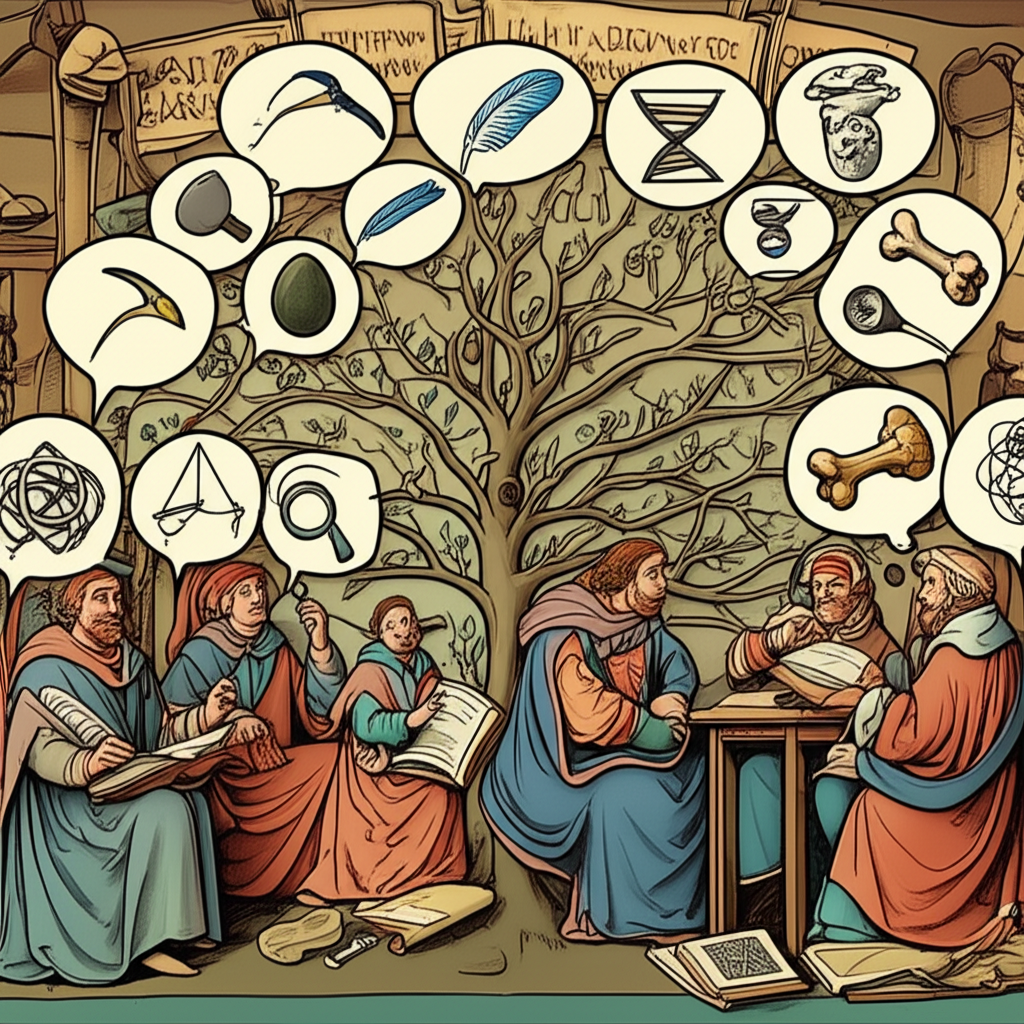
IV. Philosophical Reflections on Evolutionary Hypotheses
The role of hypothesis in evolutionary science also invites profound philosophical reflection on the nature of knowledge, truth, and the scientific enterprise itself.
- The Nature of Scientific Truth: Hypotheses are not absolute truths but rather the most plausible explanations based on current evidence. They are stepping stones in an ongoing quest, always subject to revision or rejection in light of new data. This provisional nature underscores the humility inherent in true scientific inquiry.
- The Problem of Induction and Falsifiability: Philosophers of science, notably Karl Popper, emphasized the importance of falsifiability. While we can never definitively "prove" a universal hypothesis (the problem of induction), we can gain confidence in it by failing to falsify it despite rigorous attempts. Evolutionary hypotheses, therefore, are strengthened not just by confirming observations but by surviving attempts to disprove them.
- The Role of Imagination and Reason: The formulation of a good hypothesis requires both keen observation and creative imagination. It is the ability to connect disparate observations into a coherent, testable narrative – a blend of empirical rigor and intellectual daring that echoes the philosophical pursuit of understanding that has characterized human thought since antiquity.
V. The Dynamic Landscape: Hypotheses as Catalysts for New Discoveries
The ongoing vitality of evolutionary science is inextricably linked to the continuous generation and testing of new hypotheses. They are not merely tools for confirming existing knowledge but powerful catalysts for uncovering entirely new phenomena and mechanisms.
Every new fossil discovery, every advance in genetic sequencing, and every nuanced observation in ecology sparks new questions, leading to new hypotheses that push the frontiers of our understanding. From the hypothesis of punctuated equilibrium to the role of epigenetics in inheritance, the field of evolution remains vibrant precisely because of this ceaseless cycle of questioning, hypothesizing, and testing.
Conclusion: The Enduring Quest
In the grand narrative of life's unfolding, the hypothesis stands as the indispensable compass guiding evolutionary science. It is the intellectual bridge between the observable world and our conceptual understanding, transforming raw data into meaningful insights. As "Grace Ellis" might reflect, "To hypothesize is to actively engage with the mystery of existence, daring to propose a solution and then diligently seeking its verification. It is through this iterative dance of idea and evidence that our comprehension of evolution deepens, revealing the profound elegance and complexity of life itself." The journey of discovery in science is perpetual, and the role of hypothesis remains paramount in this enduring quest for knowledge.
YouTube Video Suggestions:
-
📹 Related Video: SOCRATES ON: The Unexamined Life
Video by: The School of Life
💡 Want different videos? Search YouTube for: ""philosophy of science scientific method hypothesis falsifiability""
2. ## 📹 Related Video: ARISTOTLE ON: The Nicomachean Ethics
Video by: The School of Life
💡 Want different videos? Search YouTube for: ""history of evolutionary thought Darwin's hypothesis""