

In the grand tapestry of human thought, from the early musings captured in the Great Books of the Western World to the cutting-edge laboratories of today, the hypothesis emerges as a fundamental tool for understanding reality. Especially within medical science, this initial, testable proposition is not merely a guess; it is the thoughtful articulation of a potential truth, a crucial stepping stone in the relentless quest to comprehend and conquer disease. This article explores the indispensable role of the hypothesis in driving progress in medicine, bridging the gap between philosophical inquiry and empirical discovery.
The Genesis of Inquiry: Hypotheses in Medical Science
The hypothesis stands as the bedrock of medical science, transforming mere observation into structured inquiry. Rooted in ancient philosophical traditions of reasoning and empiricism, it is the initial, testable proposition that drives discovery, allowing us to move from 'what if' to 'what is' in understanding and treating human ailments. Without it, medical progress would be a series of disconnected observations rather than a cumulative, systematic pursuit of knowledge.
Philosophical Roots: From Ancient Wisdom to Modern Medicine
The intellectual lineage of the hypothesis stretches back to the very dawn of philosophy. Thinkers like Aristotle, whose works are cornerstones of the Great Books, meticulously observed the natural world, categorizing phenomena and inferring principles. While not always framed as 'hypotheses' in the modern sense, his method of moving from specific observations to general conclusions, or what we now call inductive reasoning, laid critical groundwork for scientific thought. Similarly, the Socratic method, emphasizing questioning and the testing of ideas, embodies an early form of challenging assumptions and proposing alternative explanations – a philosophical precursor to the scientific hypothesis.
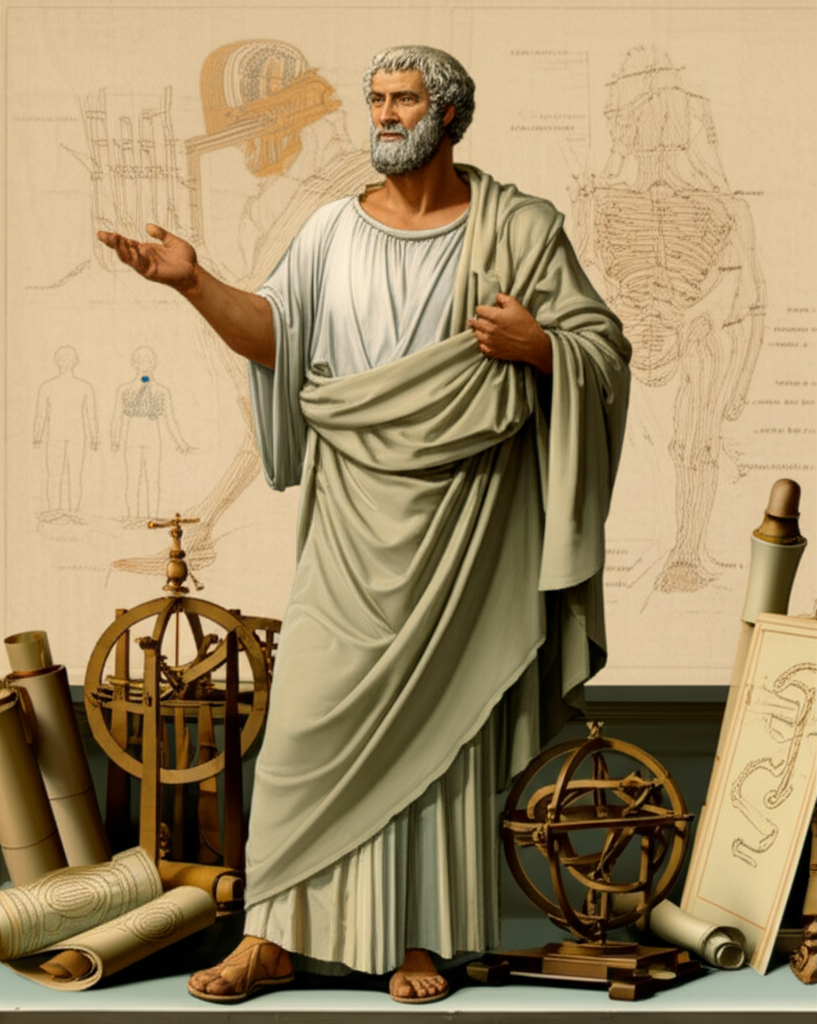 . He is gesturing towards a blackboard where a complex, modern-day biological pathway or chemical structure is subtly superimposed, symbolizing the enduring philosophical roots of scientific inquiry and the seamless flow from ancient thought to contemporary medical science.)
The Scientific Method's Engine: Driving Medical Science Forward
At its core, the scientific method, which underpins all medical science, is powered by the hypothesis. It functions as the engine, converting raw data and clinical observations into actionable research questions. A well-formulated hypothesis possesses several key characteristics that make it a potent tool for discovery:
- Testability: It must be possible to prove or disprove it through experimentation or further observation. This is paramount; an untestable hypothesis remains mere speculation.
- Falsifiability: There must be a conceivable outcome of an experiment that would demonstrate the hypothesis to be false. As Karl Popper argued, the ability to be proven wrong is a hallmark of true scientific inquiry.
- Precision: It should be clear and unambiguous, specifying the relationship between variables. Vague hypotheses lead to vague research.
- Relevance: It should address a significant problem or gap in current knowledge within medicine, promising new insights or solutions.
The Indispensable Role of Hypotheses in Clinical Practice and Research
Consider the history of medicine. From William Harvey's hypothesis about blood circulation in the 17th century (a revolutionary idea for its time, challenging ancient Galenic views) to Louis Pasteur's germ theory of disease, progress has invariably stemmed from bold, testable propositions. Each new drug, surgical technique, or diagnostic tool begins with a hypothesis: 'This compound will inhibit bacterial growth in vivo,' or 'This specific surgical intervention will improve patient outcomes for this condition.' These aren't random thoughts; they are informed conjectures, born from existing knowledge, meticulous clinical observation, and a profound understanding of biological mechanisms. The role of the hypothesis here is not just to suggest; it is to direct the entire scientific enterprise.
The Iterative Nature of Discovery: Refining Hypotheses
Science, and particularly medical science, is rarely a straight path. A hypothesis is proposed, experiments are designed, data is collected, and then the hypothesis is either supported or refuted. Crucially, even a refuted hypothesis contributes to knowledge by narrowing down possibilities and preventing dead ends. This iterative process of refinement, where failed hypotheses lead to new, more informed ones, is central to scientific progress. It echoes a philosophical commitment to truth-seeking, where ideas are constantly subjected to scrutiny and revision, much like the dialectical process championed by Plato in the Great Books. Each iteration brings us closer to a more accurate understanding of the complex biological systems we seek to influence.
Challenges and Ethical Considerations in Hypothesis Formulation
While indispensable, the formulation and testing of hypotheses in medicine are not without challenges. Bias, both conscious and unconscious, can influence how hypotheses are formed, how experiments are designed, and even how results are interpreted. Ethical considerations are paramount, especially when human subjects are involved. The pursuit of knowledge, as explored by philosophers from Kant to Mill, must always be tempered by a profound respect for human dignity and well-being. Therefore, the role of the hypothesis demands not only intellectual rigor but also ethical vigilance and a steadfast commitment to objective truth, free from prejudice and self-interest.
Conclusion: The Enduring Significance of the Hypothesis
From the philosophical inquiries of antiquity to the complex clinical trials of the 21st century, the hypothesis remains the beating heart of medical science. It is the intellectual leap that transforms curiosity into systematic investigation, guiding our understanding of health and disease. As we continue to push the boundaries of knowledge, the careful articulation and rigorous testing of hypotheses will undoubtedly remain the most vital role in unlocking the mysteries of life itself, ensuring that progress in medicine is not accidental but purposeful and profound.
**## 📹 Related Video: What is Philosophy?
Video by: The School of Life
💡 Want different videos? Search YouTube for: "'Philosophy of Science Karl Popper Falsifiability'"**
**## 📹 Related Video: PLATO ON: The Allegory of the Cave
Video by: The School of Life
💡 Want different videos? Search YouTube for: "'Great Books of the Western World Scientific Revolution'"**