

Celestial Conjectures: The Indispensable Role of Hypotheses in Astronomical Discovery
The universe, in its vast and silent grandeur, has beckoned human inquiry since time immemorial. From ancient stargazers charting the heavens to modern astrophysicists probing the edges of space-time, the quest to understand our cosmic address has been a defining characteristic of human reasoning. At the heart of this enduring pursuit lies the hypothesis—a provisional explanation that serves as the bedrock upon which the edifice of astronomy is built. This article will explore how these informed conjectures drive scientific progress, transforming observation into understanding and speculation into verifiable knowledge, echoing the intellectual journey documented in the Great Books of the Western World.
The Genesis of Inquiry: From Observation to Hypothesis
At its most fundamental level, astronomy begins with observation. Early humans noticed patterns in the night sky: the predictable cycles of the moon, the changing constellations, the wandering paths of planets. These observations naturally led to questions: Why do the stars move as they do? What are these celestial bodies? How do they relate to us?
It is in answering these questions, even provisionally, that the hypothesis emerges. A hypothesis is not merely a guess; it is an educated proposition, a testable explanation for an observed phenomenon. For instance, the ancient Greek philosophers, whose works are foundational to the Great Books, hypothesized various cosmological models—from the geocentric universe of Aristotle and Ptolemy, where Earth lay at the center, to early heliocentric ideas. These were not simply musings but structured attempts to explain the observed motions of celestial bodies, providing frameworks for further thought and debate.
Hypothesis as the Engine of Science and Reasoning
The power of a hypothesis lies in its testability. In the realm of science, a good hypothesis must be falsifiable—meaning there must be a way, at least in principle, to prove it wrong. This critical distinction elevates a hypothesis above mere speculation, guiding empirical investigation and experimental design.
Consider the Copernican hypothesis that the Earth revolves around the Sun. This radical idea challenged centuries of established geocentric reasoning. While initially lacking direct observational proof, it offered a simpler, more elegant explanation for planetary motions, leading to testable predictions. Subsequent astronomers like Tycho Brahe made precise observations, and Johannes Kepler, using Brahe's data, formulated his laws of planetary motion, which were, in essence, highly refined hypotheses about the elliptical paths of planets.
The scientific method, therefore, is a continuous loop of:
- Observation: Noticing a phenomenon.
- Question: Posing an inquiry about the phenomenon.
- Hypothesis: Formulating a testable explanation.
- Prediction: Deducing expected outcomes if the hypothesis is true.
- Experiment/Further Observation: Testing the predictions.
- Analysis: Evaluating results and refining or rejecting the hypothesis.
This iterative process, deeply rooted in philosophical reasoning, is how astronomy has progressed from rudimentary sky-gazing to sophisticated astrophysical models.
Landmark Astronomical Hypotheses Throughout History
The history of astronomy is replete with pivotal hypotheses that reshaped our understanding of the cosmos:
| Era | Key Hypothesis | Impact on Astronomy |
|---|---|---|
| Ancient Greece | Geocentric Model (e.g., Ptolemy) | Provided a comprehensive, albeit incorrect, framework for predicting planetary positions for over 1400 years. |
| Renaissance | Heliocentric Model (Copernicus) | Revolutionized cosmology, shifting Earth from the center and paving the way for modern astronomy. |
| 17th Century | Elliptical Orbits (Kepler) | Corrected the circular orbit hypothesis, accurately describing planetary motion based on empirical data. |
| 17th Century | Universal Gravitation (Newton) | Unified celestial and terrestrial mechanics, explaining why planets orbit and how objects fall on Earth. |
| Early 20th Century | Expanding Universe (Lemaître, Hubble) | Proposed the universe is not static but expanding, leading to the Big Bang hypothesis. |
| Mid-20th Century | Stellar Nucleosynthesis (Hoyt, Burbidge, Fowler, et al.) | Explained how elements heavier than hydrogen and helium are formed within stars, a cornerstone of astrophysics. |
| Late 20th Century | Dark Matter/Dark Energy | Postulated to explain observed gravitational effects and the accelerating expansion of the universe. |
These examples underscore that a hypothesis is not merely a statement of belief but a critical tool for scientific advancement. Even when proven incorrect, like the geocentric model, it serves as an essential stepping stone, guiding subsequent generations toward more accurate understandings.
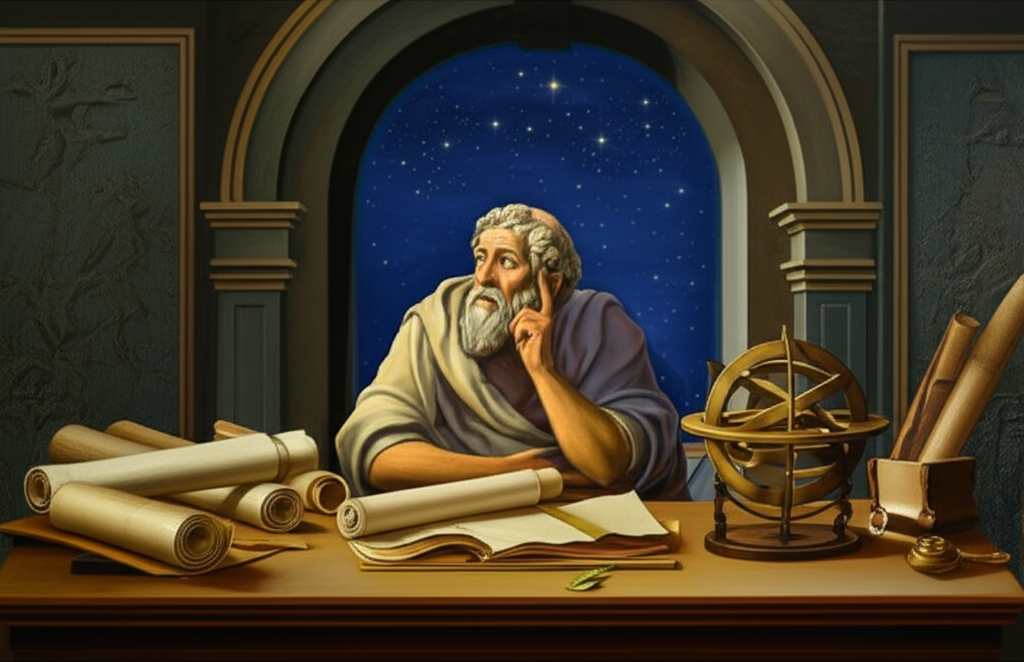
The Philosophical Underpinnings of Hypothesis Formation
The formulation of a hypothesis is a profound act of philosophical reasoning. It involves both inductive and deductive thinking. Inductive reasoning allows astronomers to generalize from specific observations (e.g., "planets appear to move in loops") to a broader principle ("planetary orbits are elliptical"). Deductive reasoning then applies this general principle to make specific predictions that can be tested (e.g., "if orbits are elliptical, then a planet at this specific point in its orbit should appear here in the sky").
This interplay between observation, hypothesis, and testing is a testament to the human intellect's capacity to build complex knowledge systems about the natural world. The Great Books of the Western World frequently explore these very questions of how we come to know what we know, and astronomy provides a tangible, ever-evolving example of this epistemological journey. The universe, in its challenging complexity, demands that we constantly question, hypothesize, and refine our understanding, pushing the boundaries of science and human reasoning.
Conclusion
The hypothesis stands as an indispensable tool in astronomy, transforming raw data into meaningful insights and driving the relentless march of scientific discovery. It is through the courageous act of proposing testable explanations that humanity has moved from simply observing the cosmos to truly understanding its intricate mechanisms. From the ancient philosophers who first dared to hypothesize about the structure of the universe to the modern scientists grappling with the mysteries of dark energy and exoplanets, the hypothesis remains the guiding light for our exploration of the celestial sphere, a testament to the enduring power of human reasoning in the pursuit of knowledge.
📹 Related Video: What is Philosophy?
Video by: The School of Life
💡 Want different videos? Search YouTube for: ""Philosophy of Science Hypothesis Testing Astronomy""
📹 Related Video: ARISTOTLE ON: The Nicomachean Ethics
Video by: The School of Life
💡 Want different videos? Search YouTube for: ""Great Books Western World Cosmology""