

The Celestial Blueprint: Unpacking the Role of Hypotheses in Astronomy
The cosmos, in its awe-inspiring vastness, has always been a profound canvas for human inquiry. From ancient star-gazers to modern astrophysicists, our understanding of the universe has been meticulously constructed, not merely through observation, but through the vital process of forming and testing hypotheses. This article delves into how hypotheses serve as the indispensable scaffolding for astronomy, driving its evolution as a rigorous science and embodying the pinnacle of human reasoning. We'll explore how these educated guesses, born from curiosity and observation, transform into foundational theories, guiding our quest to decipher the celestial blueprint.
The Genesis of Cosmic Understanding: Hypothesis as the First Step
For millennia, humanity has looked to the stars, seeking patterns, meaning, and explanation. What began as myth and speculation gradually coalesced into systematic inquiry, largely thanks to the embrace of the hypothesis. A hypothesis is more than a mere guess; it is a proposed explanation for a phenomenon, a testable proposition that can be supported or refuted by evidence. In astronomy, where direct experimentation is often impossible, hypotheses become critical tools for making sense of distant, unmanipulable objects.
Our journey through the Great Books of the Western World reveals a continuous thread of individuals grappling with cosmic mysteries through hypothetical constructs. From the geometric models of Plato and Aristotle attempting to explain planetary motions to the intricate epicycles of Ptolemy, these were early, sophisticated hypotheses designed to predict and account for observed celestial phenomena.
From Geocentric to Heliocentric: A Shift in Paradigms
Perhaps the most dramatic illustration of the power of hypothesis in astronomy is the shift from the geocentric to the heliocentric model. For over 1,400 years, Ptolemy's geocentric hypothesis, detailed in his Almagest, provided a framework that, while complex, largely explained planetary movements from an Earth-centered perspective. This was a monumental intellectual achievement, a testament to the power of reasoning even within a flawed framework.
However, as observational tools improved and discrepancies mounted, new hypotheses emerged. Nicolaus Copernicus, deeply rooted in the philosophical tradition of seeking simpler, more elegant explanations, proposed his heliocentric hypothesis. This daring idea, placing the Sun at the center of the solar system, initially lacked definitive observational proof but offered a more harmonious and mathematically simpler model. It was a philosophical hypothesis as much as a scientific one, challenging millennia of entrenched thought.
- Key Hypotheses in Astronomical History:
- Ptolemy's Geocentric Hypothesis: Earth at the center, planets moving in epicycles on deferents.
- Copernicus's Heliocentric Hypothesis: Sun at the center, planets (including Earth) orbiting it.
- Kepler's Laws of Planetary Motion: Based on Tycho Brahe's meticulous observations, Kepler formulated three hypotheses (later laws) describing elliptical orbits and varying orbital speeds.
- Newton's Law of Universal Gravitation: A grand hypothesis explaining not just celestial mechanics but all gravitational interactions, unifying terrestrial and celestial physics.
- Hubble's Expanding Universe Hypothesis: Based on redshift observations, the hypothesis that the universe is expanding, leading to the Big Bang theory.
Hypothesis as the Engine of Scientific Inquiry
The science of astronomy thrives on this iterative process: observation leads to hypothesis, which guides further observation, which refines or refutes the hypothesis. This is the very essence of the scientific method. Without the initial intellectual leap of proposing a hypothesis, observations would remain disparate facts, lacking coherence or explanatory power.
- The Indispensable Role of Reasoning
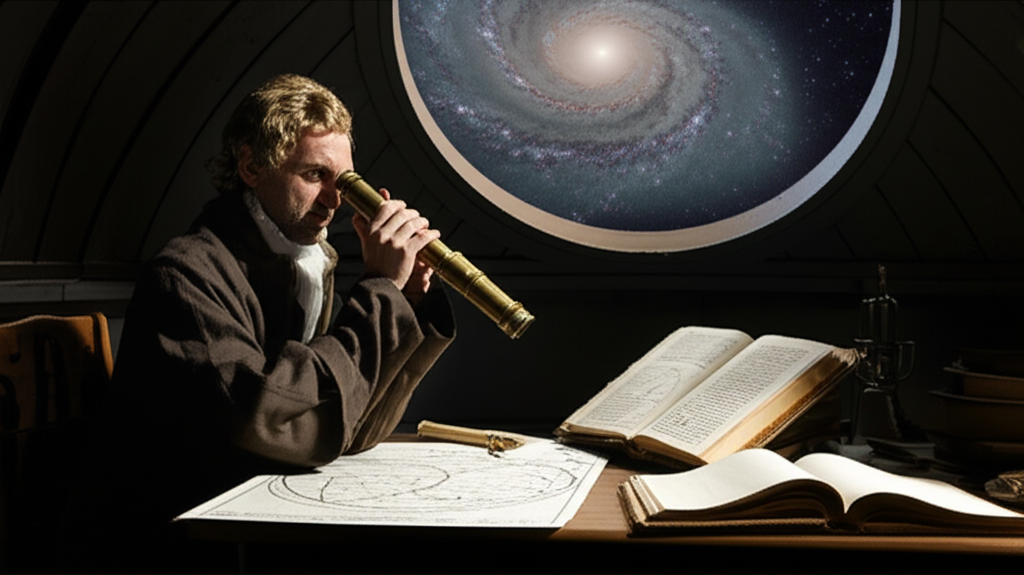
Every hypothesis is a product of sophisticated reasoning. It involves inductive leaps from specific observations to general principles, and deductive predictions that can be tested. When Galileo turned his telescope to the heavens, his observations of Jupiter's moons orbiting Jupiter, and not Earth, provided crucial evidence supporting the Copernican hypothesis and refuting the Ptolemaic one. This wasn't just seeing; it was seeing through the lens of a pre-existing hypothesis, understanding the implications of what was observed. The ability to formulate such testable propositions is what distinguishes science from mere conjecture.
The Interplay of Observation and Hypothesis in Astronomy
In astronomy, the relationship between observation and hypothesis is particularly symbiotic. Unlike laboratory sciences where experiments can be designed to isolate variables, astronomers often rely on passive observation of phenomena that are vast, ancient, and distant. Therefore, a well-formed hypothesis acts as a crucial filter and guide:
- Directs Observation: A hypothesis can suggest where to look, what to measure, and what anomalies to seek. For example, the hypothesis of dark matter led astronomers to look for its gravitational effects on galaxies, even though it cannot be directly seen.
- Interprets Data: Raw data is meaningless without a framework. A hypothesis provides the interpretive lens through which observations gain significance. The redshift of distant galaxies, for instance, became evidence for an expanding universe only after the hypothesis of cosmic expansion was formulated.
- Predicts New Phenomena: The ultimate test of a robust hypothesis is its predictive power. Einstein's theory of general relativity (a grand hypothesis initially) predicted phenomena like gravitational lensing and black holes, which were later confirmed by observation, solidifying its status.
The Philosophical Weight of Astronomical Hypotheses
Beyond their practical utility, astronomical hypotheses carry significant philosophical weight. They represent humanity's persistent drive to understand its place in the cosmos, to impose order on apparent chaos, and to push the boundaries of knowledge. The very act of formulating a hypothesis about the universe—whether it's about the existence of exoplanets, the nature of dark energy, or the origins of the Big Bang—is an assertion of our capacity for reasoning and our belief in a comprehensible reality.
The Great Books tradition, with its emphasis on fundamental questions about existence, knowledge, and reality, finds a powerful echo in the scientific pursuit of astronomy. Each hypothesis about the universe is a philosophical statement, reflecting our deepest assumptions about causality, predictability, and the very structure of being.
Conclusion: The Enduring Legacy of Hypothesis in Astronomy
From the intricate celestial spheres of ancient thought to the complex models of modern cosmology, hypotheses have been the beating heart of astronomy. They are not just tools for scientific progress; they are manifestations of human curiosity, ingenuity, and the relentless pursuit of truth. The science of astronomy, driven by the power of reasoning and the courage to propose and test new hypotheses, continues to expand our understanding of the universe, reminding us that the greatest discoveries often begin with a bold, testable idea.
📹 Related Video: KANT ON: What is Enlightenment?
Video by: The School of Life
💡 Want different videos? Search YouTube for: ""History of Astronomy from Ancient Greece to Copernicus""
📹 Related Video: SOCRATES ON: The Unexamined Life
Video by: The School of Life
💡 Want different videos? Search YouTube for: ""Karl Popper Falsifiability and Scientific Method Explained""