

The Role of God in the Moral Universe
The question of God's role in the moral universe is one of philosophy's most enduring and profound inquiries, stretching back to antiquity and continuing to shape contemporary thought. At its heart, this debate asks: Is morality dependent on God, or can it exist independently? From ancient Greek philosophers pondering the ultimate Good, to Abrahamic theologians grounding ethics in divine command and natural law, to Enlightenment thinkers seeking a rational basis for Good and Evil without direct divine intervention, the relationship between God, Theology, Religion, and our understanding of right and wrong has been continually re-evaluated. This pillar page explores the major philosophical traditions and arguments concerning the source, nature, and authority of morality in relation to the divine.
Foundations: Defining the Moral Landscape
Before we delve into the intricate relationship between God and morality, it's crucial to establish a common understanding of our core terms. What do we mean when we speak of "God" in this context, and what constitutes the "moral universe"?
Understanding "God" in Philosophical Discourse
When philosophers discuss "God" in the context of morality, they aren't always referring solely to the specific deities of organized Religion. While Abrahamic conceptions (Judaism, Christianity, Islam) of an omnipotent, omniscient, and supremely good creator God are central to many arguments, the concept can also encompass:
- The Prime Mover/First Cause: As envisioned by Aristotle, a non-personal, ultimate source of motion and existence.
- The Platonic Form of the Good: An ultimate, transcendent reality that is the source of all goodness and intelligibility.
- Deistic God: A creator who sets the universe in motion but does not intervene in its affairs or issue commands.
- Theistic God: A personal, active, and intervening God who is the source of moral law.
Our exploration will primarily focus on theistic conceptions, as they most directly engage with the idea of a God who actively dictates or embodies Good and Evil.
Navigating the "Moral Universe"
The "moral universe" refers to the entire domain of ethical principles, values, duties, and virtues that guide human conduct and judgments of Good and Evil. Key aspects include:
- Moral Objectivity vs. Subjectivity: Is morality a set of universal truths independent of human opinion (objective), or is it culturally relative or purely personal (subjective)?
- Moral Epistemology: How do we come to know what is right or wrong? Through divine revelation, reason, intuition, or experience?
- Moral Motivation: Why should we be moral? Fear of divine punishment, hope of reward, duty, compassion, self-interest?
The role of God often intersects with these questions, providing potential answers to the origin, authority, and enforcement of moral norms.
Ancient Echoes: Morality and the Transcendent
Long before the emergence of monotheistic Religion, ancient Greek philosophers wrestled with the nature of Good and Evil, often positing transcendent principles that hinted at a divine order.
Plato and the Form of the Good
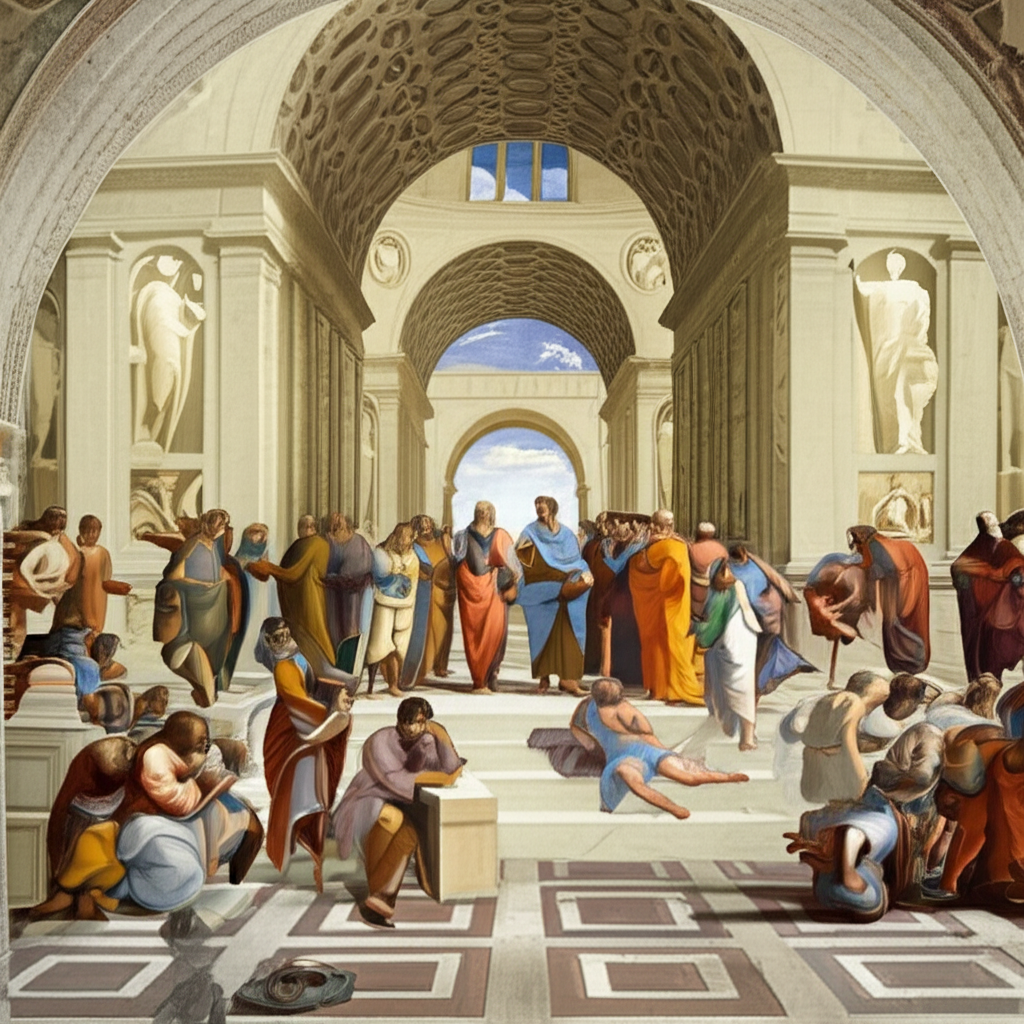
In his seminal work, The Republic, Plato introduces the Form of the Good as the ultimate reality, the source of all knowledge, truth, and existence. Just as the sun illuminates the physical world, enabling sight, the Form of the Good illuminates the intelligible world, enabling understanding of ethical principles. For Plato, to live a moral life is to align oneself with this ultimate Good. While not a personal God, the Form of the Good functions as a supreme, objective moral standard, suggesting a universe ordered by an ultimate, perfect principle.
Aristotle and Eudaimonia
Aristotle, in his Nicomachean Ethics, presents a virtue-based ethical system centered on Eudaimonia, often translated as "flourishing" or "living well." For Aristotle, every living thing has a telos (purpose or end). The telos of human beings is to live rationally, exercising virtues like courage, temperance, and justice. While Aristotle's God is a "Prime Mover," a purely actualized being that is the ultimate cause of motion in the universe and the object of all desire, this God does not issue commands or directly dictate human morality. Instead, morality is discovered through rational inquiry into human nature and its highest good, reflecting an inherent order in the cosmos.
Divine Command and Natural Law: The Abrahamic Perspective
With the rise of Abrahamic Religion, the role of God in morality became far more direct and explicit. Here, Theology provides the primary framework for understanding Good and Evil.
Divine Command Theory
Divine Command Theory (DCT) posits that an action is morally right if and only if God commands it, and morally wrong if God forbids it. In this view, God's will is the ultimate foundation of morality.
-
Proponents: Figures like Augustine of Hippo (in City of God) and early interpretations of Thomas Aquinas (though his views evolved) often emphasized God's absolute sovereignty as the source of moral law. The Ten Commandments are a classic example of divine commands forming the bedrock of a moral code.
-
Strengths:
- Provides an objective, universal moral standard, independent of human opinion.
- Offers a strong motivation for moral behavior (divine reward/punishment).
- Explains the apparent authority and universality of certain moral principles.
-
Challenges: The Euthyphro Dilemma
The most famous challenge to DCT comes from Plato's dialogue, Euthyphro, long before Abrahamic Religion took hold. Socrates asks Euthyphro: "Is the pious loved by the gods because it is pious, or is it pious because it is loved by the gods?"- Option 1: "It is good because God commands it." This implies God's commands could be arbitrary. If God commanded cruelty, would cruelty then be good? This seems to make morality capricious and undermines God's inherent goodness.
- Option 2: "God commands it because it is good." This implies there is a standard of goodness independent of God, which God recognizes and commands. This would mean God is not the ultimate source of morality, but rather a promulgator of pre-existing moral truths.
Natural Law Theory
Developed most comprehensively by Thomas Aquinas in his Summa Theologica, Natural Law Theory offers a more nuanced understanding of God's role. Aquinas argued that God imbues the universe with a rational order, and human beings, by virtue of their reason, can discern the moral principles inherent in this order.
- Key Principles:
- God's Eternal Law: The divine reason governing the universe.
- Natural Law: The part of the Eternal Law accessible to human reason. It directs us towards our natural ends (e.g., preserving life, procreation, seeking knowledge, living in society).
- Human Law: Laws created by human societies, which should ideally align with Natural Law.
- Divine Law: Revealed law (e.g., Ten Commandments) that guides us to our supernatural end (salvation).
- Relationship to God: God is the ultimate author of Natural Law, but humans discover it through rational reflection on nature, not solely through explicit divine commands. This allows for a robust, objective morality discoverable by all rational beings, regardless of specific religious belief, while still being grounded in Theology.
- Strengths:
- Provides a basis for universal human rights and duties.
- Connects morality to human nature and teleology.
- Allows for moral reasoning independent of direct revelation, yet still rooted in a divine order.
The Enlightenment and the Secular Challenge to Divine Morality
The Enlightenment marked a significant shift, as philosophers began to explore the possibility of grounding morality in human reason rather than divine authority. The role of God in the moral universe became a subject of intense scrutiny, leading to both reinterpretations and outright rejections.
Immanuel Kant: Morality from Reason
Immanuel Kant, a towering figure of the Enlightenment, famously argued that morality must be grounded in pure practical reason, independent of desires, consequences, or external authority, including God's. In works like the Critique of Practical Reason, he introduced the Categorical Imperative as the supreme principle of morality: Act only according to that maxim whereby you can at the same time will that it should become a universal law.
- Autonomy: For Kant, true morality arises from the autonomous will of rational agents, who legislate moral law for themselves. To act morally is to act out of duty, respecting the inherent dignity of all rational beings.
- God as a Postulate: While God is not the source of moral law for Kant, he posited God (along with freedom and immortality) as a necessary postulate of practical reason. For morality to make sense, given that virtue doesn't always lead to happiness in this life, there must be a God to ensure ultimate justice and a harmonious union of virtue and happiness in an afterlife. However, this God is not commanding morality, but rather guaranteeing its ultimate coherence and purpose.
Friedrich Nietzsche: The Death of God and the Revaluation of Values
In stark contrast to Kant, Friedrich Nietzsche declared "God is dead" in Thus Spoke Zarathustra, arguing that the decline of traditional Religion had removed the metaphysical foundations for objective morality. This wasn't a lament but an observation of a cultural shift.
- Nihilism and the Will to Power: Nietzsche believed that without God, the traditional values of Good and Evil (which he saw as "slave morality," promoting weakness and conformity) would collapse into nihilism. He challenged humanity to undertake a "revaluation of all values," creating new, life-affirming moral codes based on the will to power – the drive to overcome, to grow, to create.
- Beyond Good and Evil: For Nietzsche, morality is not discovered but created. The "superman" (Übermensch) would be the one who transcends conventional morality to forge his own values, embodying strength, creativity, and self-overcoming. This radical perspective completely divorces morality from any divine origin, placing the burden of value creation squarely on humanity.
Key Debates and Persistent Questions
The historical journey reveals a complex tapestry of ideas, but certain debates persist, challenging our understanding of Theology, Religion, Good and Evil, and the very nature of the moral universe.
The Problem of Evil
Perhaps the most potent challenge to the idea of a good God presiding over a moral universe is the Problem of Evil. If God is omnipotent (all-powerful), omniscient (all-knowing), and omnibenevolent (all-good), why does evil exist?
- Logical Problem: The existence of evil is logically incompatible with the existence of such a God.
- Evidential Problem: The sheer amount and gratuitous nature of evil in the world makes God's existence improbable.
The existence of suffering, injustice, and moral depravity forces us to question either God's attributes or His direct involvement in dictating Good and Evil in a way that is easily reconcilable with His nature. Various philosophical and theological responses (e.g., free will defense, soul-making theodicy) attempt to address this, but the problem remains a powerful counter-argument to a divinely ordained moral order.
Can Morality Exist Without God?
This question, central to modern ethical discourse, pits secular humanism against religious ethics.
| Argument for Morality Without God | Argument for Morality Requiring God |
|---|---|
| Human Reason: We can discern right and wrong through logic, empathy, and understanding consequences. | Objective Grounding: God provides an ultimate, objective standard for morality, preventing relativism. |
| Evolutionary Ethics: Moral behaviors (altruism, cooperation) can be explained by natural selection. | Ultimate Authority: God's commands provide an unquestionable authority for moral rules. |
| Empathy and Compassion: Innate human capacity for empathy drives moral concern for others. | Meaning and Purpose: God provides cosmic meaning and purpose for moral striving. |
| Flourishing/Well-being: Morality promotes individual and societal well-being, discoverable through experience. | Justice and Accountability: God ensures ultimate justice and accountability for moral actions, even when human systems fail. |
| Autonomy: Morality is more authentic when freely chosen by autonomous agents, not externally imposed. | Solution to Euthyphro: Some argue God's goodness is His nature, avoiding the dilemma. |
Contemporary Reflections: The Enduring Dialogue
In our increasingly pluralistic and secularized world, the question of God's role in the moral universe remains as relevant as ever. While many individuals find their moral compass firmly rooted in Religion and Theology, an equally significant number construct their ethical frameworks on secular grounds.
The dialogue between these perspectives enriches our understanding of Good and Evil. It forces us to examine the sources of our values, the justifications for our ethical principles, and the ultimate purpose of moral striving. Whether through divine revelation, rational inquiry, or the collective wisdom of human experience, the quest for a meaningful and just moral universe continues to be a defining characteristic of the human condition.
This ongoing conversation highlights the profound impact that different conceptions of God — or the absence thereof — have on how we perceive our responsibilities, our relationships, and our place in the cosmos.
YouTube Video Suggestions:
-
📹 Related Video: KANT ON: What is Enlightenment?
Video by: The School of Life
💡 Want different videos? Search YouTube for: "Euthyphro Dilemma explained"
-
📹 Related Video: ARISTOTLE ON: The Nicomachean Ethics
Video by: The School of Life
💡 Want different videos? Search YouTube for: "Kantian Ethics vs Divine Command Theory"