

The Unseen Hand: Deconstructing Fate's Grips on History
Summary: The question of fate in history is a perennial philosophical puzzle, challenging our understanding of human agency, the flow of events, and the very nature of time. This article delves into the intricate relationship between predetermined destiny and the unfolding tapestry of human choices, examining how concepts of necessity and contingency have shaped our interpretation of the past. From ancient prophecies to modern historical analysis, we explore whether history is an inevitable march towards a fixed end, or a dynamic, unpredictable arena of constant change, ultimately arguing for a nuanced interplay between structured forces and the profound impact of individual and collective will.
The Enduring Enigma of Fate
For millennia, humanity has grappled with the notion that events, particularly those of great magnitude, are not merely random occurrences but are somehow predetermined, guided by an invisible force or an ultimate design. This concept, often termed fate, has permeated myth, religion, and philosophy, offering both comfort in its promise of order and despair in its implication of limited freedom. In the grand narrative of history, the idea of fate suggests that certain outcomes were always destined to be, regardless of human endeavor or intervention. But how does this stand against the observable reality of human choices, unforeseen accidents, and the relentless march of change?
Ancient Echoes: Fate as Inexorable Destiny
In the classical world, particularly among the Greeks, fate was often depicted as an inescapable power, sometimes personified by the Moirai (Fates), who spun, measured, and cut the thread of life. Even the gods themselves were sometimes subject to its decrees. Thinkers like Heraclitus hinted at a cosmic necessity, an underlying logos that governed all things, including the trajectory of civilizations. History, in this view, was less a series of choices and more the unfolding of a pre-written script. The tragic heroes of Greek drama, for instance, often found themselves caught in a web of destiny, their struggles against it only serving to fulfill it. This perspective offered a framework for understanding suffering and grand societal shifts, attributing them to forces beyond mortal control.
Key Characteristics of Ancient Fate:
- Divine or Cosmic Origin: Often linked to gods, prophecies, or universal laws.
- Inescapable: Human actions, while seemingly free, ultimately contribute to the fated outcome.
- Often Tragic: Frequently associated with unavoidable downfall or suffering.
- Offers Explanations: Provides a framework for understanding complex events and moral dilemmas.
Theological and Philosophical Determinism: God's Plan or Nature's Law?
With the rise of monotheistic religions, the concept of fate often transformed into divine providence or predestination. For figures like Augustine, writing within the tradition of the Great Books, God's foreknowledge and omnipotence implied a predetermined path for humanity and history. While human free will was affirmed, it operated within the boundaries of a divine plan, making the ultimate outcome of history a matter of necessity.
Later philosophical systems, even secular ones, also grappled with determinism. Baruch Spinoza, for example, argued that everything in the universe, including human actions, follows from the necessity of God's (or Nature's) eternal and infinite attributes. There is no contingency in the Spinozistic universe; everything is as it must be. For such thinkers, the apparent randomness of history is merely a reflection of our incomplete understanding of the underlying causes and effects. Every war, every revolution, every moment of progress or regression is a link in an unbroken chain of necessity.
The Rise of Contingency: Human Agency and the Unforeseen
The Enlightenment and subsequent philosophical movements began to push back against strict determinism, emphasizing human reason, autonomy, and the power of individual and collective action to shape history. Thinkers like Immanuel Kant highlighted the moral imperative of freedom, suggesting that if fate truly dictated all, moral responsibility would be meaningless.
Modern historical analysis, too, often leans heavily on contingency – the idea that events could have unfolded differently. The assassination of an archduke, a missed diplomatic opportunity, a sudden invention, or a charismatic leader emerging at a critical juncture can all be seen as contingent events that profoundly alter the course of history. This perspective celebrates the dynamism of change and acknowledges the unpredictable nature of human affairs. It suggests that history is not a river flowing in a fixed channel but a vast, interconnected network where countless choices, big and small, continually redirect the current.
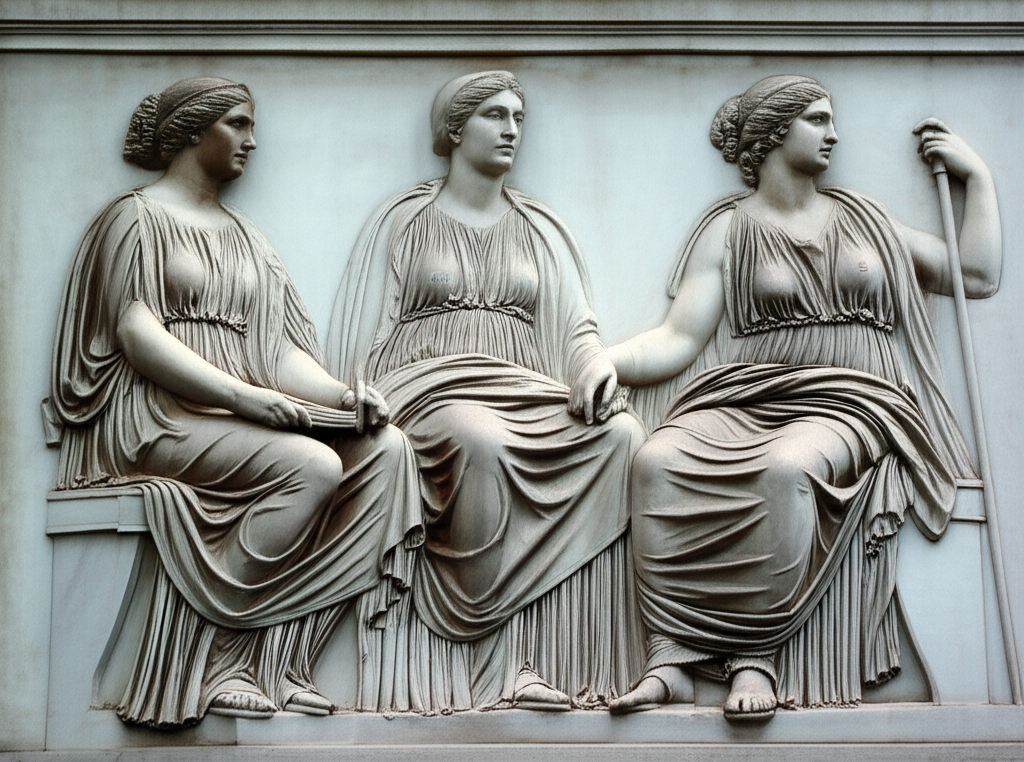 at their loom, weaving the threads of human life. One figure holds a spindle, another measures the thread, and the third stands ready with shears, all with solemn, impassive expressions, suggesting the inexorable nature of destiny over a backdrop of a tumultuous historical battle scene with struggling figures and falling banners, subtly implying the grand sweep of events being subject to their cosmic work.)
The Dialectic of Necessity and Contingency in History
Perhaps the most fruitful approach to understanding fate in history is to view it not as an either/or proposition, but as a complex interplay of necessity and contingency. Certain structural forces – geography, climate, demographic trends, technological capabilities, economic systems – can exert a powerful, almost necessary, influence on the general direction of societies. For instance, a civilization's access to navigable rivers or fertile land can create conditions that make certain developments (e.g., trade, agriculture) highly probable, if not inevitable. These are the broad currents of history.
However, within these broad currents, contingency reigns supreme. The specific timing of a technological breakthrough, the success or failure of a particular political movement, the emergence of a specific leader, or even a chance natural disaster can dramatically alter the specific path taken. These are the eddies and rapids that make the journey unpredictable.
Considerations for Understanding Fate and History:
- Long-Term Trends (Necessity?): Demographic shifts, climate change, technological evolution often seem to follow discernible patterns, suggesting a kind of necessity in their unfolding.
- Specific Events (Contingency): The precise moment of a war's outbreak, the outcome of a particular battle, or the life of an individual genius often appear highly contingent.
- Retrospective Illusion of Fate: Once an event has occurred, it's easy to construct a narrative that makes it seem inevitable, overlooking the countless alternative paths that were available at the time. This is the "hindsight bias" that can make past change appear fated.
Human Agency: Navigating the Tides of Change
Ultimately, the debate around fate in history is a debate about human agency. If fate is absolute, our choices are illusory. If contingency is absolute, history is merely a chaotic sequence without meaning. The truth, as often is the case in philosophy, lies in the tension. We are not entirely free agents, unconstrained by the past or by fundamental human nature. Yet, we are also not puppets on a string. Our decisions, our innovations, our struggles for justice or power, all contribute to the constant change that defines history.
The "fated" appearance of certain historical outcomes may simply be the recognition of powerful underlying forces that, while not absolutely deterministic, make certain outcomes overwhelmingly probable given the prevailing conditions. Yet, even within these probabilities, the human spirit finds room to innovate, resist, or redefine the terms, demonstrating that the future, while perhaps influenced by echoes of the past, is never entirely written.
YouTube: "Determinism vs Free Will History"
YouTube: "Contingency in Historical Analysis"
📹 Related Video: What is Philosophy?
Video by: The School of Life
💡 Want different videos? Search YouTube for: "The Role of Fate in History philosophy"