

The Enduring Hearth: The Role of Family in Civic Education
The foundation of any thriving polis, any robust republic, or any just society, is not merely its laws or its institutions, but the character of its citizens. Before the schoolhouse bell tolls or the public square beckons, the earliest and arguably most profound lessons in what it means to be a citizen are imparted within the sacred confines of the family. This pillar page delves into the indispensable role of the family unit in laying the groundwork for civic life, exploring how it transmits enduring values, shapes moral sensibilities, and prepares individuals to engage thoughtfully with the broader community, drawing wisdom from the venerable texts of the Great Books of the Western World.
The Primacy of the Family in Shaping the Citizen
From the moment an individual draws breath, the family serves as the primary incubator of identity and the initial crucible for social learning. It is here that the fundamental education of a human being begins, long before formal schooling takes hold. This initial tutelage is not merely academic; it is deeply moral, ethical, and social.
The Family as the First School of Custom and Convention
Before abstract principles of justice or the intricacies of constitutional law can be grasped, a child learns the unwritten rules of their immediate world. This is the realm of custom and convention – the everyday practices, rituals, and expectations that govern behavior.
- Early Moral Formation: Within the family, children first encounter concepts of fairness, sharing, responsibility, and respect. A parent's admonition to "share your toys" or "say please and thank you" is, in essence, the first lesson in social contract and reciprocal obligation. Aristotle, in his Nicomachean Ethics, speaks to the importance of habituation in developing virtue, and it is within the family that these habits are first instilled.
- Transmission of Values: Families are the primary custodians of cultural, ethical, and spiritual values. Whether through storytelling, religious practice, or simply the example set by elders, core beliefs about community, duty, and individual worth are passed down through generations. This transmission forms the bedrock upon which a citizen's worldview is built.
- Language and Communication: The ability to articulate thoughts, engage in dialogue, and understand diverse perspectives begins at home. These are critical skills for civic participation, enabling individuals to debate, persuade, and compromise in the public sphere.
From Domestic Harmony to Public Order: Educating for Civic Life
The lessons learned within the family are not meant to remain confined to the household. They are the essential preparation for participation in the broader society, transforming a private individual into a public citizen.
Cultivating Prudence and Justice at the Hearth
Plato, in his Republic, posits that the ideal state mirrors the just soul. Similarly, a well-ordered family often reflects the virtues necessary for a well-ordered state.
| Family Lesson | Civic Virtue Developed | Philosophical Link |
|---|---|---|
| Sharing and Compromise | Social Justice, Empathy | Plato's Ideal State, Rawls' Theory of Justice |
| Fulfilling Responsibilities | Civic Duty, Accountability | Aristotle's Politics, Cicero's De Officiis |
| Respect for Authority | Rule of Law, Order | Hobbes' Leviathan, Locke's Social Contract |
| Open Dialogue | Deliberative Democracy | Mill's On Liberty, Habermas' Communicative Action |
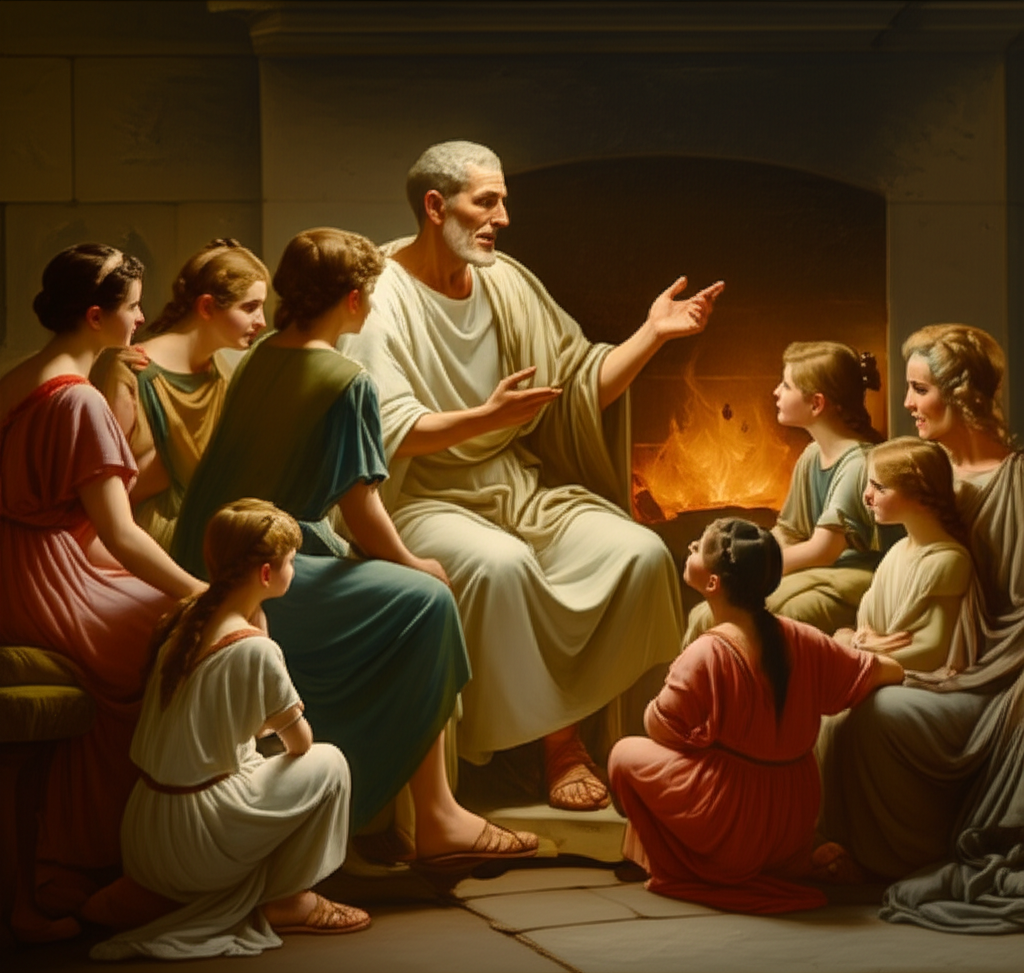
The Socratic Method at Home: Critical Thinking and Moral Reasoning
While formal education introduces complex philosophical concepts, the seeds of critical inquiry can be sown in the family. Parents who encourage questions, engage in debates, and challenge assumptions foster a spirit of intellectual curiosity vital for an informed citizen. John Locke, in Some Thoughts Concerning Education, emphasizes the importance of reasoning with children rather than merely commanding them, thereby cultivating their capacity for rational thought.
The Interplay of Family and State in Civic Education
The family's role is not in isolation but in dynamic interplay with the state and its institutions. Sometimes they reinforce each other, at other times they present differing perspectives that require a citizen to critically evaluate.
Reinforcing or Diverging Paths of Custom and Convention
The state, through its laws and public education systems, seeks to instill a particular set of civic values. The family can either act as a powerful amplifier of these values or, occasionally, as a counter-narrative, preserving alternative custom and convention. This dynamic is crucial for a pluralistic society, allowing for both cohesion and the necessary space for dissent and individual conscience. Rousseau, in Emile, or On Education, grappled with the tension between educating a child for natural freedom and for citizenship in a specific society.
The Role of Education in Bridging Gaps
When family values and state ideals diverge, public education plays a vital role in providing a broader framework, introducing students to diverse perspectives and the foundational principles of their nation. However, the most effective civic education acknowledges and builds upon the moral and social foundations established within the home. It is a partnership, not a replacement.
Enduring Wisdom from the Great Books
The profound insights into the family's role in shaping the citizen are not new. They echo through the corridors of intellectual history, from the ancient Greeks to the Enlightenment thinkers.
- Aristotle's Politics: Aristotle viewed the household (oikos) as the fundamental unit from which the village and then the polis (city-state) emerged. He argued that the virtues cultivated within the family, such as temperance and justice, were essential for the well-being of the larger political community. The master-slave, husband-wife, and parent-child relationships within the household were seen as microcosms of political life.
- Plato's Laws: While Plato in the Republic controversially suggested the communal rearing of children for guardians, in his later work, Laws, he acknowledged the practical necessity and importance of the family unit, emphasizing the state's role in guiding and supporting parental education for civic virtue.
- Burke's Reflections on the Revolution in France: Edmund Burke championed the "little platoons" of society, with the family being the most primary. He argued that affection for one's family and local community naturally expands into love for one's country, emphasizing the organic growth of civic attachment through established custom and convention.
Conclusion: The Unseen Architects of Civic Life
The family, often operating outside the grand pronouncements of state or formal institutions, remains an unparalleled force in civic education. It is within this intimate sphere that the future citizen first learns the meaning of responsibility, the value of custom and convention, and the foundational principles of justice and human dignity. To neglect or diminish the family's role is to sever the taproot of civic virtue, leaving future generations adrift without the moral compass so essential for navigating the complexities of public life. The enduring hearth, therefore, is not merely a place of comfort, but the primary forge where the very soul of the republic is shaped.
📹 Related Video: ARISTOTLE ON: The Nicomachean Ethics
Video by: The School of Life
💡 Want different videos? Search YouTube for: ""Aristotle Politics Family" or "Locke Education Parental Authority""