

The Unscripted Drama: Unpacking the Role of Chance in History
History, often presented as a grand narrative of cause and effect, power struggles, and inevitable progress, frequently overlooks its most capricious player: chance. This article delves into the profound and often unsettling Role of Chance in shaping human events, exploring how unforeseen accidents, fortunate coincidences, and random occurrences have irrevocably altered the course of civilizations. We will navigate the philosophical tension between Necessity and Contingency, examining how thinkers from antiquity to the modern era have grappled with the unpredictable currents that flow beneath the surface of historical determinism.
The Whispers of Fortune: An Introduction to Chance's Influence
From the seemingly trivial gust of wind that changed the trajectory of an arrow to the sudden illness of a pivotal leader, history is replete with moments where the unpredictable intervened with decisive force. To truly understand the unfolding of human events, we must move beyond a purely deterministic lens and acknowledge the profound impact of contingency – those events that might not have happened, yet did. This isn't to diminish human agency or the power of underlying social and economic forces, but rather to enrich our understanding by recognizing the delicate dance between the grand currents of history and the fleeting, often arbitrary, moments that can redirect their flow.
Defining the Indefinable: Chance, Necessity, and Contingency
Before we chart the historical landscape, it's crucial to define our terms. What do we mean by Chance in a historical context?
- Chance (τυχη, tyche in Greek): Often understood as an event without an apparent cause, or an unintended outcome of an action. It's the unpredictable, the accidental, the fortuitous or calamitous occurrence that defies immediate rational explanation within a given framework. Aristotle, in his Physics, distinguished between tyche (chance for animate beings) and automaton (spontaneity for inanimate objects), both referring to events that occur for no purpose, yet have consequences.
- Necessity: Refers to that which must be, that which cannot be otherwise. In history, this often points to underlying structural forces, geographical determinants, economic laws, or the inevitable consequences of certain choices. Thinkers like Hegel and Marx, for instance, saw history as driven by necessary, albeit complex, dialectical or material forces.
- Contingency: This term bridges the gap. A contingent event is one that could have been otherwise. It's not necessary, but it's also not impossible. The Role of Chance often manifests as a contingent event whose impact turns out to be immense, pushing the historical narrative down an unexpected path.
The philosophical challenge lies in discerning where necessity ends and contingency begins. Are "chance" events merely expressions of underlying necessities we haven't yet uncovered, or are they truly unpredictable disruptions?
Echoes from the Great Books: Historical Perspectives on Chance
The question of chance has haunted philosophers and historians for millennia, finding its way into many of the Great Books of the Western World.
Ancient World: Fate, Fortune, and Human Agency
The ancients grappled extensively with the interplay of fate, divine will, and human action.
- Herodotus and Thucydides: While meticulously chronicling events like the Persian Wars and the Peloponnesian War, they often acknowledged the role of tyche or fortune, sometimes personified as a goddess. Battles could be won or lost due to unexpected weather, illness, or a sudden turn of events beyond human control. Thucydides, though often seen as a rationalist, still recognized the unpredictable elements that could sway outcomes.
- Stoicism: Philosophers like Seneca, though emphasizing reason and virtue, also confronted the vagaries of fortune, urging individuals to cultivate inner resilience against external unpredictability.
Medieval Era: Divine Providence and Human Will
During the medieval period, the concept of chance often intertwined with theological doctrines.
- Augustine: In The City of God, he reconciled human free will and the apparent randomness of events with an overarching Divine Providence. What might appear as chance to humans is, from God's perspective, part of a greater, necessary plan.
Renaissance and Enlightenment: Fortuna and the Rise of Determinism
The Renaissance saw a renewed focus on human agency, yet the power of fortune remained a compelling theme.
- Machiavelli: In The Prince, he famously discussed Fortuna (fortune) as a powerful, often capricious, force that leaders must contend with. He argued that while fortune controls half of human affairs, a virtuous prince can, through prudence and foresight, control the other half. This is a clear acknowledgment of Chance's significant Role.
The Enlightenment, with its emphasis on reason and scientific laws, often sought to diminish the Role of Chance, positing a more deterministic view of history and the universe. However, even then, the unpredictable nature of human decisions and natural events proved difficult to fully dismiss.
Modern Era: Complexity, Chaos, and the Unforeseen
The 19th and 20th centuries brought new perspectives, often challenging strict determinism.
- Tolstoy: In War and Peace, he brilliantly dissects the idea of "great men" shaping history, arguing instead that countless small, often random, acts and decisions by ordinary people, alongside environmental factors and sheer luck, are the true drivers. He presents history as a complex system where individual plans often crumble under the weight of unforeseen circumstances.
- Marx: While emphasizing historical materialism and economic necessity, even Marxist analysis acknowledges that specific events, though not changing the direction of history, can alter its pace or form.
- Contemporary thought: With the rise of complexity theory and chaos theory, the idea that small, random perturbations can lead to massive, unpredictable outcomes (the "butterfly effect") has given Chance a renewed and sophisticated Role in our understanding of systems, including historical ones.
Image: 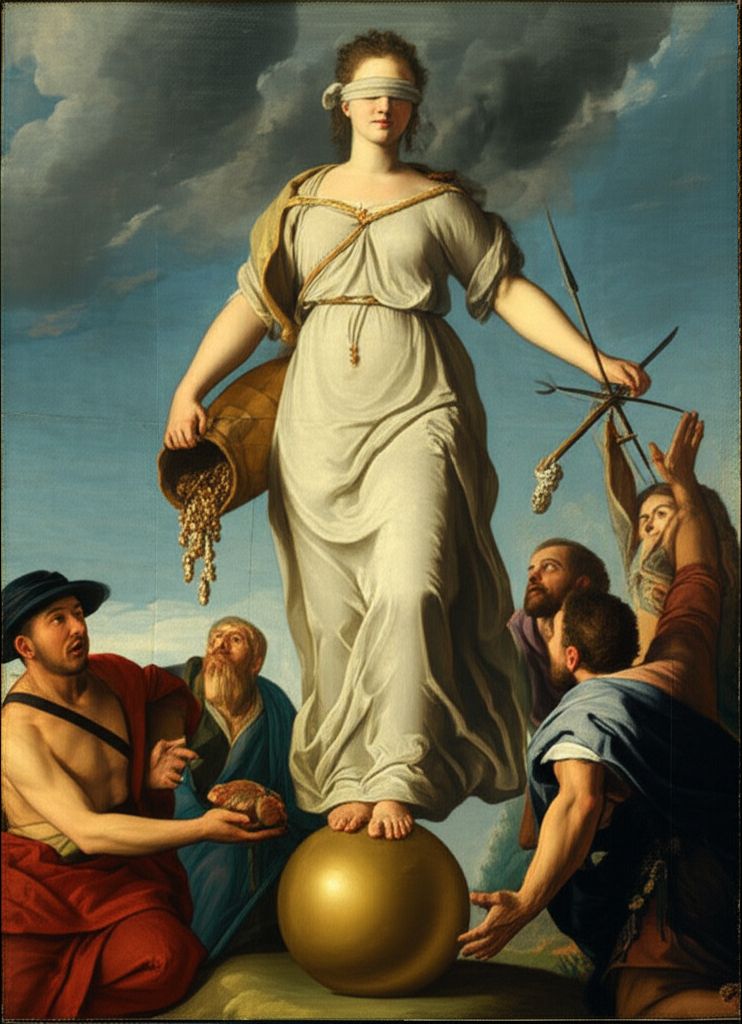
The Interplay: When Necessity Meets Contingency
The most compelling philosophical questions arise when we consider how Necessity and Contingency interact. Is history a river whose course is fixed by its banks (necessity), but whose specific eddies and currents are determined by random pebbles and winds (contingency)?
Consider these scenarios:
- Geographical Necessity: A civilization's development is undoubtedly shaped by its access to water, fertile land, or natural defenses. These are necessary conditions.
- Contingent Event: Yet, a sudden, unexpected drought or a localized earthquake could decimate that civilization, a chance event with profound consequences that alters the necessary trajectory.
- Technological Necessity: The invention of the printing press was a necessary step for the widespread dissemination of knowledge.
- Contingent Event: The specific timing of its invention, the individual who invented it, or a fire that destroyed a workshop could have delayed or altered its initial impact, a chance event influencing a necessary development.
The Role of Chance is often most visible at critical junctures, "forks in the road" where a seemingly minor event tips the scales, pushing outcomes in one direction over another, often with irreversible consequences. It reminds us that history is not a perfectly scripted play, but a vast, improvisational drama where the unexpected often steals the show.
Concluding Thoughts: The Unfinished Tapestry of Time
To acknowledge the Role of Chance in History is not to surrender to fatalism or deny human agency. Instead, it is to embrace a richer, more nuanced understanding of the past. It compels us to consider the fragility of plans, the unpredictability of events, and the astonishing chain reactions that can originate from the most unassuming origins. The tension between Necessity and Contingency remains a vibrant field of philosophical inquiry, reminding us that while certain forces may seem inevitable, the precise texture and color of the historical tapestry are often woven by the threads of the unexpected. As Grace Ellis, I find solace and wonder in this complexity, knowing that the story of humanity is far from a closed book, always open to the next unscripted turn.
YouTube Video Suggestions:
-
📹 Related Video: What is Philosophy?
Video by: The School of Life
💡 Want different videos? Search YouTube for: ""The Role of Contingency in History - Philosophy Lecture""
-
📹 Related Video: What is Philosophy?
Video by: The School of Life
💡 Want different videos? Search YouTube for: ""Chance and Necessity in History - Crash Course Philosophy""