

The Serendipitous Architect: Unpacking the Role of Chance in Evolution
The grand tapestry of life, woven over billions of years, often appears to be a testament to finely tuned adaptation and relentless progress. Yet, beneath the surface of natural selection's seemingly directed hand, chance plays a profoundly active and often underappreciated role. Far from being a mere deviation, randomness is a fundamental engine of evolution, shaping the very fabric of nature and challenging our philosophical notions of design, purpose, and the deterministic leanings often associated with the physics of the universe. This article delves into how unpredictable events, from the subatomic to the ecological, have steered the course of life, inviting us to reconsider the intricate dance between necessity and contingency in the evolutionary saga.
The Unpredictable Dance of Nature: Beyond Deterministic Paths
When we speak of evolution, our minds often gravitate towards natural selection – the elegant mechanism where advantageous traits are favored, leading to gradual adaptation. However, this deterministic view, while powerful, only tells half the story. The initial raw material for selection, the very variations upon which nature acts, are largely products of chance.
- Genetic Mutation: At the most fundamental level, evolution begins with changes in the genetic code. These mutations are often random, arising from errors during DNA replication, exposure to radiation (a physics-driven phenomenon), or chemical damage. There is no inherent "purpose" in a mutation; it simply occurs. Whether it's beneficial, neutral, or deleterious is only determined after its appearance, within the context of the environment.
- Genetic Drift: Beyond selection, populations can experience changes in gene frequency due to random sampling of genes across generations. This "genetic drift" is particularly potent in small populations, where chance events can lead to the loss or fixation of traits, irrespective of their adaptive value. Imagine a small group of beetles where, purely by accident, more brown beetles are stepped on than green ones; over time, the population might shift towards green, not because green is "better," but due to a random event.
- Gene Flow: The migration of individuals between populations introduces new genetic variations or alters existing frequencies through random encounters and successful reproduction.
These mechanisms highlight that evolution is not solely a march towards greater fitness but also a meandering journey influenced by the unpredictable.
From Physics to Phenotype: Microscopic Contingencies with Macroscopic Impacts
The influence of chance in evolution begins at the most granular levels, echoing ancient philosophical debates about the role of atoms and their unpredictable movements. Just as Lucretius pondered the "swerve" (clinamen) of atoms to introduce novelty and freedom into a deterministic universe, modern biology acknowledges the role of quantum physics and other probabilistic events in shaping biological outcomes.
Consider the following:
- Quantum Fluctuations: At the quantum level, events are inherently probabilistic. While the direct link to specific mutations is complex, the underlying physics of molecular interactions that lead to DNA replication errors or damage can have a stochastic component. Cosmic rays, a product of astrophysical physics, randomly bombard Earth, causing mutations.
- Environmental Catastrophes: Asteroid impacts, volcanic eruptions, and sudden climate shifts are largely unpredictable, chance events on a geological timescale. These catastrophes can wipe out vast swathes of life, creating evolutionary bottlenecks and opening up new ecological niches for the survivors – who may have survived purely by chance of location or a pre-existing, non-adaptive trait. The dinosaurs' demise, for instance, was not an evolutionary failure but a catastrophic chance event that paved the way for mammalian diversification.
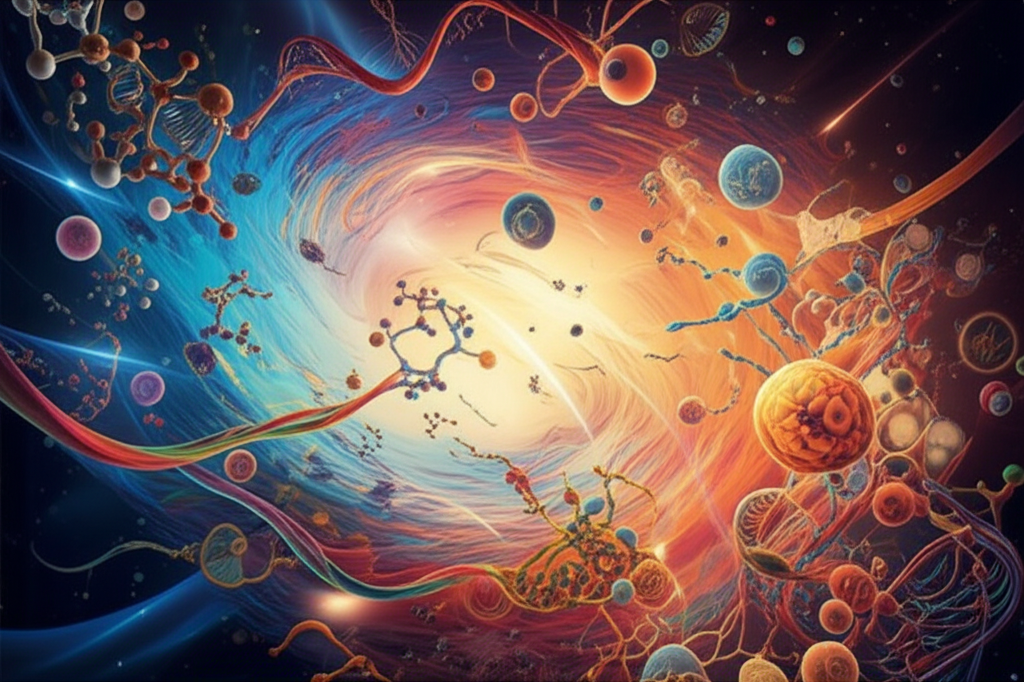 are subtly appearing, symbolizing the interplay of random microscopic events and the genesis of biological complexity. The background is a gradient from deep cosmic blue to earthy green, suggesting the connection between universal physics and terrestrial nature.)
Chance as an Evolutionary Engine, Not Just a Detour
It's tempting to view chance as merely a disruptive force, a "noise" in the system of evolution. However, this perspective fundamentally misunderstands its creative potential. Chance doesn't just introduce variation; it can also drive significant evolutionary shifts and unlock entirely new adaptive pathways.
- Founder Effects: When a small group of individuals migrates to a new, isolated habitat, the genetic makeup of the new population will be a random subset of the original. This "founder effect" can lead to a very different evolutionary trajectory than the parent population, purely by chance regarding which genes happened to be carried by the founders.
- Neutral Evolution: Many genetic changes have no immediate impact on an organism's fitness. These "neutral" mutations can accumulate over time through genetic drift. While seemingly inconsequential, some neutral mutations can become beneficial later if the environment changes, or they can contribute to the genetic distinctiveness between species, even without direct selective pressure. This highlights how chance can lay the groundwork for future adaptations.
- Exaptation: Sometimes, a trait that evolved for one purpose is co-opted for a completely different function. Feathers, for example, likely evolved for insulation or display before being exapted for flight. This "exaptation" often involves an element of chance – a random mutation or environmental shift that reveals a new utility for an existing feature.
Philosophical Implications: Determinism, Randomness, and Purpose
The profound role of chance in evolution carries significant philosophical weight. It challenges classical notions, found in the Great Books of the Western World, of a strictly ordered cosmos or a universe guided by inherent teleology (purpose).
If nature is shaped by unpredictable mutations, random drift, and contingent environmental events, what does this imply for our understanding of:
- Determinism vs. Indeterminism: The very foundation of physics for centuries leaned towards a deterministic universe, where every effect has a cause, and the future is, in principle, predictable. The role of chance in evolution introduces a powerful element of indeterminism into the biological realm, suggesting that the path of life was not preordained.
- Teleology and Purpose: Ancient and medieval philosophers, from Aristotle to Aquinas, often posited an inherent purpose or telos in nature. The prominence of chance in evolution complicates this view, suggesting that many features of life are not the result of a grand design but rather the contingent outcomes of random events sifted by selection. This doesn't necessarily negate all forms of purpose, but it certainly shifts the locus of purpose from a cosmic blueprint to the emergent properties of living systems themselves.
- Human Significance: If our existence, and the existence of all life, is profoundly influenced by chance, what does this mean for our place in the universe? It can be seen as both humbling and empowering – humbling in that we are products of cosmic contingency, yet empowering in that our unique existence is a testament to the incredible, unpredictable creativity of nature.
The interplay of chance and necessity in evolution invites us to embrace a more nuanced and dynamic understanding of life. It’s a reminder that the world is not merely a machine ticking along a predetermined path, but a vibrant, ever-unfolding story where serendipity is as crucial an author as selection.
📹 Related Video: KANT ON: What is Enlightenment?
Video by: The School of Life
💡 Want different videos? Search YouTube for: "The Role of Contingency in Evolution"
📹 Related Video: ARISTOTLE ON: The Nicomachean Ethics
Video by: The School of Life
💡 Want different videos? Search YouTube for: "Genetic Drift and Natural Selection Explained"