

The Role of Chance in Biological Evolution
In the vast, intricate drama of Nature, where life’s narrative unfolds through countless generations, the concept of chance often sparks both profound philosophical debate and scientific inquiry. It is a force that, far from being a mere absence of cause, plays an indispensable and multifaceted role in the grand process of biological evolution. This article explores how chance, from the microscopic dance of molecules to the sweeping shifts of ecosystems, underpins the diversity and adaptability of life, challenging our classical notions of design and purpose while revealing the deep contingency inherent in the living world.
The Unpredictable Weave: Defining Chance in Evolution
At its core, biological evolution is often presented as a process of natural selection, where advantageous traits are preserved and passed on. However, this elegant mechanism operates within a framework profoundly shaped by chance. Here, "chance" refers not to an absence of physical cause, but to events whose outcomes are unpredictable from the perspective of an organism's fitness or survival, or events that are statistically random within a given system. Understanding this distinction is crucial to appreciating the full complexity of life's journey.
Ancient Whispers: Chance in Philosophical Thought
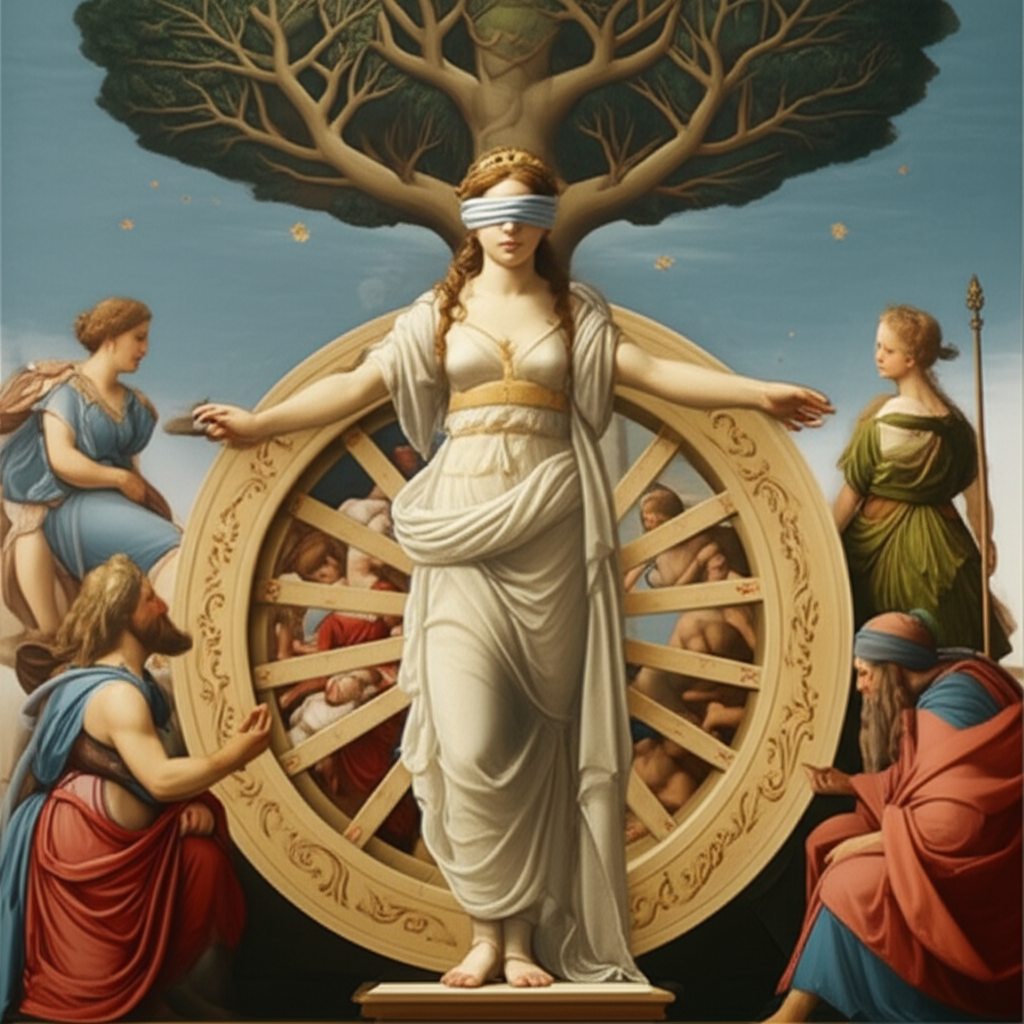
Long before Darwin, philosophers grappled with the nature of chance and its place in the cosmos. In the Great Books of the Western World, we find thinkers like Aristotle, in his Physics, distinguishing between different types of causes, including accidental causes (τυχη, tyche), which arise when two independent causal chains intersect unexpectedly. This contrasts with teleological causes, where events unfold towards a specific end.
Later, Lucretius, in De Rerum Natura, offered a radically materialist view where the universe is composed of atoms swerving randomly (the clinamen), creating the very fabric of existence through accidental collisions. This ancient atomist perspective, though lacking modern scientific rigor, presaged the idea that random, undirected events could be foundational to complex phenomena, including the formation of species. The tension between a universe governed by fixed laws and one susceptible to unpredictable turns has been a recurring theme, deeply informing our understanding of Nature itself.
The Mechanisms of Chance in Modern Evolutionary Theory
In contemporary evolutionary biology, chance manifests through several distinct, yet interconnected, mechanisms:
-
Genetic Mutation: The ultimate source of all genetic variation. Mutations—changes in the DNA sequence—are largely random with respect to their utility for the organism. A mutation might be beneficial, harmful, or neutral, but its initial appearance is not directed by the organism's needs or environmental pressures. This fundamental randomness provides the raw material upon which natural selection can act.
-
Genetic Drift: This refers to random fluctuations in the frequency of genes (alleles) within a population, particularly pronounced in small populations. Imagine a small island population of birds where, purely by chance, a few individuals carrying a rare gene fail to reproduce, or conversely, happen to have many offspring. Over time, genetic drift can lead to significant changes in the genetic makeup of a population, entirely independent of natural selection.
-
Gene Flow: While often a source of new variation, the arrival of new individuals (and their genes) into a population can be a chance event, influenced by factors like weather patterns, dispersal accidents, or habitat fragmentation.
-
Environmental Stochasticity: Random, unpredictable changes in the environment—a sudden drought, a volcanic eruption, a meteor impact—can drastically alter survival and reproductive rates, irrespective of an organism's adaptations. These events create new selective pressures or wipe out populations indiscriminately, fundamentally reshaping evolutionary trajectories.
-
Sexual Recombination: During sexual reproduction, genes are shuffled and recombined in new ways. While not entirely random (certain gene linkages are preserved), the specific combination of alleles an offspring receives is a matter of chance, generating novel genotypes for selection to operate upon.
The Interplay with Natural Selection
It is crucial to understand that the role of chance does not negate natural selection; rather, it provides the substrate upon which selection operates. Natural selection is often described as a non-random process because it favors traits that enhance survival and reproduction in a given environment. However, the origin of those traits, the survival of certain individuals through bottlenecks, or the timing of environmental shifts are often matters of chance.
Consider the metaphor of a sculptor: Chance provides the raw, unshaped marble (mutations, genetic drift), while natural selection is the sculptor, shaping the material to fit the environment. Without the random variations supplied by chance, natural selection would have nothing to work with, and evolution would grind to a halt.
Philosophical Implications: A Universe Without Design?
The pervasive role of chance in evolution has profound philosophical implications. It challenges teleological views of Nature—the idea that life, or the universe itself, is moving towards a predetermined end or was designed with a specific purpose. If significant evolutionary pathways are contingent on random events, then the existence of any particular species, including Homo sapiens, becomes a product of a specific, unpredictable historical sequence.
This perspective, while perhaps unsettling to those seeking ultimate design, also highlights the immense creativity and resilience of Nature. It underscores that life is not merely a deterministic march but a dynamic, exploratory process, constantly adapting to unforeseen circumstances. It forces us to reconsider our understanding of causality, demonstrating how microscopic random events, governed by the laws of physics, can cascade into macroscopic biological patterns.
Conclusion: Embracing the Contingency of Life
The role of chance in biological evolution is not a peripheral detail but a fundamental characteristic of life's unfolding. From the random flicker of genetic mutation to the unpredictable cataclysms that reshape ecosystems, chance provides the essential variability and contingency that drives evolutionary change. By embracing this intricate dance between chance and necessity, between randomness and selection, we gain a deeper appreciation for the profound, often surprising, beauty and adaptability of Nature. It reminds us that our existence, and the existence of all life, is a testament to an ongoing, undirected experiment within the vast expanse of the cosmos.
YouTube Video Suggestions:
-
📹 Related Video: What is Philosophy?
Video by: The School of Life
💡 Want different videos? Search YouTube for: ""Philosophy of Chance and Free Will" or "The Role of Contingency in Evolution""
2. ## 📹 Related Video: What is Philosophy?
Video by: The School of Life
💡 Want different videos? Search YouTube for: ""Ancient Greek Philosophy on Causality and Chance" or "Lucretius De Rerum Natura Explained""