

The Unseen Hand: Exploring the Profound Role of Chance in Biological Evolution
Summary: Biological evolution is often perceived as a grand, deterministic march towards increasing complexity and adaptation, driven solely by natural selection. However, this view overlooks a profound and often unsettling truth: chance is not merely a background noise but a fundamental, active participant in shaping life's trajectory. From the random mutations that provide the raw material for change to the unpredictable environmental shifts that redefine survival, randomness, deeply rooted in the very physics of our universe, consistently intervenes. This article delves into how chance operates within Nature's grand design, challenging our notions of purpose and predictability in life's unfolding story.
The Fabric of Reality: Understanding Chance in Evolution
When we speak of evolution, our minds often conjure images of fierce competition, the "survival of the fittest," and the elegant refinement of species through natural selection. While undeniably powerful, this selective force isn't the sole architect of biodiversity. Beneath the surface, the subtle, often chaotic, influence of chance weaves through the very fabric of life.
What do we mean by chance in this context? It's not simply a lack of knowledge, but an inherent unpredictability at various scales. At the most fundamental level, the quantum realm of physics whispers of probabilities rather than certainties, a randomness that can manifest in macroscopic biological events. In Nature, this translates into phenomena that are not directed towards a specific outcome, but rather occur with a certain probability, often with profound consequences for species and ecosystems.
- Random Mutation: The very wellspring of genetic variation, mutations are largely undirected changes in DNA. A nucleotide substitution doesn't "know" if it will be beneficial or harmful; it simply occurs.
- Genetic Drift: In populations, especially small ones, gene frequencies can fluctuate randomly from one generation to the next, entirely independent of natural selection.
- Environmental Stochasticity: Unpredictable events like volcanic eruptions, meteor impacts, or sudden climate shifts can drastically alter habitats, create new selective pressures, or lead to mass extinctions, resetting the evolutionary clock in unforeseen ways.
These elements of chance are not aberrations; they are intrinsic to the evolutionary process, providing both the raw material for selection and the unpredictable twists and turns that define life's history.
Echoes of Ancient Thought: Chance in the Great Books
The philosophical contemplation of chance is as old as philosophy itself. Long before Darwin, thinkers grappled with the role of randomness in the natural world, insights that resonate deeply with our modern understanding of evolution.
In the Great Books of the Western World, we find contrasting perspectives:
- Aristotle, in his Physics, distinguished between four causes, but also acknowledged "chance" and "spontaneity" as accidental causes, occurring when an outcome is not the primary purpose of an action. For Aristotle, Nature largely operated with inherent purpose or telos, yet he couldn't deny the existence of events that simply "happen."
- Lucretius, in On the Nature of Things, offered a more radical view rooted in atomism. He proposed the clinamen, or "swerve," of atoms – a tiny, unpredictable deviation from their deterministic paths. This random swerve, according to Lucretius, was the source of all novelty and the very possibility of complex formations, including life itself. Here, chance isn't an accidental add-on, but a fundamental principle of creation, a philosophical precursor to our understanding of random genetic mutations.
These ancient inquiries remind us that the tension between order and randomness, purpose and accident, has long been central to our attempts to comprehend Nature. Modern evolutionary biology, with its embrace of chance, continues this profound philosophical dialogue.
Mechanisms of Randomness: How Chance Shapes Life
The influence of chance in evolution is multifaceted, manifesting through several key mechanisms:
- Mutation: The ultimate source of new genetic variation. DNA replication is not perfect; errors occur. Exposure to radiation or certain chemicals can also induce changes. These mutations are largely random with respect to their utility. A mutation that confers antibiotic resistance on a bacterium doesn't arise because the bacterium "needs" it; it simply happens, and if it's beneficial in a given environment, natural selection will favor it.
- Genetic Drift: Particularly powerful in small populations, genetic drift describes the random fluctuations in the frequencies of gene variants (alleles). Imagine a small island population of beetles where a few individuals are accidentally stepped on. If those individuals happened to carry a rare gene variant, that variant could be lost entirely from the population, or conversely, become more common, purely by chance, without any selective advantage or disadvantage.
- Gene Flow: The movement of genes between populations can introduce new variation or alter existing frequencies in a random manner, sometimes swamping local adaptations.
- Recombination: During sexual reproduction, genetic material is reshuffled, creating new combinations of genes. While not purely random in the sense of mutation, it introduces a vast array of novel genotypes upon which selection can act.
- Environmental Catastrophes: Asteroid impacts, ice ages, volcanic eruptions, and other large-scale geological or climatic events are inherently unpredictable. They can wipe out dominant species, create new ecological niches, and drastically alter selective pressures, often leading to rapid bursts of evolution in the surviving lineages. The mass extinction event that cleared the way for the age of mammals is a prime example.
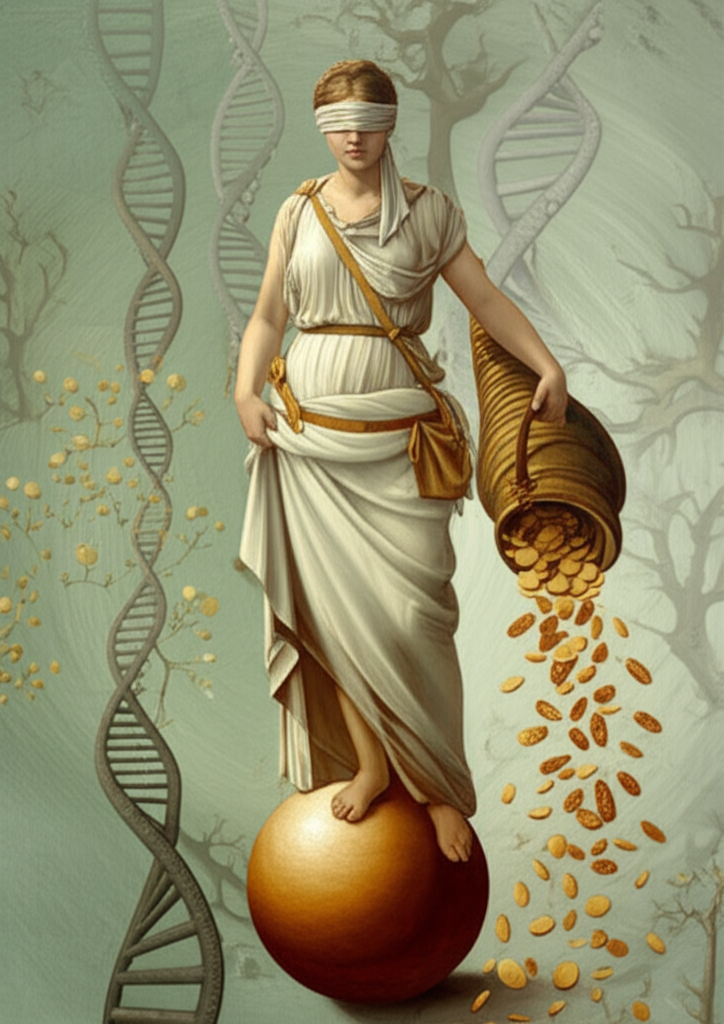
The Dance Between Chance and Selection
It's crucial to understand that chance and natural selection are not opposing forces in a zero-sum game. Rather, they are partners in the intricate dance of evolution. Chance provides the raw material – the variations, the new combinations, the altered environments – upon which natural selection acts. Without randomness, there would be no novelty, no diversity, and ultimately, no evolution.
Consider the profound implications of this interplay:
- Contingency of Life: If the "tape of life" were replayed, as Stephen Jay Gould famously mused, would the outcomes be the same? The pervasive role of chance suggests a resounding "no." The specific path life has taken, the species that exist today, are not preordained but are the result of a unique sequence of random events and selective pressures.
- Non-Adaptive Evolution: Chance can lead to the fixation of traits that are neither beneficial nor harmful, or even slightly detrimental, especially through genetic drift in small populations. Not every characteristic of an organism is a product of adaptation.
- Rapid Diversification: Environmental catastrophes, while destructive, can create "empty" niches, allowing surviving species to diversify rapidly as chance mutations and genetic drift, coupled with new selective pressures, drive speciation.
The intricate relationship between chance and selection reveals a Nature that is both orderly and unpredictable, a testament to the profound complexity of life's journey.
Philosophical Reflections: A Universe of Contingency
The recognition of chance's pivotal role in biological evolution has deep philosophical ramifications. It challenges deterministic views of the universe and our place within it. If life's path is not entirely directed, if randomness can profoundly alter its course, what does this imply for concepts of purpose, design, or even free will?
- It suggests that the astounding diversity and complexity of life on Earth are not the inevitable result of a grand plan, but rather the contingent outcome of billions of years of random events filtered through the sieve of natural selection.
- It highlights the interconnectedness of physics and biology, showing how fundamental principles of randomness at the smallest scales can ripple upwards to shape the grand narrative of life.
- It invites us to embrace a vision of Nature that is dynamic, unpredictable, and endlessly inventive, where the beauty lies not just in its elegant adaptations but also in its surprising, often serendipitous, twists and turns.
Understanding the role of chance in evolution is not to diminish the power of natural selection, but to enrich our appreciation for the chaotic beauty and profound contingency of life itself. It reminds us that the world, in all its intricate glory, is still full of surprises.
YouTube:
- "Genetic Drift Explained: The Randomness of Evolution"
- "Stephen Jay Gould Contingency and the History of Life"
📹 Related Video: What is Philosophy?
Video by: The School of Life
💡 Want different videos? Search YouTube for: "The Role of Chance in Biological Evolution philosophy"