

The Unpredictable Hand: Unpacking the Role of Chance in Biological Evolution
Summary: The journey of life on Earth, from single-celled organisms to complex ecosystems, is often attributed to the directed force of natural selection. However, to truly grasp the profound mechanisms of biological evolution, we must confront the pervasive, often underestimated, influence of chance. Far from being a mere footnote, chance—manifesting as random mutations, genetic drift, and environmental unpredictability—acts as a fundamental sculptor of life's trajectory, working in an intricate dance with deterministic forces. This article explores how seemingly random events, echoing philosophical debates on determinism and contingency, shape the very fabric of Nature and underscore the unique, unrepeatable path of life.
The Unseen Architect: Defining Chance in Evolutionary Context
When we speak of chance in evolution, we are not merely referring to an absence of cause, but rather to events whose specific outcomes are unpredictable from within the system, often due to a multitude of interacting, uncorrelated factors. This distinction is crucial, moving beyond a simplistic view of pure randomness to acknowledge the inherent stochasticity embedded within biological processes and the external environment.
Historically, philosophers have grappled with the concept of chance and necessity. Thinkers from the Great Books of the Western World, such as Aristotle in his Physics, distinguished between events that happen "always or for the most part" and those that occur "by chance" (tyche or automaton), often viewing the latter as incidental or peripheral to the natural order. Yet, modern evolutionary theory posits chance as a central, indispensable engine of novelty.
Key Manifestations of Chance in Evolution:
- Random Mutations: The ultimate source of all new genetic variation. Errors in DNA replication or external mutagens introduce changes without foresight or direction towards adaptive advantage.
- Genetic Drift: Random fluctuations in allele frequencies from one generation to the next, particularly potent in small populations, where alleles can be lost or fixed purely by chance.
- Environmental Stochasticity: Unpredictable and often catastrophic environmental events (e.g., meteor impacts, volcanic eruptions, sudden climate shifts) that drastically alter selective pressures, independent of any organism's fitness.
The Intricate Dance: Chance and Natural Selection
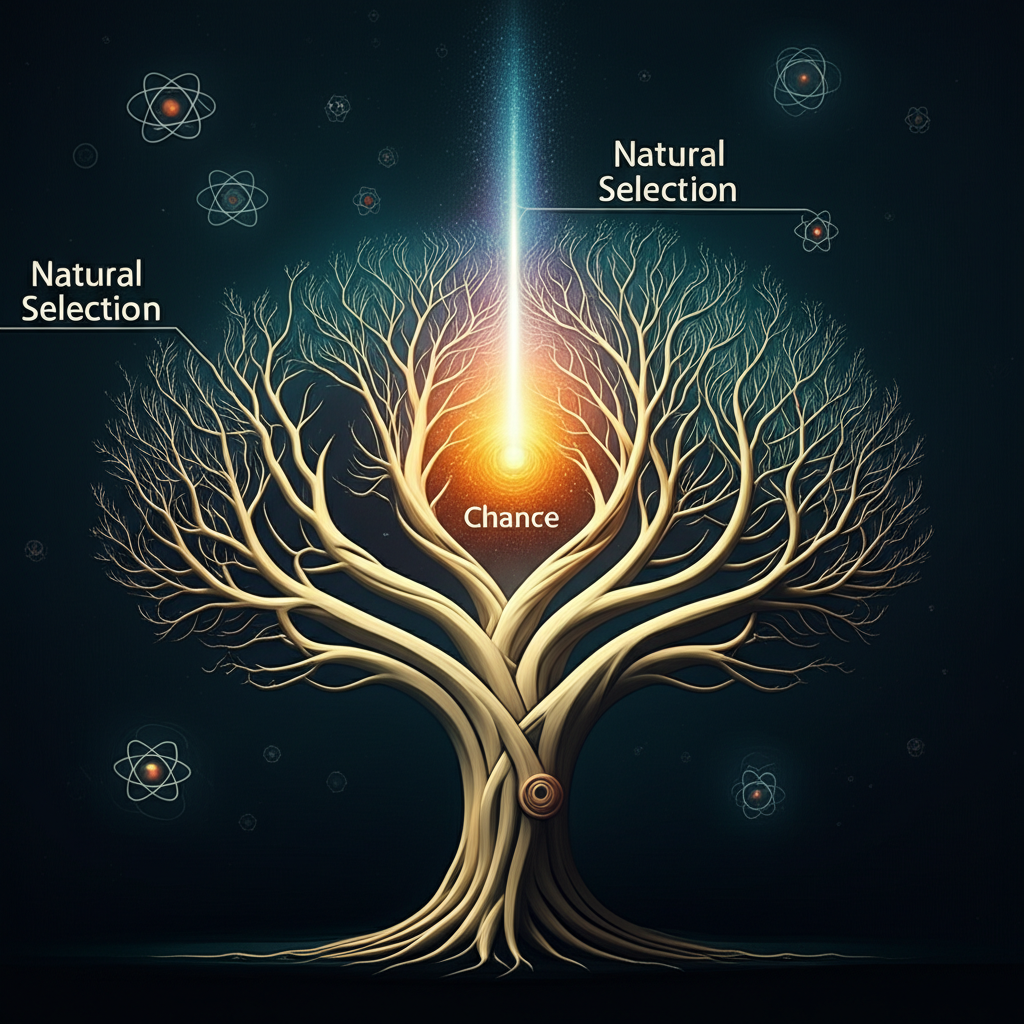
It is a common misconception to view evolution solely through the lens of natural selection, as if life were a perfectly optimized machine. While natural selection is undoubtedly a powerful, directional force, it operates on the raw material provided by chance.
| Feature | Role of Chance | Role of Natural Selection |
|---|---|---|
| Origin of Variation | Generates novel genetic traits randomly. | Has no role in generating new variation. |
| Directionality | Undirected; outcomes are unpredictable. | Directed; favors traits that enhance survival and reproduction in a given environment. |
| Outcome | Can lead to non-adaptive or even deleterious changes. | Tends to lead to adaptation and increased fitness. |
| Interaction | Provides the palette of possibilities. | Selects the most "fit" colors from that palette. |
Consider the analogy: chance deals the cards (mutations, genetic drift, environmental events), while natural selection plays the hand, favoring certain combinations over others. Without the random shuffle of the deck, there would be no new hands to play, no new strategies to develop.
Echoes of Physics: Chance in the Fabric of Reality
The philosophical implications of chance in biology resonate with profound discoveries in modern Physics. The advent of quantum mechanics introduced fundamental unpredictability at the subatomic level, challenging classical deterministic worldviews. If the very building blocks of the universe operate with inherent probabilities rather than strict causal chains, it lends credence to the idea that chance is not merely an epistemological limitation but an ontological feature of reality.
Philosophers like Lucretius, in De Rerum Natura (another Great Book), posited the "swerve" (clinamen) of atoms as a source of novelty and, by extension, free will, prefiguring a universe where absolute predictability might be an illusion. This ancient insight finds a modern counterpart in the random nature of mutation, which, while not a direct consequence of quantum events at the macro scale, mirrors a universe where fundamental unpredictability can seed complex outcomes.
The Contingent Tapestry of Nature
The profound role of chance means that the evolutionary path taken by life on Earth is highly contingent. If a particular asteroid had missed, if a specific mutation had not occurred, or if a small population had not experienced a particular genetic bottleneck, the entire trajectory of life might be vastly different. This highlights the non-repeatable nature of evolution; "replaying the tape of life" would likely yield an entirely different cast of organisms and ecosystems.
Nature, in its grand design, is not a pre-programmed algorithm but a dynamic, ever-unfolding story where moments of pure chance can open entirely new chapters. This perspective enriches our understanding of biodiversity, transforming it from a predictable outcome into a miraculous, highly improbable, and utterly unique phenomenon.
YouTube Video Suggestions:
-
📹 Related Video: KANT ON: What is Enlightenment?
Video by: The School of Life
💡 Want different videos? Search YouTube for: "The Role of Chance and Contingency in Evolution"
2. ## 📹 Related Video: What is Philosophy?
Video by: The School of Life
💡 Want different videos? Search YouTube for: "Determinism vs Indeterminism Philosophy Physics Biology"