

The Rhetoric of War and Peace: Crafting Consent and Conflict
Summary:
The intricate dance between rhetoric, war, and peace reveals how profoundly language shapes human experience, influencing decisions that lead to conflict or foster harmony. From ancient battlefields to modern diplomatic tables, the strategic deployment of words by governments and leaders can incite populations to war or guide them towards lasting peace, underscoring the critical importance of understanding the persuasive power of language in shaping our collective destiny.
Introduction: The Unseen Architect of Human Affairs
As thoughtful observers of the human condition, we often ponder the forces that propel societies towards the brink of war or guide them to the tranquility of peace. Beyond geopolitical interests, economic pressures, or ideological divides, there exists a fundamental, often overlooked, architect of these grand narratives: rhetoric. It is through the artful construction and dissemination of language that perceptions are forged, emotions are stirred, and collective actions are mobilized. The rhetoric of war and peace is not merely an academic exercise; it is the very fabric upon which the tapestry of human conflict and cooperation is woven. Understanding this dynamic is crucial for anyone seeking to comprehend the true levers of power in our world.
The Power of Language in Conflict: Inciting the Flames of War
When the drums of war begin to beat, they are invariably accompanied by a chorus of carefully chosen words. Language becomes a formidable weapon, capable of transforming abstract political disputes into visceral struggles for survival, honor, or justice. The historical record, replete with examples from the Great Books of the Western World, demonstrates how leaders have masterfully employed rhetorical devices to rally support, demonize adversaries, and justify bloodshed.
-
Framing the Enemy: Dehumanization and Justification
One of the most potent rhetorical strategies in the build-up to war involves the dehumanization of the "other." By stripping an opposing group of their shared humanity, their actions can be portrayed as inherently evil, their intentions as purely malicious. This narrative, often amplified bygovernmentpropaganda, makes violence seem not just permissible, but necessary. Think of Thucydides' account of the Peloponnesian War, where both Athens and Sparta used rhetoric to paint the other as an existential threat, justifying their aggressive actions. Suchrhetoricreduces complex situations to simplistic binaries of good versus evil. -
The Call to Arms: Inspiring Sacrifice
Beyond demonization, therhetoricof war must also inspire courage and sacrifice among one's own populace. This often involves invoking powerful ideals: freedom, patriotism, national honor, or the defense of sacred values. Leaders appeal to a sense of collective identity and purpose, framing the conflict as a noble endeavor that transcends individual lives. Such appeals can transform fear into resolve and hesitation into fervent commitment, often by using evocative imagery and emotional appeals (pathos).
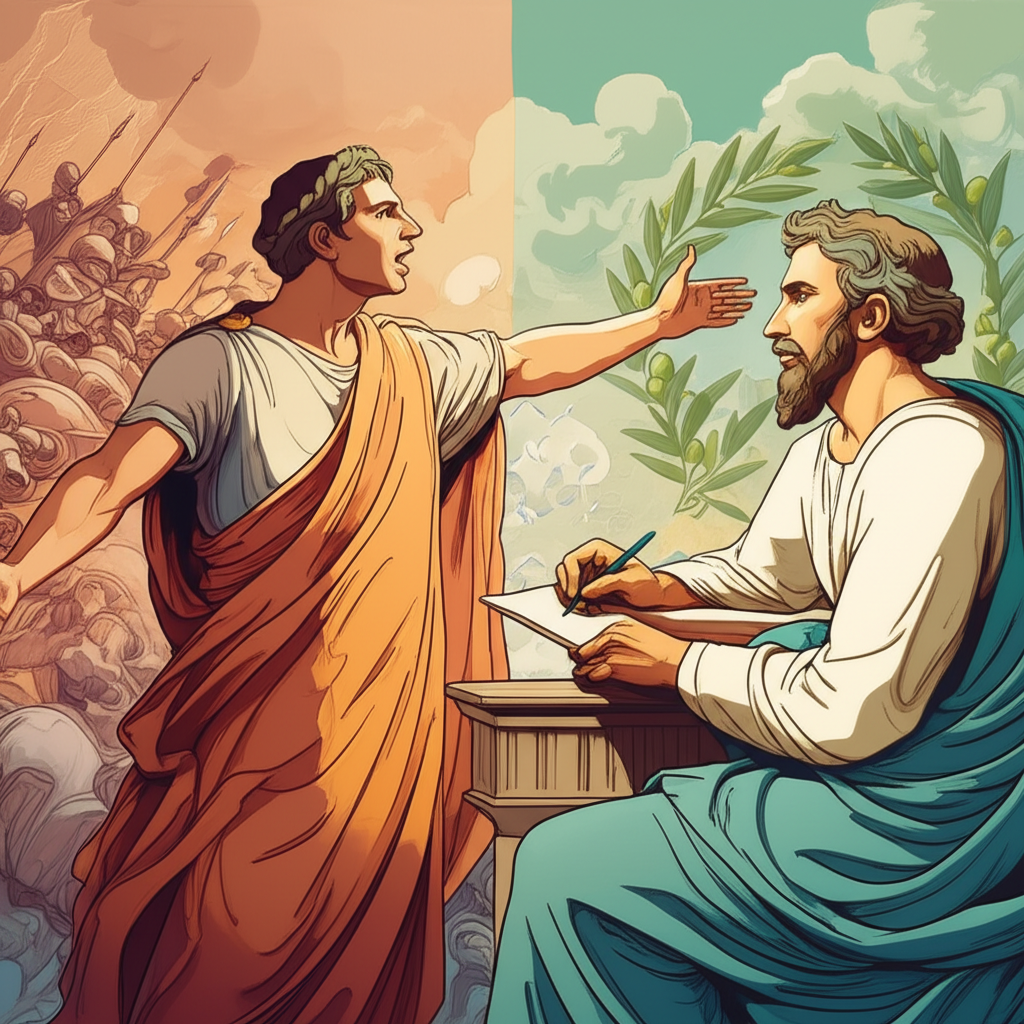
The Eloquence of Peace: Crafting Pathways to Harmony
Conversely, the pursuit of peace also relies heavily on the art of rhetoric. Here, the objective shifts from division to unity, from condemnation to understanding. The language of peace seeks common ground, emphasizes shared aspirations, and builds bridges across divides. It requires a different kind of persuasive power, one focused on empathy and mutual benefit.
-
Diplomacy and Dialogue: Bridging Divides
At the heart of any peace process lies dialogue. Diplomaticlanguageis meticulously crafted to de-escalate tensions, explore mutual interests, and negotiate compromises. It demands precision, empathy, and a profound understanding of the other's perspective. The ability to articulate a vision of shared prosperity and security, rather than a zero-sum game, is crucial for successful mediation and conflict resolution. This often involves careful use of logos (logic) and ethos (credibility) to build trust. -
Constructing Common Ground: Shared Values and Aspirations
Effectiverhetoricfor peace often appeals to universal human values: the desire for stability, prosperity, and the well-being of future generations. By highlighting commonalities and shared goals, it seeks to transcend historical grievances and ideological differences. Leaders who successfully broker peace often do so by painting a compelling picture of a future where cooperation yields greater benefits than continued conflict, appealing to a broader, shared human experience.
Government and the Narrative: The State's Rhetorical Arsenal
The role of government in deploying rhetoric for war and peace cannot be overstated. State apparatuses possess immense power to shape public opinion through various channels, from official pronouncements to media control. This makes an informed citizenry all the more vital.
-
Controlling the Message: Information and Persuasion
Governments utilize sophisticated communication strategies to control narratives, manage public perception, and ensure compliance with their policies. In times of war, this often involves censorship, propaganda, and the selective dissemination of information to maintain morale and support for military action. In times of peace, it focuses on building national consensus, promoting civic engagement, and fostering international goodwill. The deliberate choice of words, metaphors, and symbols by agovernmentcan dramatically alter how its citizens perceive domestic and international events. -
The Ethical Dilemma: Truth vs. Expediency
This raises profound ethical questions for philosophers and citizens alike. To what extent is agovernmentjustified in using persuasiverhetoricthat may bend or obscure the truth for the sake of national security or political stability? Plato's critique of rhetoric in the Gorgias comes to mind, where he questions its ability to lead to genuine knowledge or justice when detached from truth. The tension between rhetorical effectiveness and ethical responsibility remains a perennial concern, forcing us to critically examine thelanguageof power.
Philosophical Roots: Insights from the Great Books
The study of rhetoric and its implications for war and peace has deep roots in Western thought, explored extensively in the Great Books of the Western World. These foundational texts remind us that the strategic deployment of language is an ancient and enduring aspect of human governance and conflict.
- Aristotle's Rhetoric: Provided a systematic analysis of persuasion, categorizing its appeals (ethos, pathos, logos) and recognizing its power in both the political assembly and the courtroom. His insights remain foundational to understanding how arguments are constructed and received, crucial for both inciting conflict and forging consensus.
- Plato's Gorgias: Explored the moral dimensions of rhetoric, often questioning its capacity to lead to truth when divorced from philosophical inquiry. His dialogues highlight the potential for rhetoric to manipulate rather than enlighten, raising enduring questions about the ethical use of persuasive
language. - Thucydides' History of the Peloponnesian War: A masterclass in analyzing the rhetoric of statecraft, presenting speeches from opposing sides that reveal the motivations, justifications, and strategic uses of language during wartime. The "Melian Dialogue" stands as a stark testament to the rhetoric of power, where logic and morality clash with force.
- Machiavelli's The Prince: While not directly about rhetoric, Machiavelli's advice to rulers on maintaining power implicitly acknowledges the importance of shaping public perception and using strategic communication to achieve political ends, whether through fear or feigned virtue, demonstrating a pragmatic view of
rhetoricin governance.
Rhetorical Strategies: A Dual-Purpose Tool
The table below illustrates how similar rhetorical tools can be adapted for vastly different ends, depending on whether the aim is to foster war or peace.
| Strategy/Tool | Application in War Rhetoric | Application in Peace Rhetoric |
|---|---|---|
| Metaphor & Analogy | "War on Terror," "Surgical Strikes," "Axis of Evil," "Crusade" | "Building Bridges," "Olive Branch," "Roadmap to Peace," "Common Home" |
| Ethos (Credibility) | Leader's unwavering resolve, military strength, moral superiority | Leader's commitment to dialogue, wisdom, impartiality, shared values |
| Pathos (Emotion) | Fear of enemy, anger at injustice, pride in nation, call to avenge | Hope for future, empathy for suffering, desire for stability, joy |
| Logos (Logic/Reason) | Justification of pre-emptive strike, strategic necessity, threat analysis | Rational argument for mutual benefit, economic cooperation, conflict costs |
| Framing | "Us vs. Them," "Clash of Civilizations," "Existential Threat" | "Shared Humanity," "Global Community," "Common Challenges," "Partnership" |
Conclusion: The Enduring Significance of Discerning Words
The rhetoric of war and peace is a profound testament to the power of language as a primary tool of human agency. From the subtle nuances of diplomatic communiqués to the fiery pronouncements that ignite national fervor, words possess an unparalleled capacity to shape our understanding of the world, influence our collective decisions, and ultimately determine the trajectory of human history. As citizens and critical thinkers, an acute awareness of how government and other actors deploy rhetoric is not merely an intellectual pursuit but an essential civic responsibility, enabling us to discern manipulation from genuine persuasion, and to advocate for a language that truly serves the cause of justice and lasting peace.
YouTube Video Suggestions:
📹 Related Video: ARISTOTLE ON: The Nicomachean Ethics
Video by: The School of Life
💡 Want different videos? Search YouTube for: ""Aristotle Rhetoric explained""
📹 Related Video: KANT ON: What is Enlightenment?
Video by: The School of Life
💡 Want different videos? Search YouTube for: ""Thucydides Melian Dialogue analysis""