

The Rhetoric of Tyranny: How Language Fuels Despotism
Unmasking the Persuasive Power of Oppression
Summary: The rhetoric of tyranny is the insidious art by which despots seize and maintain power, manipulating public perception through language to justify oppression, stifle dissent, and erode critical thought. It is a sophisticated weapon, often disguised as patriotism or common sense, that targets emotions over reason, simplifies complex issues, and creates a clear division between "us" and "them." Understanding these linguistic tactics, as illuminated by centuries of philosophical inquiry from the Great Books of the Western World, is crucial for safeguarding free societies against authoritarian control.
The Foundations of Control: Language as a Weapon
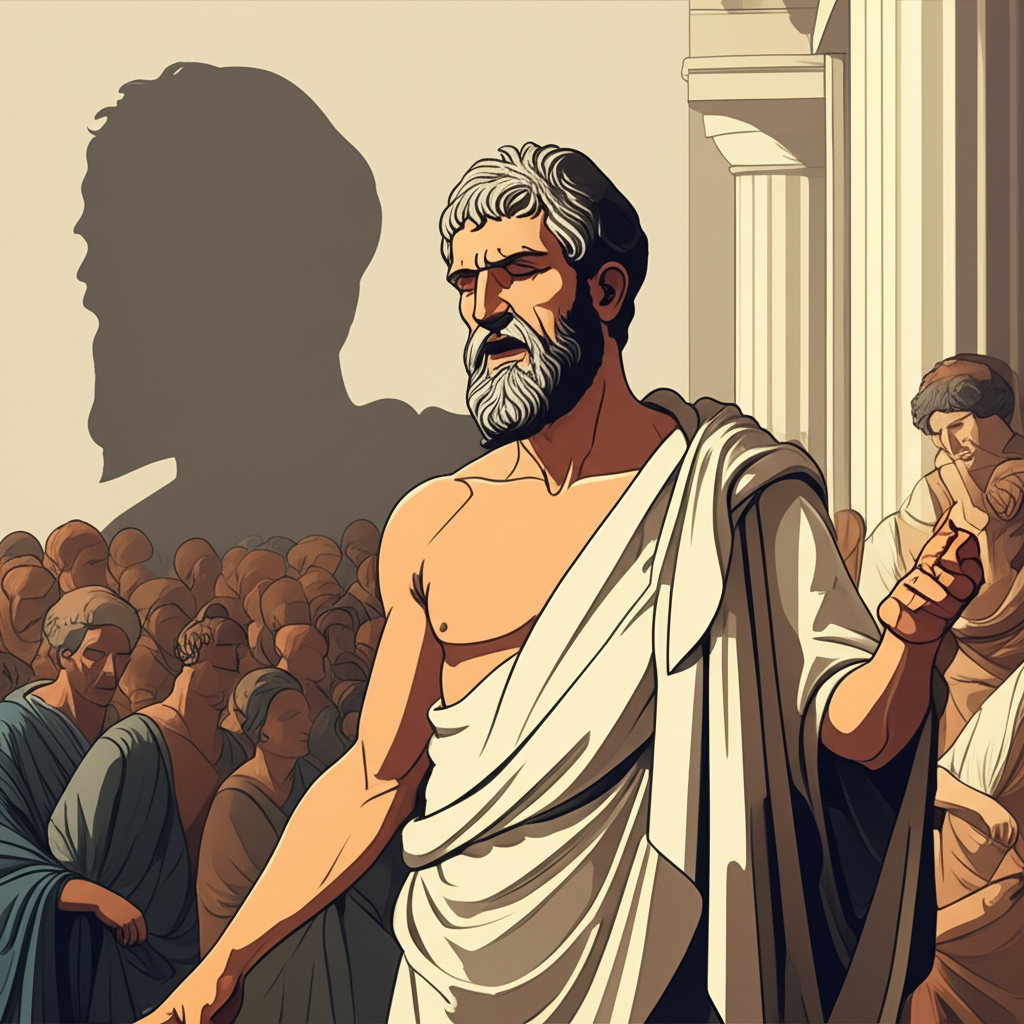
From ancient city-states to modern nations, the specter of tyranny has consistently challenged the ideals of justice and self-governance. Yet, true tyranny rarely announces itself with overt violence alone. Instead, its most potent precursor and persistent companion is a carefully constructed narrative, a pervasive system of persuasive communication – what we call the rhetoric of tyranny. This is not merely propaganda; it is a fundamental distortion of language itself, turning words meant for understanding and connection into tools of division and subjugation.
Philosophers across the ages, whose works form the bedrock of the Great Books, have grappled with this phenomenon. Plato, in his Republic, warned against the demagogue who rises to power by flattering the masses and then gradually enslaving them. Aristotle, in his Rhetoric and Politics, meticulously dissected the methods of persuasion, implicitly highlighting how these same techniques could be perverted for illiberal ends. These foundational texts serve as a timeless guide to recognizing the patterns of tyrannical discourse, demonstrating that the struggle against despotism is, at its heart, a battle for the integrity of meaning.
The Architectonics of Tyrannical Discourse
Tyrannical rhetoric operates on several interconnected levels, each designed to dismantle the intellectual and moral defenses of a populace. It seeks to control not just what people think, but how they think, establishing a mental framework conducive to authoritarian rule.
I. Simplification and the Cult of Certainty
One of the most effective tools in the tyrant's rhetorical arsenal is the radical simplification of complex issues. Nuance is the enemy of absolute power. Problems, whether economic, social, or political, are reduced to easily digestible, often binary, narratives.
- Black-and-White Thinking: The world is presented as a struggle between good and evil, with the tyrant and their followers embodying the former, and all dissenters or opposition representing the latter.
- False Solutions: Complex societal challenges are offered facile, immediate, and often unrealistic solutions, promising a swift end to suffering if only the people follow the leader's absolute guidance.
- Erosion of Doubt: Critical inquiry, skepticism, and intellectual curiosity are branded as weakness, disloyalty, or even treason. The government's narrative becomes the sole legitimate truth.
II. The Engineering of "The Other"
Central to the rhetoric of tyranny is the identification and demonization of an external or internal enemy. This tactic serves multiple purposes: it unifies the populace against a common threat, diverts attention from the regime's failures, and justifies oppressive measures.
- Scapegoating: Blame for societal problems is consistently shifted to a specific group – minorities, foreigners, intellectuals, or a previous administration.
- Dehumanization: The designated "Other" is stripped of their humanity through inflammatory language, making it easier for the populace to accept their persecution or marginalization.
- Fabricated Threats: Exaggerated or entirely invented threats are used to instill fear and create a perpetual state of emergency, allowing the regime to consolidate power under the guise of protection.
III. Emotional Manipulation Over Rational Argument
Tyrannical rhetoric bypasses reason, aiming directly for the gut and the heart. It leverages powerful emotions to cloud judgment and foster uncritical loyalty.
- Fear-Mongering: The constant invocation of danger, chaos, and impending doom, positioning the tyrant as the only savior who can restore order.
- False Hope and Grand Promises: Appeals to a glorious past or a utopian future, offering a vision of national greatness contingent upon absolute obedience.
- Cult of Personality: The leader is presented as infallible, charismatic, and uniquely capable, often with messianic qualities, demanding unquestioning adoration.
The Subtle Corruptions of Language
The very fabric of language is twisted under tyrannical rule. Words lose their conventional meanings, becoming instruments of ideological control.
- Newspeak and Euphemism: Concepts like "freedom" might be redefined to mean obedience, or brutal acts might be described with soft, bureaucratic terms (e.g., "re-education" for imprisonment).
- Repetition and Sloganeering: Simple, catchy phrases are endlessly repeated, embedding the regime's ideology deep within the public consciousness, often replacing genuine thought with rote affirmation.
- Silencing and Censorship: Not just the suppression of dissenting voices, but also the deliberate omission of information, the rewriting of history, and the control of media outlets to ensure only the official narrative prevails.
Building Defenses: Resisting the Rhetorical Assault
The primary defense against the rhetoric of tyranny lies in cultivating robust critical thinking and fostering an informed, engaged citizenry.
Strategies for Resistance:
- Cultivate Critical Literacy: Actively question sources, motives, and underlying assumptions in all public discourse. Recognize logical fallacies and emotional appeals.
- Embrace Nuance and Complexity: Resist the urge for simplistic answers. Understand that most societal problems are multifaceted and require thoughtful, diverse perspectives.
- Protect Free Inquiry and Open Dialogue: Champion institutions that promote education, independent journalism, and the free exchange of ideas.
- Value Dissent: Understand that disagreement is not disloyalty but a vital component of a healthy government and a vibrant society.
As Machiavelli observed in The Prince, while a ruler might initially gain power through force, maintaining it often requires the consent, or at least the acquiescence, of the governed. This is where rhetoric becomes indispensable. By understanding the linguistic mechanisms of tyranny, we equip ourselves to recognize its early warning signs and resist its seductive, destructive pull. The lessons embedded in the Great Books remind us that eternal vigilance is the price of liberty, and that vigilance begins with how we interpret and use words.
YouTube Video Suggestions:
-
📹 Related Video: PLATO ON: The Allegory of the Cave
Video by: The School of Life
💡 Want different videos? Search YouTube for: ""Plato's Republic and the Dangers of Democracy""
-
📹 Related Video: ARISTOTLE ON: The Nicomachean Ethics
Video by: The School of Life
💡 Want different videos? Search YouTube for: ""Aristotle Rhetoric explained""