

The Rhetoric of Oligarchy: The Subtle Chains of Language
In the annals of political philosophy, few forms of government have drawn as much scrutiny as oligarchy – the rule by a select few, often distinguished by wealth or lineage. Yet, the mechanisms by which these exclusive powers sustain their dominion are rarely purely coercive. More often, they are subtly woven into the fabric of public discourse through the art of rhetoric. This article delves into how oligarchic systems employ language not merely to communicate, but to persuade, legitimize, and ultimately, control, drawing insights from the timeless wisdom preserved in the Great Books of the Western World.
I. Oligarchy Defined: Rule by the Few
Before dissecting its rhetorical strategies, it is crucial to grasp the essence of oligarchy. As articulated by Aristotle in his Politics, oligarchy arises when the wealthy hold power, making property qualifications the defining characteristic of citizenship and governance. Unlike aristocracy, which theoretically prioritizes virtue, oligarchy places wealth at its core, often leading to a focus on self-preservation and the accumulation of more resources for the ruling class. Plato, in his Republic, similarly critiques the oligarchic soul, driven by avarice and a hierarchical structure that values money above all else. The challenge for any such government is to present this inherently unequal arrangement as just, stable, or even beneficial for the broader populace—a task invariably entrusted to sophisticated rhetoric.
II. The Ancient Roots of Rhetorical Scrutiny
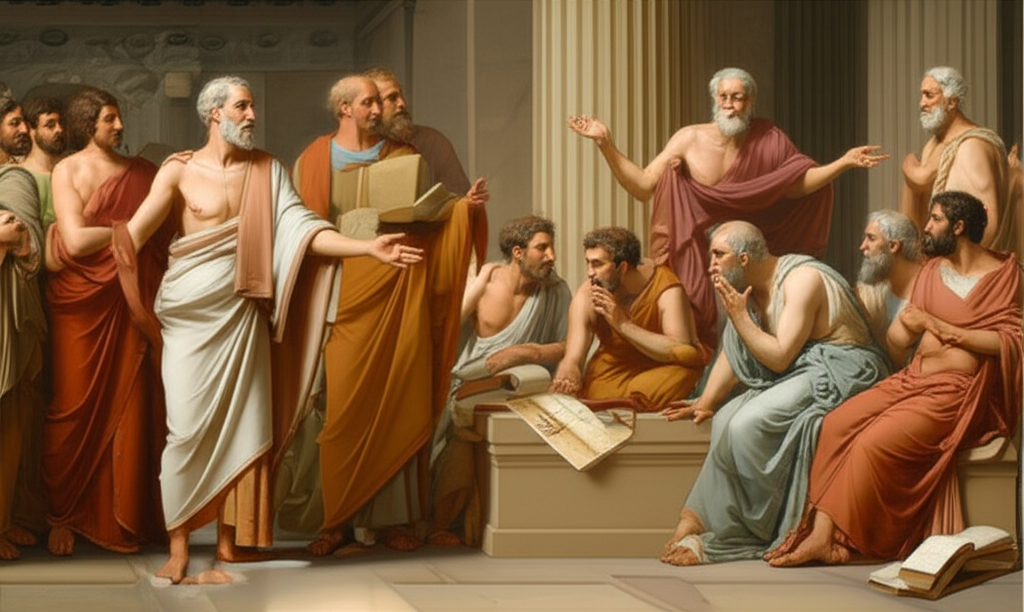
The philosophers of antiquity were acutely aware of rhetoric's power, both for good and ill. Plato, through Socrates in Gorgias, famously assailed rhetoric when divorced from truth and justice, seeing it as a tool for flattery and manipulation, particularly potent in the hands of those seeking to sway popular opinion for personal gain. This ancient critique resonates powerfully when examining oligarchic government, where the truth about resource distribution or political access is often inconvenient.
Aristotle, while more pragmatic in his assessment, viewed rhetoric as the art of discovering the available means of persuasion in any given situation. He meticulously cataloged its components: ethos (credibility), pathos (emotion), and logos (logic). An oligarchy, seeking to legitimize its rule, must master all three, projecting an image of wisdom and stability (ethos), tapping into public fears or aspirations (pathos), and constructing seemingly rational arguments for its policies (logos), however fallacious they may be.
III. Mechanisms of Oligarchic Rhetoric
The language of oligarchy is a carefully constructed edifice, designed to reinforce the existing power structure and neutralize dissent. Its strategies are multifaceted and often subtle.
A. The Illusion of Meritocracy and Stability
A primary rhetorical strategy is to justify rule by presenting the wealthy as inherently more capable, intelligent, or virtuous—a kind of "meritocracy of means." The argument often posits that their success is proof of their superior judgment, making them best suited to lead the government. This rhetoric often takes the form of:
- Claims of Economic Expertise: Portraying the ruling elite as the only ones capable of managing complex economic affairs, thereby ensuring prosperity for all.
- Appeals to Order and Security: Suggesting that their rule guarantees stability and prevents chaos, often by contrasting it with the perceived disorder of broader popular participation.
- The "Natural Order" Argument: Implying that wealth and power naturally gravitate to the most deserving, thus legitimizing inequality as an unavoidable or even desirable state.
B. Crafting the "Other": Division and Diversion
To maintain cohesion within its ranks and distract from internal inequalities, oligarchy frequently employs rhetoric to create external or internal enemies.
Common Rhetorical Tactics for Division:
- Scapegoating: Blaming specific groups (e.g., immigrants, the poor, external nations) for societal problems, diverting attention from systemic issues perpetuated by the ruling class.
- Populist Appeals (from the elite): Paradoxically, oligarchs may adopt populist language, framing themselves as defenders of the "common person" against abstract threats or rival elites, while still serving their own interests.
- Exaggeration of Threats: Amplifying dangers (e.g., crime, foreign influence, economic collapse) to justify increased control, reduced liberties, or the suppression of opposition.
C. The Euphemistic Veil: Obscuring Reality
One of the most insidious aspects of oligarchic rhetoric is its adeptness at using euphemisms to sanitize harsh realities. Language is manipulated to make unpalatable policies seem benign, necessary, or even beneficial.
| Euphemism | Underlying Reality |
|---|---|
| "Fiscal Adjustment" | Austerity measures, budget cuts |
| "Market Correction" | Economic downturn, wealth redistribution |
| "Efficiency Measures" | Layoffs, reduced public services |
| "Strategic Re-alignment" | Corporate mergers, job losses |
| "Wealth Creators" | The wealthy elite, tax beneficiaries |
This deliberate obfuscation through language prevents clear public understanding and critical debate, making it difficult for citizens to connect policies with their true consequences.
D. Appeals to Fear and Security
Fear is a potent motivator, and oligarchic government often leverages it through rhetoric to consolidate power. By constantly invoking threats—whether real or imagined—to national security, economic stability, or social order, the ruling class can justify extraordinary measures, restrict freedoms, and demand unquestioning loyalty. The language here is often alarmist, emphasizing potential dangers over actual conditions, and framing any opposition as a threat to the collective well-being.
IV. The Erosion of Truth and Public Discourse
The cumulative effect of oligarchic rhetoric is a profound erosion of truth and the quality of public discourse. When language is consistently used as a tool for manipulation rather than genuine communication, the very foundation of informed democratic participation is undermined. Citizens struggle to differentiate genuine facts from carefully constructed narratives, and the capacity for critical thinking becomes dulled. The marketplace of ideas, ideally a vibrant arena for open debate, transforms into a battleground of competing narratives, with the oligarchic government often having the loudest and most pervasive voice.
Conclusion: Vigilance in the Face of Eloquence
The rhetoric of oligarchy is not merely a historical curiosity; it is a persistent feature of political life. From the ancient Greek city-states to contemporary global powers, the skillful manipulation of language remains a crucial instrument for those who seek to rule by the few. Understanding these rhetorical strategies—the appeals to false meritocracy, the divisive scapegoating, the euphemistic veils, and the exploitation of fear—is the first step towards intellectual emancipation. As students of philosophy and citizens of any government, our vigilance against such eloquent deceptions is not just an academic exercise but a vital civic duty, ensuring that language serves truth and justice, not merely the interests of a select few.
YouTube: "Plato's Republic Oligarchy"
YouTube: "Aristotle Rhetoric political power"
📹 Related Video: What is Philosophy?
Video by: The School of Life
💡 Want different videos? Search YouTube for: "The Rhetoric of Oligarchy philosophy"