

The relation between language and thought is one of philosophy's most enduring and intricate puzzles, a fundamental inquiry into how we perceive, process, and articulate reality. This article explores the profound interplay between our internal conceptual world—the Mind and its Ideas—and the external system of symbols we use to communicate, arguing that neither can be fully understood in isolation from the other.
The Unspoken Dialogue: Unraveling Language and Thought
At the heart of human experience lies the profound relation between what we think and how we express it. Is language merely a vessel for pre-existing ideas in the mind, or does it actively sculpt the very landscape of our thought? This question has captivated thinkers for millennia, from the ancient Greeks pondering the nature of logos to modern cognitive scientists dissecting neural pathways. The answer, as we shall see, is rarely simple, revealing a dynamic, reciprocal dance where language and thought are not just connected, but intimately interwoven, each shaping and reflecting the other in a continuous, complex relation.
Ideas Before Words: The Primacy of the Mind
One perspective posits that thought, or the Idea, holds a certain primacy. We often experience a flash of insight, a nascent concept, or a complex emotion that feels fully formed in the mind before we can articulate it. This view suggests that language serves primarily as a tool for expression, a means to translate internal, non-linguistic ideas into a communicable form.
- The Inner Monologue: Even when we "think in words," those words often seem to be an internal articulation of a deeper, more fundamental idea.
- Pre-linguistic Thought: Infants and animals demonstrate complex problem-solving and emotional responses without the formal structures of human language, suggesting a capacity for thought independent of specific linguistic forms.
- The Struggle for Articulation: The common experience of "knowing what you mean but not being able to say it" powerfully illustrates the perceived gap between an idea and its linguistic representation.
Philosophers throughout the Great Books of the Western World have grappled with this. Plato, for instance, spoke of Forms existing independently of their linguistic descriptions, accessible through reason. Descartes, too, emphasized the thinking Mind (the res cogitans) as distinct from its external expressions. Here, language is a powerful, yet secondary, instrument, a bridge between inner idea and outer world.
The Shaping Power: How Language Constructs Our Reality
Conversely, a compelling argument can be made for the profound influence of language on thought. Our native tongue provides the very categories, distinctions, and conceptual frameworks through which we organize and interpret reality. It's not just what we say, but how our language allows us to say it that shapes our mind.
Consider the following ways language sculpts thought:
- Conceptual Frameworks: Different languages emphasize different aspects of reality. For example, some languages have multiple words for snow, or nuances for different types of love, potentially influencing how speakers perceive and categorize these phenomena.
- Grammatical Structures: The way a language structures time, agency, or causality can subtly direct the mind's attention and interpretation. Does a language habitually use passive voice, or emphasize the doer of an action? This can influence our understanding of responsibility.
- Cultural Narratives: Language carries with it a culture's history, values, and metaphors, embedding a particular worldview within the very fabric of communication. These narratives become the lens through which ideas are formed and understood.
This perspective suggests that our mind doesn't just produce language; language also produces our mind, at least in terms of its structured ideas. Ludwig Wittgenstein, a key figure in 20th-century philosophy (whose precursors can be found in the Great Books tradition of examining logic and meaning), famously argued that the limits of our language mean the limits of our world.
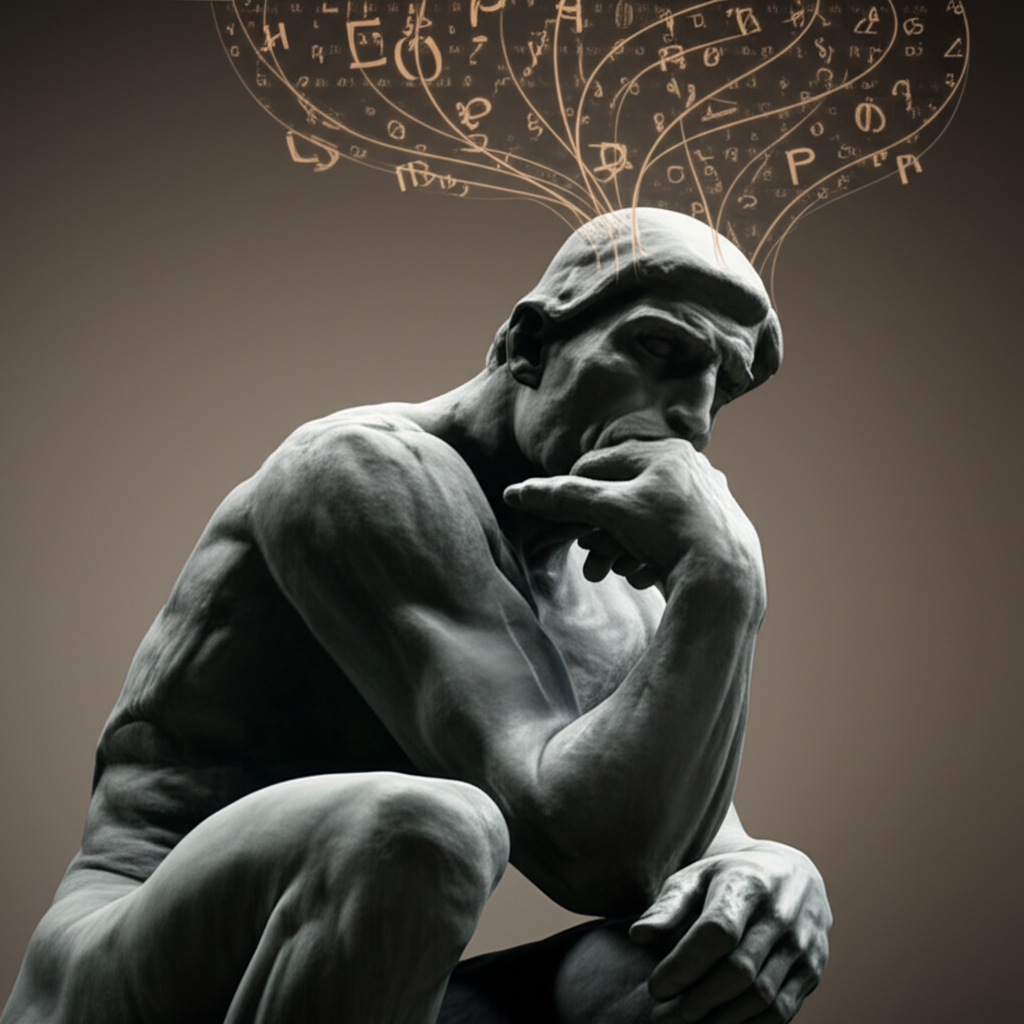
A Symbiotic Relation: The Inseparable Dance
The most compelling view of the relation between language and thought is not one of primacy, but of an intricate, dynamic symbiosis. They are two sides of the same cognitive coin, constantly interacting, influencing, and co-evolving.
Think of it as a feedback loop:
- The Mind conceives an Idea.
- The Mind attempts to articulate this Idea through Language.
- The act of articulation often refines, clarifies, or even alters the original Idea.
- New linguistic tools or distinctions, once learned, expand the Mind's capacity to conceive novel ideas.
This ongoing relation can be summarized in the following points:
| Aspect of Interaction | Description |
|---|---|
| Expression & Clarification | Language allows us to externalize and share our ideas. In doing so, it often forces us to clarify vague thoughts, making them more precise and coherent. |
| Conceptual Formation | Language provides the categories and labels that help us organize raw sensory input into meaningful ideas and concepts. Without the word "tree," the idea of "tree" might be less distinct. |
| Cognitive Scaffolding | Language acts as a scaffold for complex thought. We use internal language (inner speech) to plan, reason, and solve problems, especially those requiring sequential processing. |
| Cultural Transmission | Language is the primary vehicle for transmitting knowledge, culture, and ideas across generations, profoundly shaping the individual mind within its broader context. |
| Innovation & Evolution | As new ideas emerge from the mind, language adapts by creating new words, phrases, or meanings. This linguistic innovation, in turn, enables further conceptual development. |
This reciprocal relation is evident in how we learn. A child learns a word (e.g., "justice") and simultaneously begins to grasp the complex idea it represents. As their understanding of "justice" deepens, their use of the word becomes more nuanced, and they might even contribute to evolving its meaning. The Great Books are replete with examples of this, from Aristotle's meticulous definitions shaping philosophical inquiry to Locke's examination of how ideas are formed from sensory experience and then articulated through words.
The Philosophical Journey: An Ever-Present Inquiry
The relation between language and thought is not a settled question but a continuous philosophical journey. From the ancient Greek debates on universals and particulars, through medieval scholasticism's focus on logic and meaning, to the Enlightenment's exploration of human understanding, and on to 20th-century analytic philosophy, this core inquiry underpins much of Western thought.
Understanding this dynamic relation is crucial for appreciating the depth of human cognition and communication. It encourages us to look beyond the surface of words to the ideas they convey, and to examine how the very structure of our language might be influencing the way our mind perceives and interacts with the world. It’s a powerful reminder that our capacity for language is not merely a tool, but an integral part of what it means to think, to conceive of ideas, and to be human.
YouTube Suggestions:
- "Noam Chomsky on Language and Thought"
- "Linguistic Relativity: Does Language Shape Thought? | The School of Life"
📹 Related Video: What is Philosophy?
Video by: The School of Life
💡 Want different videos? Search YouTube for: "The Relationship Between Language and Thought philosophy"