

The Unspoken Dialogue: Unraveling the Intricate Relationship Between Language and Thought
Summary:
The relation between language and thought is one of philosophy's most enduring and fascinating puzzles. Are our ideas merely reflections of the words we use, or does a rich, pre-linguistic mind shape the very structure of our communication? This article delves into the historical and philosophical perspectives, drawing from the "Great Books of the Western World," to explore how these two fundamental aspects of human experience are inextricably linked, each profoundly influencing the other in the complex tapestry of the human mind.
Introduction: The Symbiotic Dance of Words and Ideas
From the moment we begin to articulate sounds, to the deepest recesses of our internal monologues, language appears to be the very fabric of our conscious experience. But what comes first: the idea or the word? This isn't just an academic query; it touches upon the very essence of what it means to be human, to reason, and to communicate. The philosophical journey through the "Great Books of the Western World" reveals a persistent fascination with this symbiotic dance, offering diverse insights into the profound relation between our linguistic tools and the inner workings of our mind.
Ancient Foundations: Language as a Mirror and a Molder of Thought
The earliest philosophers wrestled with how our words connect to reality and our internal states, laying the groundwork for centuries of debate.
- Plato's Forms and the Idea: In works like the Phaedo and Republic, Plato grappled with the nature of ideas (Forms) existing independently of our perception. While not directly focusing on language as a shaper of thought, his emphasis on apprehending these pure Forms suggests a mind striving to grasp universal truths. Language serves as an imperfect, yet necessary, vehicle for their discussion. The idea of justice, for instance, exists beyond any specific articulation, but language allows us to debate and approach it.
- Aristotle's Logic and Categories: Aristotle, in his Categories and On Interpretation, systematically explored how language reflects and structures our thought. He meticulously categorized reality, arguing that our linguistic structures (substance, quantity, quality, relation, etc.) are not arbitrary but mirror the fundamental ways in which our mind apprehends the world. For Aristotle, language provides the very framework through which we can articulate logical propositions, making it an indispensable tool for reasoned thought.
The Medieval Bridge: Words as Signs of Concepts
Moving into the medieval period, philosophers continued to refine these concepts, often within a theological framework.
- Thomas Aquinas and Mental Concepts: Aquinas, drawing heavily from Aristotle, discussed language in his Summa Theologica as a system of signs. Words, for Aquinas, are signs of concepts (or ideas) in the mind, which in turn are derived from our experience of reality. The spoken word is secondary to the mental word, emphasizing the primacy of the idea within the mind, which then seeks expression through language.
The Early Modern Inquiry: Mind, Ideas, and the Limits of Language
The Enlightenment brought a renewed focus on the individual mind and its capabilities, leading to more direct investigations into the relation between internal ideas and external language.
- Descartes and the Primacy of Thought: René Descartes, with his famous "I think, therefore I am" (Discourse on Method, Meditations), placed thought firmly at the core of existence. For Descartes, the mind (or soul) is a thinking substance, separate from the body. Language is a means to express these thoughts, but the capacity for thought itself precedes and is independent of linguistic expression. An idea exists in the mind before it is clothed in words.
- Locke's Empiricism and Ideas: John Locke, in his An Essay Concerning Human Understanding, argued that all our ideas originate from experience. Words, for Locke, are "sensible marks of ideas," serving primarily to communicate these ideas from one mind to another. He emphasized the conventional nature of language, where words are arbitrarily assigned to represent ideas. The challenge, as Locke saw it, was ensuring that different speakers attached the same idea to the same word to avoid confusion and miscommunication.
- Berkeley's Immaterialism: George Berkeley, in his Principles of Human Knowledge, pushed Locke's empiricism further. For Berkeley, "to be is to be perceived." While he didn't extensively detail the relation between language and thought in the same manner, his philosophy implies that our ideas are primary. Language serves to evoke these ideas in others, and the words themselves can even influence the formation of ideas, particularly in abstract concepts where there might not be a direct sensory correlate.
The Ongoing Debate: Does Language Shape Thought, or Vice Versa?
This historical overview from the "Great Books" reveals a consistent tension in understanding the relation between language and mind.
- Linguistic Determinism vs. Thought Primacy:
- Some perspectives lean towards linguistic determinism, suggesting that the structure of our language dictates the way we perceive and conceptualize the world. Our culture's vocabulary and grammatical forms might limit or expand our capacity for certain kinds of thought.
- Conversely, others argue for the primacy of thought, asserting that a rich, non-linguistic mind generates ideas which then seek expression through language. This view often points to pre-linguistic infants, non-human animals, or even moments of "aha!" where an idea seems to crystallize before words can adequately capture it.
The Interplay: A Dynamic and Inseparable Bond
Rather than a simple cause-and-effect, the relation between language and thought is best understood as a dynamic interplay.
- Language as a Tool for Complex Thought: Language provides the scaffolding for abstract thought. It allows us to categorize, generalize, remember, and reason about things not immediately present. Without words, how would we discuss concepts like "democracy," "infinity," or "justice" in their full complexity? It enables us to build intricate mental models and share them.
- Thought as the Engine of Language: Conversely, our capacity for complex thought drives the evolution and refinement of language. As new ideas emerge, new words and linguistic structures are developed to express them. The creativity of the human mind constantly pushes the boundaries of what language can articulate.
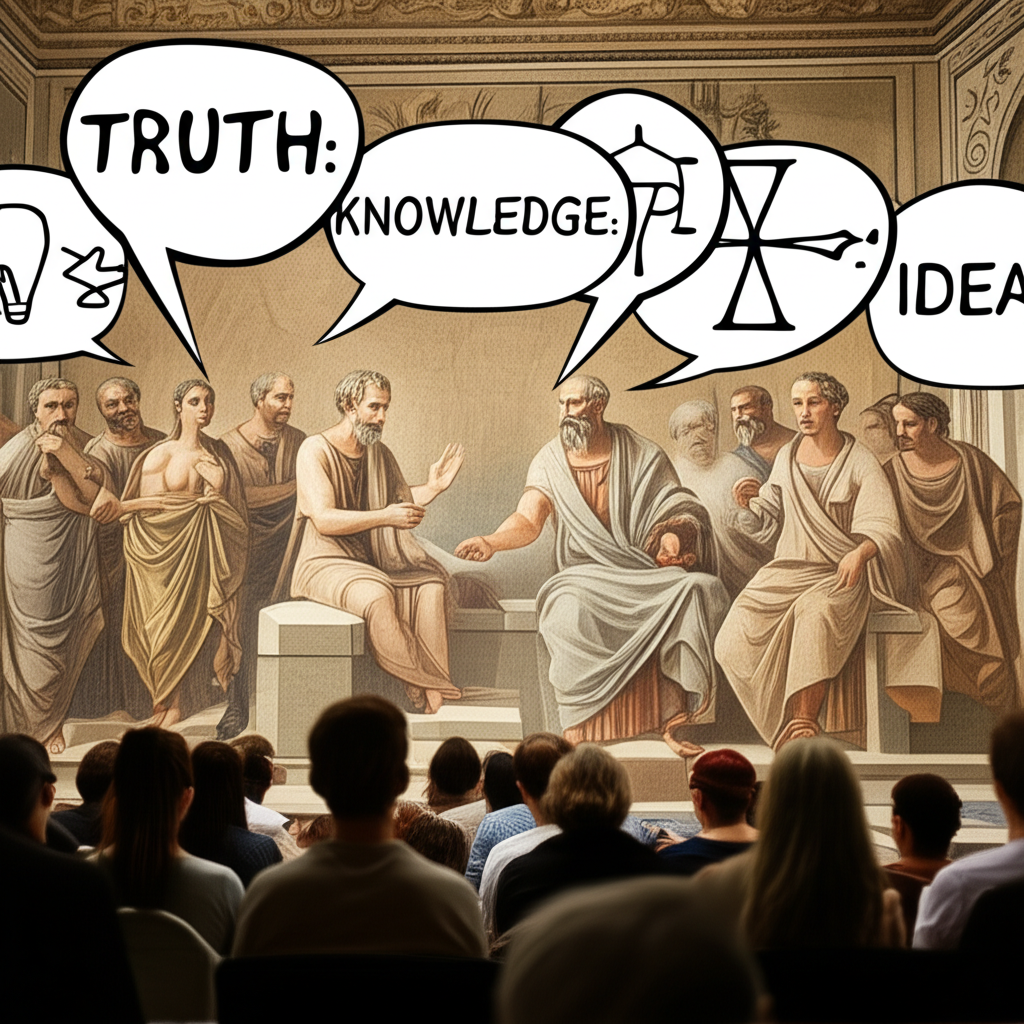
Conclusion: An Endless Conversation Within the Mind
The journey through the "Great Books of the Western World" highlights that the relation between language and thought is not a settled matter but an ongoing philosophical exploration. From Plato's Forms to Locke's ideas, philosophers have grappled with how our words shape, reflect, and enable the intricate workings of the human mind. It is clear that language is more than just a communication tool; it is deeply woven into the very fabric of our cognition, influencing how we form ideas, understand the world, and relate to one another. The conversation between our inner mind and our external language is indeed an endless one, continually shaping who we are and how we experience reality.
YouTube Video Suggestions:
-
📹 Related Video: What is Philosophy?
Video by: The School of Life
💡 Want different videos? Search YouTube for: ""Whorf-Sapir Hypothesis explained philosophy""
2. ## 📹 Related Video: PLATO ON: The Allegory of the Cave
Video by: The School of Life
💡 Want different videos? Search YouTube for: ""Plato Aristotle Language Thought Great Books""