

The Indissoluble Bond: Unpacking the Relationship Between Language and Thought
Summary: The profound and often perplexing relation between language and thought lies at the heart of philosophical inquiry. This article explores how our mind processes ideas and how language serves not merely as a tool for expression, but as a fundamental shaper of our conceptual landscape, drawing insights from the Great Books of the Western World. From ancient Greek philosophers pondering the nature of names to Enlightenment thinkers dissecting the origins of ideas, the intricate dance between what we think and how we articulate it reveals a connection far more complex than simple causality.
Unraveling the Intricate Dance: An Introduction
From the moment we begin to conceptualize the world around us, the question arises: does language merely provide a means to express pre-existing ideas, or does it fundamentally shape the very structure of our thought? This is not a trivial academic exercise but a deeply human inquiry into the nature of consciousness, reason, and communication. The Western philosophical tradition, as chronicled in the Great Books, offers a rich tapestry of perspectives, each attempting to delineate the precise relation between these two pillars of human experience. We delve into how the mind generates ideas and the indispensable role language plays in this intricate process.
Classical Foundations: Language as a Mirror of the Mind
The earliest systematic explorations into the relation between language and thought often viewed language as a reflection or symbol of an already formed mental state.
-
Plato's Forms and Words:
In dialogues like the Cratylus, Plato grappled with whether names (words) have a natural relation to the things they signify, or if they are purely conventional. While not fully resolving the debate, Plato's theory of Forms suggests that true ideas (the Forms) exist independently of human language. Language, then, is an attempt, often imperfect, to grasp and communicate these transcendent ideas. The mind, through reason, accesses the Forms, and language then endeavors to articulate these insights. -
Aristotle's Logic and Symbols:
Aristotle, in works such as On Interpretation, provided a foundational understanding of the relation. He posited that "Spoken words are the symbols of affections in the soul [thoughts], and written words are the symbols of spoken words." For Aristotle, thought (the "affections in the soul" or pathemata tou psychēs) is primary and universal across all humanity, reflecting the objective reality of things. Language, on the other hand, is secondary, conventional, and particular to different cultures. The mind conceives of an idea, and then language provides the means to symbolize and convey that idea to others. This established a clear hierarchy where thought precedes and dictates language.
Enlightenment Perspectives: Ideas, Words, and Understanding
The Enlightenment era brought renewed focus on the individual mind and the empirical origins of ideas, further refining the perceived relation with language.
-
Descartes: The Primacy of Thought:
René Descartes, with his famous dictum "Cogito, ergo sum" (I think, therefore I am), placed thought at the absolute core of existence and self-awareness. For Descartes, the very act of thinking proved one's existence, a process that did not inherently rely on external language for its initial formulation. Ideas could be clear and distinct in the mind before finding linguistic expression. Language, therefore, served as a tool for expressing these pre-formed, internal cogitations. -
Locke: Language as Signs of Ideas:
John Locke, in his Essay Concerning Human Understanding, built upon the notion that words primarily stand for ideas in the mind of the speaker. He argued that words are "sensible signs" chosen by people to "make known their ideas to others." The challenge, Locke noted, lay in ensuring that the words used by one person evoked the same ideas in the mind of another. This highlights the conventional and social aspect of language, emphasizing its role in facilitating the communication of empirically derived ideas. For Locke, ideas originate from sensation and reflection, and language then labels and organizes them.
Kant and the Structure of Experience
Immanuel Kant, in his Critique of Pure Reason, introduced a revolutionary perspective. He argued that the mind is not a passive recipient of sensory data but actively structures experience through innate "categories of understanding." These categories (e.g., causality, substance, unity) are fundamental to how we apprehend and make sense of the world. While Kant did not directly equate these categories with language, his work implied that our capacity for structured thought—and thus the very possibility of forming coherent ideas—is deeply rooted in these inherent mental frameworks. Language, in this context, becomes the primary vehicle through which these structured ideas are articulated, shared, and further refined. The relation here suggests an underlying cognitive architecture that both enables thought and is expressed through language.
The Enduring Interplay: Beyond Simple Causality
As philosophy progressed, the understanding of the relation between language and thought moved beyond a simple cause-and-effect model to one of profound interdependence. While the Great Books largely predate the "linguistic turn" of the 20th century, the seeds of this more complex understanding are clearly present. Language is not merely a transparent window to the mind's ideas; it is also a framework that shapes how those ideas are conceived, remembered, and manipulated. The very act of naming an abstract concept like "justice" or "freedom" allows the mind to reify it, to discuss it, and to develop more intricate ideas around it.
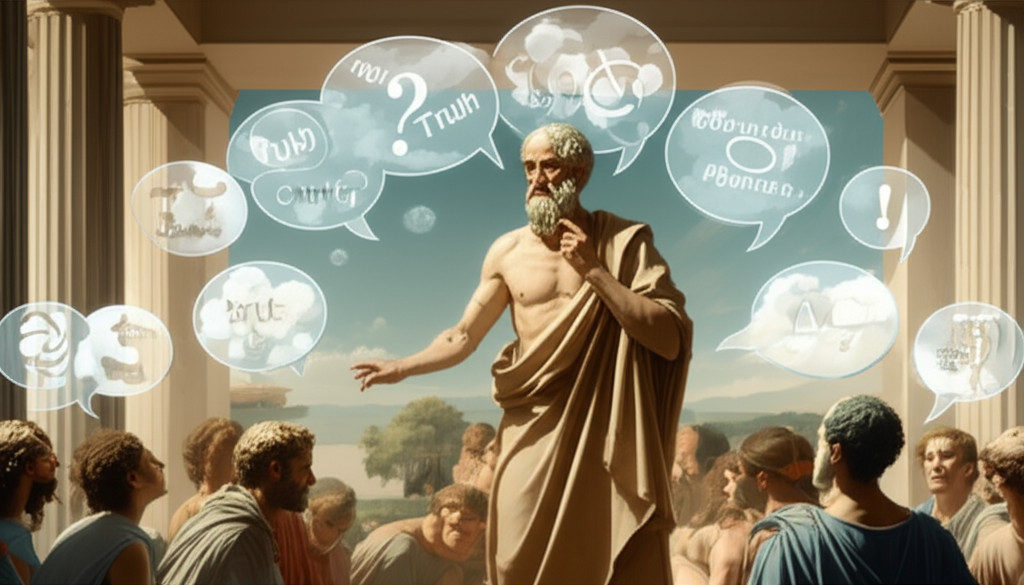
Key Philosophical Questions on Language and Thought
The enduring inquiry into this relation has given rise to several fundamental questions that continue to challenge philosophers:
- Can we truly think without language, particularly abstract ideas?
- Does language merely express thought, or does it fundamentally shape, and perhaps even limit, our cognitive processes?
- How do we form abstract ideas—such as justice, beauty, or truth—and what role does language play in their conceptualization?
- What is the precise relation between words and the reality they purport to describe?
- Does the structure of our mind dictate the structure of our language, or vice versa, creating a feedback loop of influence?
Conclusion: An Inseparable Bond
The journey through the Great Books of the Western World reveals a consistent, albeit evolving, fascination with the relation between language and thought. From Plato's Forms to Locke's ideas and Kant's categories, philosophers have consistently sought to understand how the mind generates meaning and how language enables its expression and communication. What emerges is not a simple hierarchy but an intricate, reciprocal dynamic. Language is more than a mere tool; it is an environment in which our ideas flourish, are refined, and become communicable. The human mind cannot fully realize its potential for complex thought without the rich, structuring power of language, making them an inseparable and mutually constitutive bond.
📹 Related Video: What is Philosophy?
Video by: The School of Life
💡 Want different videos? Search YouTube for: ""Philosophy of Language and Thought: Ancient to Modern Views""
📹 Related Video: PLATO ON: The Allegory of the Cave
Video by: The School of Life
💡 Want different videos? Search YouTube for: ""Does Language Shape Thought? Philosophical Debate""