

The Eternal Dance: Unpacking the Relationship Between Fate and Will
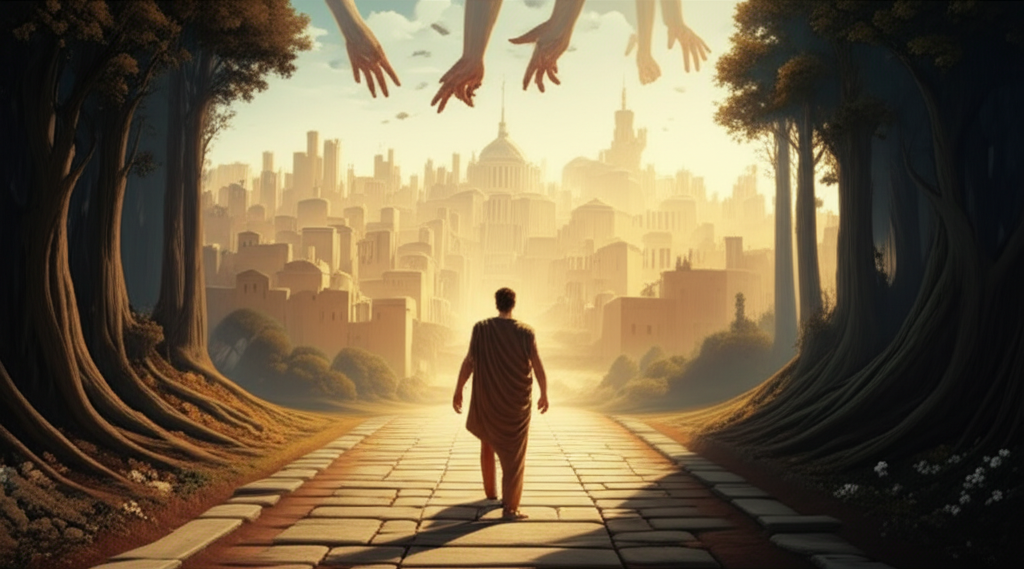
The human experience is a constant negotiation between what we believe is predetermined and what we feel we choose. Are our lives meticulously scripted by an unseen hand, or are we the sculptors of our own destiny? This profound relation between fate and will has captivated philosophers, poets, and everyday thinkers for millennia, forming a cornerstone of inquiry within the Great Books of the Western World. This article delves into the intricate interplay of these forces, exploring how different philosophical traditions have grappled with the tension between the inevitable and the volitional, touching upon concepts of necessity and contingency.
Table of Contents
- The Unyielding Hand of Fate: What Does It Mean to Be Fated?
- The Assertion of Will: Embracing Choice and Agency
- The Intricate Relation: Where Worlds Collide
- Echoes Through the Great Books: A Philosophical Journey
- Ancient Insights: From Homeric Destiny to Stoic Acceptance
- Medieval Syntheses: Divine Providence and Human Liberty
- Early Modern Challenges: Reason, Causality, and Freedom
- Existentialist Affirmations: Radical Freedom in a Meaningless World
- Navigating the Tension: Implications for Life
- Conclusion: The Ongoing Dialogue
The Unyielding Hand of Fate: What Does It Mean to Be Fated?
When we speak of fate, we often conjure images of an inescapable destiny, a predetermined course of events that unfolds regardless of our desires or efforts. This concept manifests in various forms across philosophical thought:
- Determinism: The belief that all events, including human actions, are ultimately determined by causes external to the will. This can be causal (every event is the inevitable result of prior causes) or logical (the truth of future propositions is already fixed).
- Predestination: A theological variant, often associated with divine omniscience and omnipotence, where God has foreordained all events, including who will be saved or damned.
- Cosmic Necessity: In ancient thought, particularly among the Stoics, the universe operates according to an unyielding rational order or logos. Everything that happens is part of this necessary cosmic plan.
Consider the tragic heroes of Greek drama, like Oedipus, whose fate is sealed by prophecy long before his birth. His attempts to defy it only serve to bring it to pass, illustrating a powerful sense of an unalterable destiny.
The Assertion of Will: Embracing Choice and Agency
Opposite the seemingly immovable force of fate stands the concept of will—our capacity for conscious choice, self-determination, and intentional action.
- Free Will: The power of acting without the constraint of necessity or fate; the ability to choose between different possible courses of action.
- Agency: The capacity of an individual to act independently and to make their own free choices.
- Moral Responsibility: A key implication of free will, suggesting that because we can choose, we are accountable for our actions and their consequences.
If fate dictates every step, where does that leave our sense of accomplishment, our regret, or our aspirations? The very fabric of our legal systems, ethical frameworks, and personal relationships rests on the assumption that we possess a genuine capacity for choice.
The Intricate Relation: Where Worlds Collide
The relation between fate and will is not a simple dichotomy but a complex spectrum, giving rise to profound philosophical dilemmas.
The Paradox at the Core
If everything is fated, then our will is an illusion. If our will is truly free, then fate loses its absolute power. How can both be true? This paradox has led to various attempts at reconciliation:
- Compatibilism: The view that free will and determinism are mutually compatible and that it is possible to believe in both without logical inconsistency. Often, this involves redefining "free will" not as an absence of causation, but as action stemming from one's own desires and intentions, even if those desires are themselves causally determined.
- Incompatibilism: The view that free will and determinism are mutually exclusive. This camp is further divided into:
- Hard Determinism: Fate (determinism) is true, and therefore free will is an illusion.
- Libertarianism: Free will is true, and therefore determinism is false.
- Pessimistic Incompatibilism: Neither determinism nor indeterminism allows for free will.
Contingency in a Determined World
The concept of contingency offers a crucial lens through which to view this relation. A contingent event is one that might or might not happen; its occurrence is not necessary.
| Concept | Description | Relation to Fate/Will |
|---|---|---|
| Necessity | That which must be; cannot be otherwise. | Often associated with fate and determinism. |
| Contingency | That which may or may not be; depends on circumstances or choice. | Often associated with free will and the possibility of alternative outcomes. |
Some philosophers argue that even in a determined universe, our subjective experience of contingency – the feeling that we could have chosen otherwise – is what defines our freedom, even if that freedom is psychological rather than metaphysical. Others contend that true freedom requires genuine contingency in the world itself, allowing for open possibilities.
Echoes Through the Great Books: A Philosophical Journey
The relation between fate and will is a recurring motif in the Great Books, each era offering unique perspectives.
Ancient Insights: From Homeric Destiny to Stoic Acceptance
- Homer and the Tragedians: Early Greek thought, as seen in the Iliad or Sophocles' Oedipus Rex, often portrays a world where human actions are intertwined with, and often subservient to, the decrees of the gods or an overarching cosmic destiny. While heroes exhibit will and make choices, these often serve to fulfill an already written fate.
- Plato and Aristotle: While acknowledging cosmic order, both philosophers emphasized the importance of individual character, virtue, and rational choice. For Plato, the soul's choices in previous lives influence its fate, yet reason allows for self-improvement. Aristotle, in works like Nicomachean Ethics, firmly grounds moral responsibility in voluntary action, distinguishing between what is chosen and what happens by necessity or compulsion.
- The Stoics (e.g., Epictetus, Marcus Aurelius): Advocated a profound acceptance of what is fated. They believed the universe is governed by an intelligent, rational principle (logos) that dictates all events with necessity. True freedom, for a Stoic, lies not in changing external events (which are fated), but in aligning one's will with the cosmic order, accepting what cannot be controlled, and focusing will on one's own perceptions and reactions.
Medieval Syntheses: Divine Providence and Human Liberty
The advent of monotheistic religions introduced a new layer of complexity: how does an omniscient, omnipotent God's plan (Divine Providence, a form of fate) reconcile with human free will?
- Saint Augustine: In Confessions and On Free Choice of the Will, Augustine grappled with God's foreknowledge and human sin. He argued that God's foreknowledge does not cause human actions; rather, God knows what humans will freely choose. The problem of evil further complicated this, leading him to emphasize divine grace as essential for the will to choose good, though not entirely negating human responsibility.
- Saint Thomas Aquinas: Drawing heavily on Aristotle, Aquinas, in Summa Theologica, provided a sophisticated synthesis. He distinguished between God's universal causality (which encompasses all things) and human secondary causality. God moves the will as a first cause, but the will retains its own proper movement and freedom. He introduced the idea of contingency within divine providence, where God's plan includes contingent events that depend on free choices.
Early Modern Challenges: Reason, Causality, and Freedom
The rise of scientific inquiry and mechanistic views of the universe posed new challenges to free will.
- Baruch Spinoza: In Ethics, Spinoza presented a rigorously deterministic system. He posited God (or Nature) as the sole substance, operating under strict necessity. Human beings are modes of this substance, and our actions, like all events, are causally determined. Free will is an illusion stemming from our ignorance of the true causes of our actions. Freedom, for Spinoza, is not the ability to choose otherwise, but the intellectual understanding and acceptance of this necessity.
- David Hume: While not a hard determinist, Hume, in A Treatise of Human Nature, argued that human actions are as predictable as physical events, governed by motives and character. He offered a compatibilist view: liberty is not the absence of causation, but the absence of external constraint. Our will is free when it acts according to our desires, even if those desires are themselves determined.
- Immanuel Kant: In his Critique of Pure Reason and Groundwork of the Metaphysics of Morals, Kant famously sought to reconcile scientific necessity (in the phenomenal world of experience) with moral freedom (in the noumenal world, the world as it is in itself). He argued that while our actions in the empirical world appear determined, as moral agents, we must presuppose free will to be responsible for our duties. Our will is truly free when it acts autonomously, guided by reason and the moral law, rather than by external impulses or inclinations.
Existentialist Affirmations: Radical Freedom in a Meaningless World
In the 20th century, existentialism offered a radical reassertion of human will and contingency.
- Jean-Paul Sartre: In Being and Nothingness, Sartre famously declared that "man is condemned to be free." There is no predetermined fate or essential human nature; we are thrown into existence and must continually create ourselves through our choices. This radical freedom comes with the heavy burden of absolute responsibility, leading to anguish and dread. For Sartre, denying this freedom and blaming external forces (like fate) is an act of "bad faith."
Navigating the Tension: Implications for Life
The ongoing philosophical debate about fate and will has profound practical implications:
- Moral Responsibility: If fate is absolute, can we truly be held responsible for our actions? This question underpins legal systems and ethical judgments.
- Hope and Action: A belief in free will fuels hope, innovation, and the motivation to strive for a better future. If all is fated, what is the point of effort?
- Personal Agency: Our sense of self, our identity, and our capacity for personal growth are deeply tied to the belief that our choices matter.
The Great Books remind us that this isn't merely an academic exercise. It's about how we choose to live, how we understand our place in the cosmos, and what it means to be human. Do we passively accept what comes, or do we vigorously shape our path, knowing that perhaps even that shaping is part of a grander design?
Conclusion: The Ongoing Dialogue
The relation between fate and will remains one of philosophy's most enduring and captivating mysteries. From the ancient Greeks grappling with divine decrees to modern existentialists proclaiming radical freedom, thinkers have consistently sought to understand the boundaries of our agency in a world often perceived as governed by necessity. While no single answer fully resolves the tension, the journey through these profound ideas, enriched by the wisdom of the Great Books, illuminates the depth of the human condition. It prompts us to reflect on our choices, our responsibilities, and the ever-present interplay between what is given and what we create.
📹 Related Video: What is Philosophy?
Video by: The School of Life
💡 Want different videos? Search YouTube for: ""Free Will vs Determinism Crash Course Philosophy #24""
📹 Related Video: STOICISM: The Philosophy of Happiness
Video by: The School of Life
💡 Want different videos? Search YouTube for: ""The Stoics on Fate and Free Will""