

The Enduring Dance: Unpacking the Relationship Between Fate and Will
The human experience is perpetually caught between the whispers of destiny and the shouts of personal conviction. Is our path predetermined, or are we the architects of our own journey? This profound relation between fate and will stands as one of philosophy's most ancient and compelling debates, a central thread woven through the tapestry of the Great Books of the Western World. It's a question that doesn't just reside in abstract thought but permeates our understanding of responsibility, morality, and the very nature of existence itself. This article will delve into the intricate interplay between these concepts, exploring how philosophers have grappled with necessity and contingency in their quest to define human agency.
A Summary of the Cosmic Tug-of-War
At its core, the relation between fate and will explores the extent of human freedom within a universe that may or may not be predetermined. Fate suggests an unalterable sequence of events, a cosmic blueprint beyond our control, often tied to divine providence or immutable natural laws. Will, conversely, champions our capacity for conscious choice, deliberation, and self-determination. The tension arises when we ask how these two forces can coexist. Do we merely play out a script, or do our choices genuinely shape our reality? Philosophers, from the Stoics to Kant, have offered diverse and often conflicting answers, framing this debate through the lenses of necessity and contingency.
Defining the Players: Fate, Will, Necessity, and Contingency
To truly understand the relation, we must first clarify our terms. These concepts, while often discussed together, carry distinct philosophical weight.
- Fate: Often conceived as an inescapable destiny, a preordained course of events. This can manifest as:
- Cosmic Determinism: The universe operates on strict cause and effect, leaving no room for alternative outcomes.
- Divine Predestination: A higher power has already charted every event, including our choices.
- Natural Law: Events unfold according to immutable laws of nature, irrespective of human desire.
- Will: Refers to the faculty of consciousness that allows for choice, intention, and action. It embodies:
- Free Will: The belief that individuals have the power to make genuine choices that are not entirely determined by prior causes.
- Moral Agency: The capacity to act ethically and be held responsible for one's actions.
- Self-Determination: The ability to guide one's own life and make decisions based on personal reason or desire.
- Necessity and Contingency: These terms provide the framework for understanding the nature of events themselves.
- Necessity: An event or truth that must be the case; it cannot be otherwise. For instance, the laws of physics are often considered necessary, or a logical truth like "all bachelors are unmarried." In the context of fate, necessary events are those that are unavoidable.
- Contingency: An event or truth that could be otherwise; it is not compelled to exist or happen. Most everyday occurrences are contingent – you could have chosen a different path to work, or the weather could have been different. Free will is often argued to operate in the realm of contingency.
| Concept | Core Idea | Philosophical Implication |
|---|---|---|
| Fate | Predetermined, unalterable sequence of events. | Limits or negates true human freedom; implies a grand design or causal chain. |
| Will | Capacity for conscious choice, intention, and action. | Basis for moral responsibility, autonomy, and the belief in genuine alternatives. |
| Necessity | That which must be; cannot be otherwise. | Often associated with determinism, natural laws, or logical truths. |
| Contingency | That which could be otherwise; not compelled to exist or happen. | The domain where free will is often argued to operate; possibility and openness. |
Echoes from the Great Books: A Historical Perspective
The philosophical journey through the relation between fate and will is rich with diverse perspectives, each contributing to our nuanced understanding.
Ancient Greece: Destiny's Grip and the Dawn of Choice
In ancient Greek thought, particularly in epic poetry like Homer's Iliad and Greek tragedy, fate often loomed large, an inescapable force even for the gods. Yet, even amidst this, we see the nascent exploration of will.
- The Stoics: Philosophers like Epictetus and Marcus Aurelius grappled directly with fate. They posited a deterministic universe governed by an all-encompassing rational principle (Logos). For them, wisdom lay in understanding what is within our control (our judgments, desires, actions – our will) and what is not (external events, our body, reputation – fate). Freedom, for the Stoics, was not the ability to change fate, but the ability to align one's will with the rational order of the universe, accepting necessity with equanimity.
- Aristotle: In his Nicomachean Ethics, Aristotle places significant emphasis on human will and choice. He argues that moral virtue is developed through habituation and deliberate choice (prohairesis). We are responsible for our character because we choose our actions, demonstrating a clear belief in contingency and the power of the individual will to shape moral destiny.
Medieval Theology: Divine Foreknowledge and Human Freedom
The advent of monotheistic religions intensified the debate, introducing the problem of divine omnipotence and omniscience.
- St. Augustine: A central figure in reconciling divine foreknowledge with human free will. In On Free Choice of the Will, Augustine grapples with how God can know all future events (implying necessity) and yet humans still be genuinely free to choose good or evil (implying contingency and responsibility). His solution often involved distinguishing between God's knowledge and God's causation, arguing that foreknowledge doesn't compel actions.
- St. Thomas Aquinas: Building on Aristotle, Aquinas further explored the relation in Summa Theologica. He maintained that God's providence extends to all things, yet human beings possess free will. He distinguished between God's primary causality and secondary causes (including human will), allowing for genuine human agency within a divinely ordered universe.
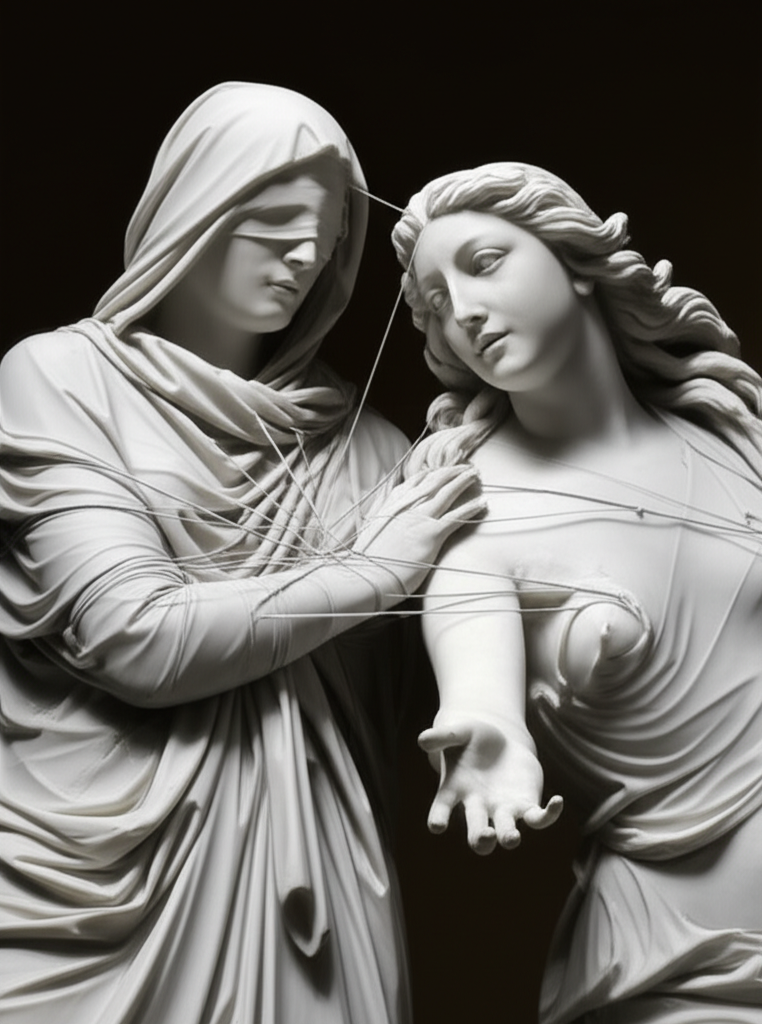
Early Modern Philosophy: Rationalism, Determinism, and the Call for Autonomy
The Enlightenment brought new perspectives, often emphasizing reason and scientific determinism.
- Baruch Spinoza: In his Ethics, Spinoza presented a rigorously deterministic worldview. For Spinoza, everything that happens is a necessary consequence of God's (or Nature's) infinite attributes. Human will is not truly free but is rather a mode of thought determined by prior causes. Freedom, for Spinoza, is the intellectual understanding of this necessity, leading to a serene acceptance rather than an illusion of choice.
- Immanuel Kant: A staunch defender of free will, particularly in his Critique of Practical Reason. Kant argued that while the empirical world might be governed by necessity (the phenomenal realm), human beings, as rational agents, possess a transcendental freedom in the noumenal realm. This freedom of the will is not something we can empirically prove, but it is a necessary postulate for morality, as moral responsibility would be meaningless without it. The relation here is one of dualism: determinism in the world of appearances, freedom for the moral agent.
The Intertwined Relation: More Than Just Opposition
While often presented as an either/or dilemma, the relation between fate and will is arguably more nuanced. Many philosophers suggest that fate might provide the framework or set the initial conditions, while will operates within those parameters.
Consider the metaphor of a river. The riverbed, its banks, and the general direction of the current might represent fate or necessity – unchangeable givens. Yet, a boat navigating the river still has choices: to paddle faster, to steer left or right to avoid obstacles, to decide when to dock. These choices represent the will and the realm of contingency. The boat cannot change the river's fundamental course, but it can influence its own journey within that course.
This perspective allows for:
- Acknowledging Limits: We are born into specific circumstances, possess certain inherent talents or limitations, and exist within a universe governed by physical laws. These are aspects of necessity.
- Emphasizing Agency: Despite these limits, we still make choices, deliberate, and strive. Our will allows us to respond creatively to our circumstances, to find meaning, and to shape our character.
The relation is therefore not a simple opposition where one negates the other, but a dynamic interplay where necessity defines the stage and will performs the drama.
Conclusion: The Enduring Mystery of Our Agency
The relation between fate and will remains one of philosophy's most profound and unresolved mysteries. From the tragic heroes of ancient Greece battling their destinies to Kant's defense of transcendental freedom, thinkers have relentlessly sought to understand the extent of our control over our lives. The concepts of necessity and contingency provide the intellectual tools to dissect this problem, revealing the intricate layers of determination and choice that define the human condition.
Ultimately, the ongoing debate compels us to reflect on our responsibility, our aspirations, and our place in the cosmos. Whether we see ourselves as entirely free, wholly fated, or somewhere in between, the very act of questioning this relation underscores our unique capacity for self-awareness and philosophical inquiry.
**## 📹 Related Video: What is Philosophy?
Video by: The School of Life
💡 Want different videos? Search YouTube for: ""Fate vs Free Will - Crash Course Philosophy #24""**
**## 📹 Related Video: ARISTOTLE ON: The Nicomachean Ethics
Video by: The School of Life
💡 Want different videos? Search YouTube for: ""Determinism and Free Will: An Introduction""**