

The relationship between Fate and History is one of philosophy's most enduring and perplexing questions. Are the events that unfold in our world, which we dutifully record as History, merely the inevitable manifestation of a preordained Fate? Or is History a testament to human agency, a sprawling narrative woven from countless individual choices and contingent circumstances, constantly pushing against any notion of an unalterable destiny? This article delves into this profound tension, exploring how philosophers throughout Time have grappled with the interplay of Necessity and Contingency in shaping the human story.
The Unyielding Hand of Fate: An Ancient Whisper
From the earliest myths to the grandest philosophical treatises, the concept of Fate has haunted human consciousness. It represents the idea that certain events must happen, irrespective of individual desires or efforts. Whether personified as the Greek Moirai, the Roman Parcae, or conceived as a cosmic law, Fate often implies an inescapable destiny.
Ancient Echoes of Predestination
In the Great Books of the Western World, we encounter this powerful notion repeatedly. The tragic heroes of Sophocles, such as Oedipus, find themselves entangled in a web of prophecy and divine decree from which there is no escape. Their actions, though seemingly their own, ultimately serve to fulfill a predetermined destiny. The Stoics, too, embraced a form of fatalism, arguing that the universe operates according to an immutable rational order (logos), and true wisdom lies in accepting what is fated.
Consider Boethius's Consolation of Philosophy, written while he awaited execution. He wrestles with the problem of divine foreknowledge and human free will, asking whether God's perfect knowledge of future events implies that those events are fated and our choices illusory. This deep dive into Necessity highlights the challenge Fate poses to any conception of genuine human freedom.
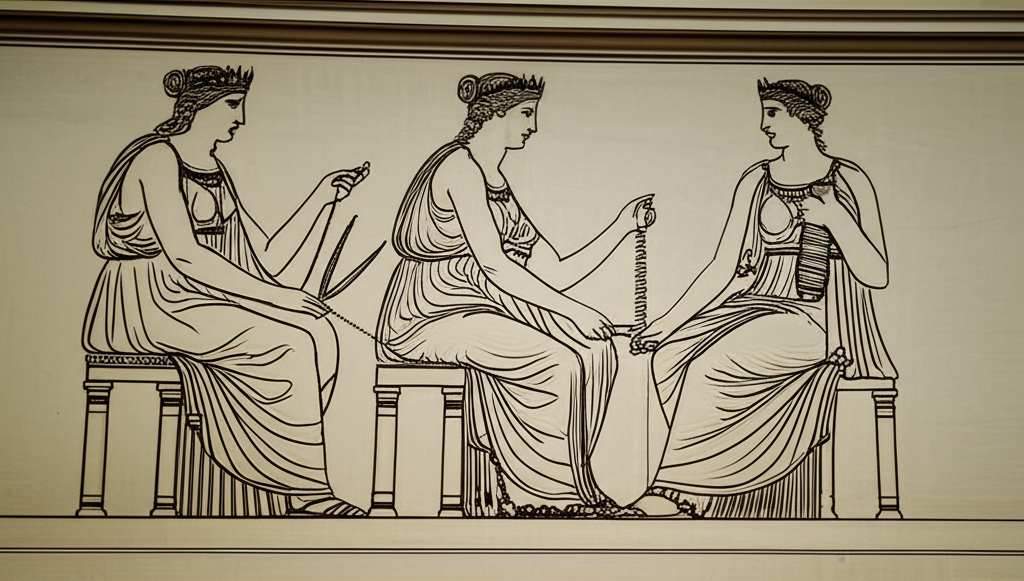 – Clotho spinning the thread of life, Lachesis measuring it out, and Atropos cutting it, symbolizing the predetermined nature of human existence.)
History's Tapestry: Woven by Choice
In stark contrast to the unyielding grip of Fate, History presents itself as a dynamic, evolving record of human endeavors. It is the story of societies rising and falling, of innovations transforming lives, of wars fought and peace brokered. Here, the emphasis shifts from predestination to human agency, to the myriad choices that, for better or worse, have shaped our world.
The Arena of Human Agency
Historians like Thucydides, in his History of the Peloponnesian War, meticulously document the decisions of leaders, the strategies of armies, and the motivations of city-states. While he acknowledges the role of chance, his work primarily illustrates how human deliberation, ambition, and folly drive events. There's a strong sense of Contingency in his narrative – the idea that things could have unfolded differently had different choices been made.
Even within theological frameworks, such as Augustine's City of God, while God's ultimate plan is acknowledged, there's significant room for human responsibility and the consequences of moral choices in the unfolding of earthly History. The "city of man" is built by human hands, its History a reflection of human will, even if ultimately overseen by divine providence.
Time's Relentless March: Necessity and Contingency
The intersection of Fate and History is perhaps most keenly felt in our understanding of Time and the forces of Necessity and Contingency.
Time itself can be seen as the medium through which both Fate (if it exists) is revealed and History is recorded. Is Time merely the stage upon which a pre-written drama unfolds, or is it the very fabric within which new possibilities are constantly being woven?
The Interplay of What Must Be and What Might Be
The tension between Necessity – what must happen – and Contingency – what might happen or could have happened – is central to this debate. If Fate dictates Necessity, then History becomes merely the chronicling of its inevitable unfolding. However, if History is truly shaped by human choices and unpredictable events, then Contingency reigns supreme, and Fate loses its grip.
Consider the following distinctions:
| Aspect | Perspective of Fate (Necessity) | Perspective of History (Contingency) |
|---|---|---|
| Driving Force | Cosmic law, divine will, inherent structure of reality | Human choices, chance events, social movements, individual actions |
| Nature of Events | Inevitable, predetermined, unalterable | Open-ended, subject to change, influenced by countless variables |
| Role of Prediction | Possible, as the future is already set | Difficult, as outcomes are not fixed |
| Human Freedom | Limited, illusory, or only effective within a fated framework | Central, enabling agency and responsibility |
| Meaning of "Why?" | To understand the divine plan or cosmic order | To understand causes, motivations, and consequences of human actions |
Philosophers like Hegel, in his Philosophy of History, attempted a grand synthesis, suggesting that History is the unfolding of a rational spirit or 'Geist,' moving towards a necessary end. In this view, individual actions, while seemingly contingent, contribute to a larger, necessary historical progression. Yet, even here, the question of whether this "necessity" is truly predetermined or merely a retrospective understanding of past events remains.
Reconciling the Irreconcilable?
Can Fate and History truly be reconciled? Perhaps the answer lies not in choosing one over the other, but in understanding their complex interplay. Fate might represent the underlying structures, the universal laws, or the deep-seated human tendencies that set the broad parameters for existence. Within these parameters, History unfolds as the arena of human freedom, innovation, and the unpredictable dance of Contingency.
We are, perhaps, fated to exist within certain biological and physical laws, but how we live, what societies we build, and the stories we tell become our History. The very act of engaging with the past, of learning from its lessons, implies a belief in our ability to shape the future, to resist what feels inevitable, and to forge new paths.
Ultimately, the relationship between Fate and History remains a dynamic philosophical frontier. It challenges us to reflect on our place in the cosmos: are we mere instruments of a grand, hidden design, or are we the active co-authors of an ever-unfolding narrative? The Great Books offer no easy answers, but they provide the profound questions that continue to define our human experience.
YouTube Video Suggestions:
-
📹 Related Video: What is Philosophy?
Video by: The School of Life
💡 Want different videos? Search YouTube for: "Fate vs Free Will Philosophy"
-
📹 Related Video: What is Philosophy?
Video by: The School of Life
💡 Want different videos? Search YouTube for: "Necessity and Contingency in Philosophy History"