

The Unfolding Tapestry: Fate, History, and the Dance of Time
Summary: The relationship between fate and history is one of philosophy's most enduring and intricate puzzles. At its core, it asks whether human events, the very fabric of history, are predetermined by an inescapable cosmic necessity (fate), or if they emerge from the unpredictable tapestry of human choice and contingency. This article delves into how these two powerful concepts interact, are shaped by time, and have been debated across the millennia, drawing insights from the "Great Books of the Western World."
Introduction: The Enduring Question
From the ancient Greek tragedians to modern existentialists, humanity has grappled with the fundamental question: are we merely actors in a play scripted by an unseen hand, or are we the playwrights of our own unfolding drama? This profound inquiry lies at the heart of understanding the relationship between fate and history. History, in its broadest sense, is the chronicle of human events, actions, and consequences. Fate, conversely, suggests a predetermined course, an inevitable destiny. How these two forces—one seemingly born of human agency, the other of cosmic decree—coexist, collide, or even define each other, forms a cornerstone of philosophical thought.
I. The Implacable Hand of Fate: Necessity's Embrace
The concept of fate has deep roots in Western thought, often linked to an idea of necessity that transcends human will. For the ancient Greeks, Moira or Fate was a power even the gods could not defy. Sophocles' Oedipus Rex stands as a stark testament to this, where Oedipus's every attempt to escape his prophecy only draws him closer to its fulfillment. This isn't merely prediction; it's an unalterable decree.
Later, the Stoics embraced a sophisticated form of determinism, believing that the universe operates according to an immutable rational order, a divine Logos. For them, everything that happens is necessary, part of a grand design. While human beings possess free will in their assent to or dissent from events, the events themselves are fated. This perspective offers a profound sense of cosmic coherence, but also raises challenging questions about moral responsibility and the efficacy of human action.
- Key Characteristics of Fate:
- Predetermination: Events are set in advance.
- Inescapability: Attempts to alter fate are futile.
- Necessity: Events unfold according to an inherent, unchangeable law or design.
- Cosmic or Divine Origin: Often attributed to gods, a universal order, or divine will.
II. History: The Human Drama of Contingency
In contrast to the rigid structure of fate, history often appears as a realm of contingency—the unpredictable, the accidental, the result of countless individual and collective choices. History is the story of human endeavor, replete with triumphs and failures, revolutions and regressions, all seemingly born from the decisions made at critical junctures.
Think of Thucydides' History of the Peloponnesian War, which meticulously details the political maneuverings, strategic blunders, and human passions that shaped a pivotal conflict. Here, the focus is on observable causes and effects, on the rational (and irrational) choices of leaders and citizens. There's a strong sense that different choices could have led to different outcomes.
Niccolò Machiavelli, in The Prince, explicitly acknowledges the role of Fortuna (fortune or fate), but he equally emphasizes Virtù (skill, courage, prowess) as the human capacity to navigate and even bend fortune to one's will. For Machiavelli, history is not merely a passive unfolding but an active struggle where human agency, for better or worse, plays a decisive role.
- Key Characteristics of History (as distinct from Fate):
- Human Agency: Driven by human decisions, actions, and intentions.
- Contingency: Events are not inevitable; alternative outcomes are possible.
- Unpredictability: The future is open and subject to change.
- Process of Change: An ongoing, dynamic narrative of evolution and transformation.
III. Time's Unseen Current: Where They Converge (or Diverge)
The concept of time is the crucible in which fate and history are forged and examined. Is time a linear progression towards a fixed, fated endpoint, or is it an open, branching path where historical events continuously reshape the future?
For St. Augustine, in Confessions and City of God, time is a creation of God, moving linearly from creation to judgment. While he wrestled with the problem of free will, his theology posits a divine providence that, while not strictly "fate" in the pagan sense, imbues history with a purposeful, divinely guided direction—a form of necessity ultimately leading to God's plan. Human history, in this view, becomes the unfolding of a pre-ordained spiritual journey.
Later, Georg Wilhelm Friedrich Hegel, in his Phenomenology of Spirit, presented history as the unfolding of absolute spirit or reason. For Hegel, history is not a series of random events but a rational, dialectical process moving towards a predetermined end: the realization of absolute freedom and self-consciousness. This teleological view of history imbues it with a powerful sense of necessity, almost making it a form of collective fate, where individual actions contribute to a larger, inevitable historical trajectory.
IV. The Great Debate: Necessity vs. Contingency
The philosophical tension between necessity and contingency is central to understanding fate and history.
- Necessity aligns with the idea that certain events must happen, often due to physical laws, logical principles, or divine decree. If fate is real, then the events of history are largely necessary.
- Contingency suggests that events might not have happened, or could have happened differently. If history is truly shaped by human choices and unpredictable circumstances, then it is largely contingent.
Philosophers have attempted to reconcile these forces in various ways:
- Compatibilism: Argues that free will (and thus historical contingency) can coexist with determinism (and thus a form of fate/necessity). Our choices are free because they are our own, even if those choices are themselves determined by prior causes.
- Incompatibilism: Maintains that free will and determinism are mutually exclusive. If fate is real, history is not truly contingent; if history is contingent, then fate cannot be entirely deterministic.
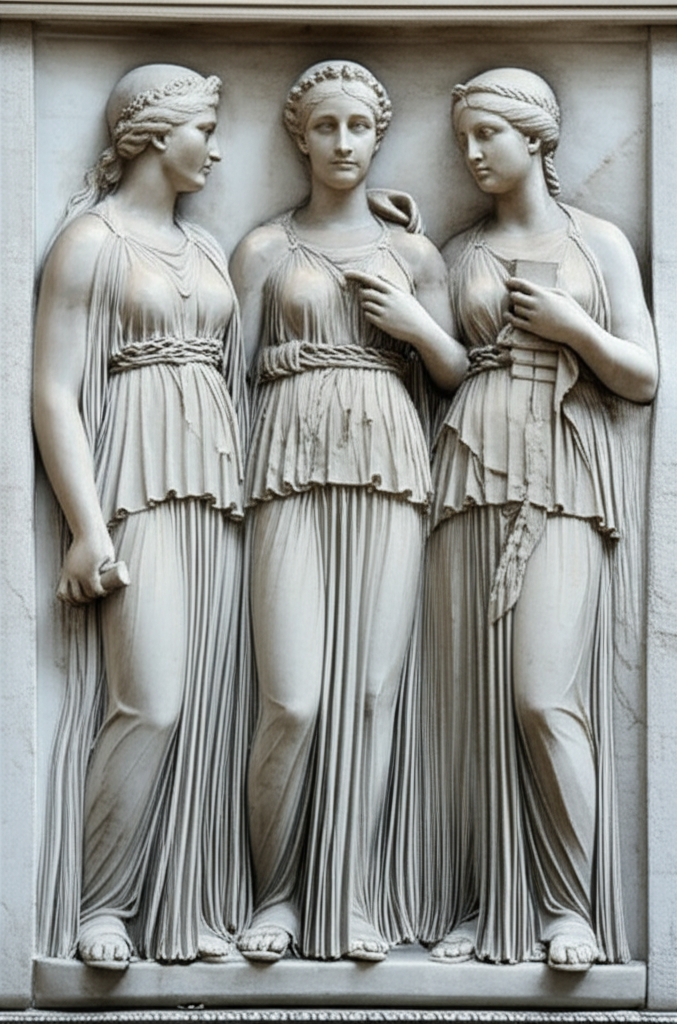 spinning, measuring, and cutting the thread of human life. Their faces are stern and ancient, their hands engaged with the symbolic threads, while in the background, a chaotic, dynamic scene of human historical events—battles, construction, intellectual discourse—unfolds, suggesting the contrast between their static, immutable task and the vibrant, contingent human experience.)
V. Echoes from the Great Books
The "Great Books of the Western World" offer a rich tapestry of perspectives on this relationship:
- Homer's Iliad and Odyssey: The gods frequently intervene, guiding or thwarting human endeavors, yet heroes like Achilles and Odysseus make crucial, often fated, choices that shape their destinies and the course of the war.
- Plato's Republic: While discussing the ideal state and justice, Plato hints at a cosmic order and a Forms that suggest an underlying structure to reality, which could be interpreted as a form of philosophical necessity guiding the potential for human societal development.
- Aristotle's Nicomachean Ethics: Emphasizes practical wisdom (phronesis) and human choice in shaping individual character and the good life, focusing on the contingent nature of moral action rather than predetermined outcomes.
- Leo Tolstoy's War and Peace: Tolstoy famously grapples with the 'great man' theory of history, arguing that individual leaders (like Napoleon) are merely instruments of larger, impersonal historical forces, almost a form of collective fate, rather than true shapers of events. He posits that history is moved by the aggregate of countless small actions, not by singular wills.
- Karl Marx's Das Kapital: While not speaking of "fate" in a divine sense, Marx proposed a historical materialism where economic forces and class struggle necessarily drive history towards specific stages, culminating in communism. This presents history as a deterministic, albeit secular, process.
Conclusion: An Unresolved Symphony
The relationship between fate and history remains an active and vital area of philosophical inquiry. Is history merely the stage upon which a fated drama unfolds, or is fate a concept we invoke to make sense of history's often overwhelming and unpredictable contingencies? The interplay of time, necessity, and contingency continues to challenge our understanding of agency, responsibility, and the very meaning of human existence. As we look back at the historical record, we see patterns that might suggest destiny, yet we also feel the undeniable pull of our own choices, forever suspended between what must be and what might yet be.
YouTube Video Suggestions:
-
📹 Related Video: What is Philosophy?
Video by: The School of Life
💡 Want different videos? Search YouTube for: ""Fate vs Free Will Philosophy Debate""
2. ## 📹 Related Video: What is Philosophy?
Video by: The School of Life
💡 Want different videos? Search YouTube for: ""Hegel Philosophy of History Explained""