

The Unseen Hand and the Human Story: Navigating Fate and History
The human journey, as meticulously chronicled in the annals of history, often presents itself as a grand narrative of cause and effect, choice and consequence. Yet, beneath this visible tapestry of events, a persistent philosophical question lingers: To what extent are these unfolding moments truly free, and to what extent are they guided, or even dictated, by an unseen, ineluctable force we call Fate? This article delves into the intricate and often contradictory relationship between Fate—the predetermined course of events—and History—the record of human experience through Time, exploring how philosophers from antiquity to the modern era have grappled with the concepts of Necessity and Contingency in shaping our understanding of existence.
I. The Echoes of Destiny: Unpacking the Concept of Fate
From the ancient Greek tragedians to the Stoic philosophers, the notion of Fate has cast a long shadow over human endeavors. It embodies the idea that certain events are inevitable, predetermined by a higher power, divine will, or an impersonal cosmic order.
- Classical Fate: In the world of Sophocles' Oedipus Rex, a tragic hero's desperate attempts to escape his prophecy only lead him deeper into its fulfillment. Here, fate is a relentless, often cruel, force that even the gods cannot entirely alter. It speaks to a profound sense of Necessity—what must be.
- Stoic Determinism: For thinkers like Epictetus and Marcus Aurelius, fate was understood as the rational, ordered unfolding of the universe (Providence). While advocating for inner freedom and acceptance of what cannot be changed, they acknowledged a deterministic cosmos where events are causally linked.
- Medieval Providence: Christian theology introduced the concept of divine Providence, where God's foreknowledge and plan guide all events. This raised complex questions about human free will, famously debated by figures like Boethius in The Consolation of Philosophy.
Regardless of its specific interpretation, Fate fundamentally challenges the idea of absolute human autonomy, suggesting that the path of Time is, in some measure, already etched.
II. History's Canvas: The Human Narrative in Time
History, in contrast, appears to be the domain of human agency. It is the study of past events, human societies, and the forces that have shaped them. Historians meticulously piece together evidence, seeking to understand motivations, decisions, and the contingent circumstances that led to particular outcomes.
Key Facets of History:
- The Medium of Time: History is intrinsically bound to Time. It records events in a chronological sequence, mapping change and development across generations and epochs.
- Human Agency: At its heart, History often emphasizes the choices of individuals and groups—leaders, innovators, revolutionaries—and their impact on the world.
- Contingency: A core aspect of historical understanding is the recognition that events could have unfolded differently. The "what ifs" of history highlight the role of chance, unforeseen circumstances, and individual decisions that were not necessary but contingent.
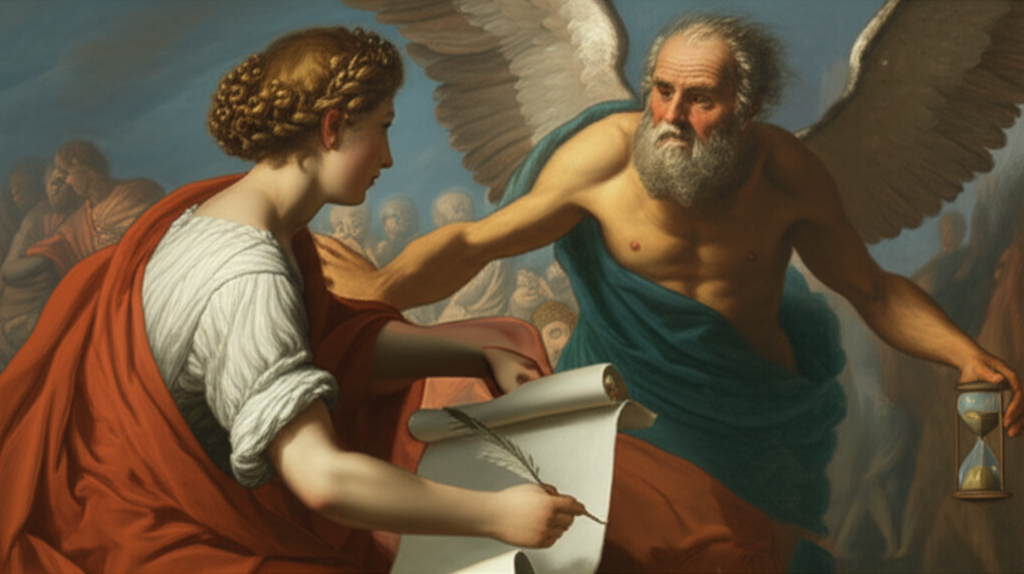
III. The Intertwined Threads: Where Fate and History Meet
The true philosophical challenge lies in reconciling these two powerful concepts. Is History merely the unfolding of Fate? Or does human freedom carve its own path, creating a History that is genuinely open-ended?
Points of Convergence:
- Grand Historical Narratives: Philosophers like Hegel posited a dialectical process in history, suggesting an inherent rationality or "spirit" guiding human development towards a specific end. Marx, similarly, saw history as the inevitable progression through class struggles towards communism, implying a certain historical Necessity.
- Patterns and Cycles: Some historians and philosophers observe recurring patterns in history—the rise and fall of empires, the repetition of certain social conflicts—which can be interpreted as evidence of underlying forces, almost fated rhythms, dictating human affairs.
- The Weight of the Past: While not strictly "fate," the cumulative effect of past decisions, environmental conditions, and established institutions can create a powerful momentum that severely limits present choices, making certain historical outcomes appear almost inevitable in retrospect.
Points of Divergence:
- The Role of the Individual: Great historical figures, from Alexander to Gandhi, often appear to defy prevailing trends, making choices that dramatically alter the course of events, demonstrating genuine Contingency.
- Unforeseen Events: Natural disasters, chance encounters, or sudden technological breakthroughs can dramatically shift the trajectory of history in ways that seem utterly un-fated and purely contingent.
- Moral Responsibility: If history is entirely fated, what then of moral responsibility? The Great Books often explore the tension between divine will and human culpability, suggesting that our choices, even within a larger framework, still matter.
IV. Necessity and Contingency: The Philosophical Crossroads
The distinction between Necessity and Contingency is crucial for understanding the relationship between Fate and History.
- Necessity: Refers to that which must be. In the context of fate, it suggests an outcome that cannot be otherwise, often due to logical, causal, or divine decree. If Fate is absolute, then all of History is a manifestation of Necessity.
- Contingency: Refers to that which might not be, or could be otherwise. It speaks to possibilities, chance, and genuine alternatives. If History is driven by human choice and random events, then it is rich with Contingency.
Philosophers continuously debate the balance. Is history a river whose course is fixed (necessity), or a series of rapids where countless eddies and currents (contingency) determine the immediate flow, even if the general direction is downstream? Aristotle, for instance, explored the nature of potentiality and actuality, allowing for both determined processes and contingent events within the natural world.
V. The Dynamic Narrative: Time as the Crucible
The relationship between Fate and History is not static; it is a dynamic inquiry that unfolds through Time itself. Our understanding of this relationship evolves as we gain new perspectives on causality, human psychology, and the vast sweep of historical data. The very act of writing History is an attempt to make sense of the past, to discern patterns, and perhaps to discover whether there is a guiding hand or simply the chaotic dance of human freedom.
Ultimately, the tension between Fate and History reflects a deeper human yearning: to understand our place in the cosmos. Are we merely players in a script written long ago, or are we the authors of our own unfolding narrative? The Great Books of the Western World offer no simple answer, but rather a rich tapestry of perspectives that invite us to continually ponder this profound question.
YouTube Video Suggestions:
-
📹 Related Video: What is Philosophy?
Video by: The School of Life
💡 Want different videos? Search YouTube for: "Fate vs Free Will Philosophy Debate"
-
📹 Related Video: PLATO ON: The Allegory of the Cave
Video by: The School of Life
💡 Want different videos? Search YouTube for: "Determinism vs Contingency in History"