

The Enduring Shadow: Unpacking the Relation Between Labor and Slavery
The relation between labor and slavery is one of philosophy's most enduring and discomforting inquiries, a stark reminder of humanity's capacity for both creation and exploitation. While distinct in their legal and social definitions, history and philosophy reveal a deeply intertwined narrative where the very act of labor, fundamental to man's existence and self-realization, has often been perverted into forms of bondage. This article will explore this complex relation, drawing insights from the Great Books of the Western World to understand how the necessity of labor has, throughout history, skirted dangerously close to the abyss of slavery.
From Necessity to Bondage: The Ancient Understanding of Labor
In ancient thought, particularly as articulated by figures like Aristotle in his Politics, the relation between labor and slavery was often viewed through the lens of societal structure and natural hierarchy. For the Greek polis, labor was a necessary but often demeaning activity, essential for the sustenance of the community but largely incompatible with the leisure required for citizenship and philosophical contemplation.
- Aristotle's "Natural Slavery": Aristotle posited that some individuals were "natural slaves," inherently suited to physical labor and lacking the rational capacity for self-governance. For him, the household required both master and slave, the latter providing the physical labor that freed the former for higher pursuits. This wasn't merely economic; it was a perceived natural order, establishing a foundational relation where one man's labor directly served another's freedom.
- The Burden of Toil: Across many ancient societies, labor was often seen as a curse or a punishment, a mark of the lower classes or conquered peoples. This perception implicitly linked intense, manual labor with a diminished status, paving the way for its association with various forms of servitude, whether chattel slavery or debt bondage.
The crucial point here is that the labor of the man who was a slave was not his own; it was alienated from his will and his person. This fundamental lack of self-possession is what defines slavery and distinguishes it from free labor, even though both involve physical or mental exertion.
The Enlightenment's Reassessment: Labor, Property, and the Seeds of Freedom
The Enlightenment brought a profound shift in understanding the relation between labor and individual rights. Thinkers like John Locke, in his Two Treatises of Government, began to elevate labor as the very source of property and a fundamental expression of man's self-ownership.
- Labor as Property: Locke argued that when a man mixes his labor with nature, he imbues it with his own essence, making it his property. This revolutionary idea placed labor at the heart of individual rights and freedom, directly contrasting with the ancient view of labor as a mark of subservience.
- The Inherent Contradiction: Despite this elevation, the institution of slavery persisted, creating a profound philosophical contradiction. How could man's labor be the source of his freedom and property, yet simultaneously be coercively extracted from others, denying them that very self-ownership? This tension highlighted that while labor could be an act of creation and self-realization, its relation to slavery underscored the ongoing struggle for true human liberty.
The Enlightenment's emphasis on individual autonomy and natural rights laid the groundwork for the eventual abolitionist movements, forcing a re-evaluation of the relation between what a man does (his labor) and who a man is (his inherent freedom).
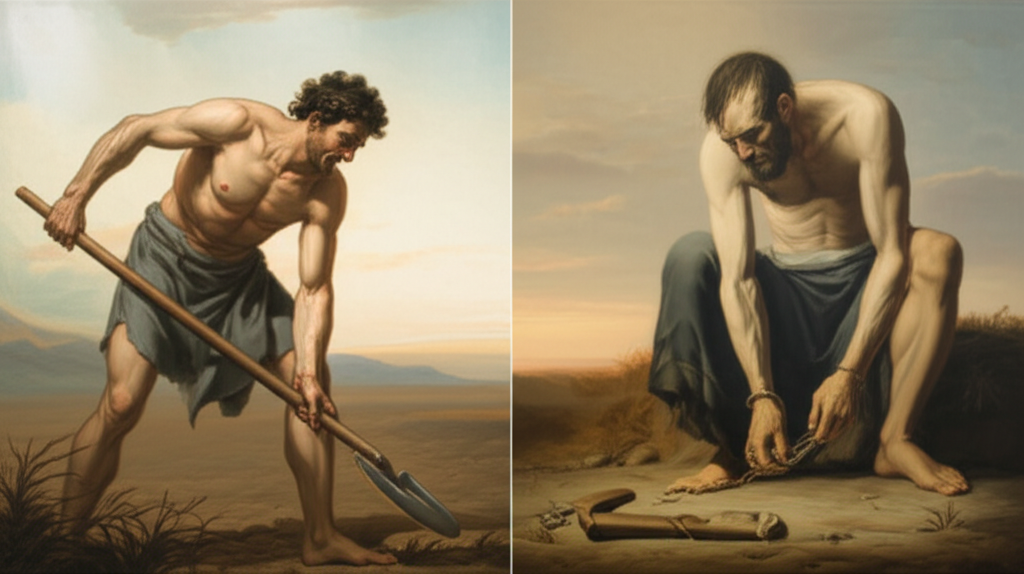
Industrialization and Alienated Labor: A New Form of Servitude?
The Industrial Revolution, while promising progress, introduced new complexities to the relation between labor and slavery. Karl Marx, a towering figure in the Great Books tradition, critically examined the nature of labor under capitalism, arguing that it could become a form of alienation akin to, if not identical with, a kind of "wage slavery."
- Alienated Labor: Marx contended that in capitalist societies, the man who labors often does not own the means of production, nor the product of his labor. His labor becomes a commodity to be bought and sold, and he becomes alienated from the product, the process, his fellow man, and ultimately, his own species-being. This alienation, Marx suggested, stripped labor of its fulfilling potential, reducing the worker to a mere appendage of the machine.
- Wage Slavery: While distinct from chattel slavery (where the person themselves is property), Marx argued that the economic compulsion to labor for wages, under conditions often dictated by others and with little control over one's work, could constitute a form of "wage slavery." The man is "free" to sell his labor, but not free from the necessity of selling it to survive, creating a coercive relation that echoes the power dynamics of traditional slavery.
The core philosophical problem here is the extent to which man can truly be free if his labor, the very essence of his productive being, is controlled by external forces, whether a master or the impersonal forces of the market.
The Modern Conundrum: Exploitation and the Enduring Shadow of Slavery
Today, the relation between labor and slavery continues to manifest in various forms, challenging our ethical and philosophical frameworks. While chattel slavery is globally condemned, modern forms of exploitation demonstrate that the shadow of slavery still looms over the world of labor.
- Human Trafficking and Forced Labor: Millions worldwide are trapped in modern slavery, forced to labor under threat, often in industries like agriculture, manufacturing, or domestic service. This is a direct, brutal manifestation of slavery, where man's labor is stolen, and his freedom utterly denied.
- Precarious Labor and Global Supply Chains: The globalized economy often relies on labor in developing nations where regulations are weak, and workers face extreme exploitation, long hours, and meager wages. While not legally slavery, the relation between their desperate need to labor and the often-inhumane conditions raises profound questions about dignity, freedom, and the ethical limits of economic systems.
The philosophical challenge remains: how do we ensure that labor is always an expression of man's freedom and dignity, rather than a pathway to exploitation or a subtle form of bondage? The relation between labor and slavery forces us to continually examine the conditions under which man works and to strive for a world where labor is truly liberating.
In conclusion, the relation between labor and slavery is not a simple dichotomy but a complex spectrum of human experience. From Aristotle's "natural slaves" to Marx's "wage slavery" and the modern reality of human trafficking, philosophy consistently grapples with the inherent tension between the necessity of labor and the fundamental human yearning for freedom. Understanding this intricate relation is crucial for building societies where every man's labor contributes to his flourishing, rather than his subjugation.
📹 Related Video: ARISTOTLE ON: The Nicomachean Ethics
Video by: The School of Life
💡 Want different videos? Search YouTube for: ""Marx Alienation of Labor Explained""
📹 Related Video: ARISTOTLE ON: The Nicomachean Ethics
Video by: The School of Life
💡 Want different videos? Search YouTube for: ""Aristotle on Slavery and the Household""