

Unraveling the Fabric: The Intimate Relation Between Cause and Change
Summary: At the heart of our understanding of reality lies an inseparable relation between cause and change. Simply put, a cause is the antecedent event, force, or condition that brings about an effect, while change is the observable manifestation of that effect—a shift from one state of being to another. This fundamental principle dictates that nothing changes without a reason, and every change, in turn, points to an underlying cause, forming the very bedrock upon which we build our knowledge of the world and ourselves.
The Unseen Hand and the Shifting Sands
To truly grasp the essence of existence, we must first confront the dynamic interplay between cause and change. It is a philosophical principle so pervasive that it often goes unexamined, yet its implications are profound, shaping our scientific inquiries, ethical considerations, and even our personal narratives. The Great Books of the Western World, from the ancient Greeks to the Enlightenment thinkers, consistently grapple with this fundamental relation, seeking to define, understand, and sometimes even challenge its perceived necessity.
Defining the Core Concepts
Before we delve deeper into their intricate dance, let us establish a clear understanding of what we mean by cause and change.
- Cause: In its broadest sense, a cause is that which produces an effect. It is the agency, the impetus, the reason why something happens or exists in a particular way. Philosophers throughout history have categorized causes in various ways, but the common thread is its role as the primary mover or determinant.
- Change: Change refers to any alteration, transformation, or modification in the state, quality, quantity, or position of a thing. It is the transition from one condition to another, a journey from potentiality to actuality, or simply a difference observed over time.
The relation between these two is not merely one of sequence but of inherent necessity. One without the other is, in our empirical world, inconceivable. A cause that produces no change is inert; a change without a cause is an inexplicable anomaly, challenging the very order we perceive.
The Inexorable Principle of Causality
The principle that every effect has a cause is perhaps one of the most enduring and intuitively accepted axioms of human thought. It is the very foundation of scientific inquiry, legal justice, and even common-sense reasoning. When we observe a change, our minds instinctively seek its cause.
Consider a simple scenario: a glass falls from a table and shatters. The change is evident – the intact glass becomes fragments. Our immediate inquiry is, "What caused it to fall?" Was it gravity, an accidental bump, or perhaps a deliberate push? The search for the cause is a natural response to the observation of change. This inherent drive to link effects to their causes allows us to predict, control, and understand the world around us. Without this principle, the universe would be a chaotic, unpredictable series of unrelated events, rendering knowledge and agency impossible.
Philosophical Lenses on the Cause-Change Relation
The nature of causality and its relation to change has been a perennial subject of debate among philosophers, leading to diverse perspectives captured within the Great Books.
-
Aristotle's Four Causes: The Stagirite provided one of the most comprehensive early frameworks, distinguishing between:
- Material Cause: What something is made of (e.g., bronze of a statue).
- Formal Cause: The form or essence (e.g., the shape of the statue).
- Efficient Cause: The primary agency that brings about the change (e.g., the sculptor).
- Final Cause: The purpose or end for which the change occurs (e.g., to honor a hero).
For Aristotle, understanding these causes was paramount to understanding the change from potentiality to actuality that defines the natural world.
-
Hume's Skepticism: David Hume famously challenged the notion of a necessary connection between cause and effect. He argued that we never truly observe causation itself, but rather a constant conjunction of events. We see event A consistently followed by event B, and from this repeated observation, we form a habit of expectation. While Hume didn't deny the practical utility of the concept, he questioned its metaphysical certainty, suggesting that our belief in causality is more a psychological principle than an empirically verifiable truth. This perspective introduced a profound layer of nuance to the relation.
-
Kant's Synthetic A Priori: Immanuel Kant, in response to Hume, posited that causality is a fundamental category of the understanding, a "synthetic a priori" principle that our minds impose on experience to make sense of it. For Kant, we cannot experience a world without cause and effect, because our minds are structured to perceive it that way. The relation is, therefore, a condition for the possibility of experience itself.
The Dynamic Interplay: Beyond Simple Linearity
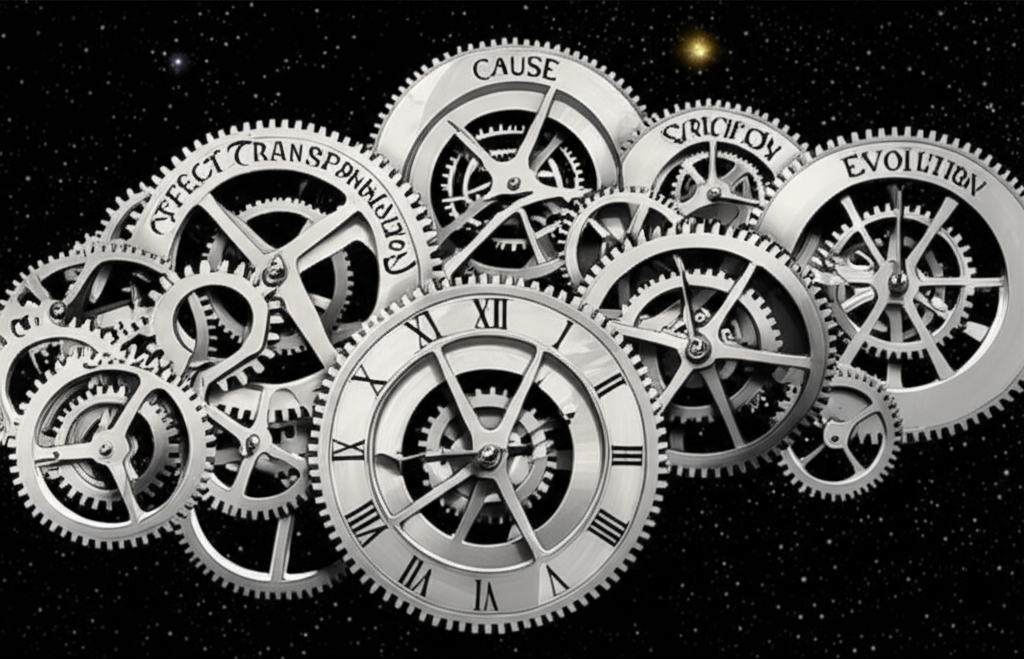
While often conceptualized as a linear sequence (Cause → Change), the relation is far more complex and dynamic.
- Chain Reactions: A single cause can initiate a cascade of changes, where each change becomes the cause for the next. Think of a domino effect, or a ripple spreading across a pond.
- Convergent Causation: Conversely, multiple causes can converge to produce a single, significant change. A complex historical event, for instance, rarely has one sole cause but is the result of numerous interacting factors.
- Feedback Loops: In many systems, change itself can become a new cause, influencing the original cause or setting off further changes in a cyclical manner. This is evident in ecological systems, economic models, and even human psychology. The relation is not static but constantly evolving.
Conclusion: The Enduring Principle
The relation between cause and change is not merely an academic philosophical puzzle; it is an indispensable principle that underpins our very existence and our capacity to navigate the world. From the simplest physical interactions to the grandest historical movements, the quest to understand what causes what and how things change remains central to human inquiry. Whether viewed as an empirical observation, a psychological habit, or an inherent structure of the mind, this intimate relation compels us to continually seek explanations, anticipate outcomes, and reflect on the intricate tapestry of reality.
YouTube Video Suggestions:
- "Aristotle's Four Causes Explained" (for a deep dive into classical understanding of causality)
- "David Hume and the Problem of Causation" (for exploring modern philosophical challenges to the concept)
📹 Related Video: What is Philosophy?
Video by: The School of Life
💡 Want different videos? Search YouTube for: "The Relation Between Cause and Change philosophy"