

The Intertwined Dance: Unpacking the Relation Between Cause and Change
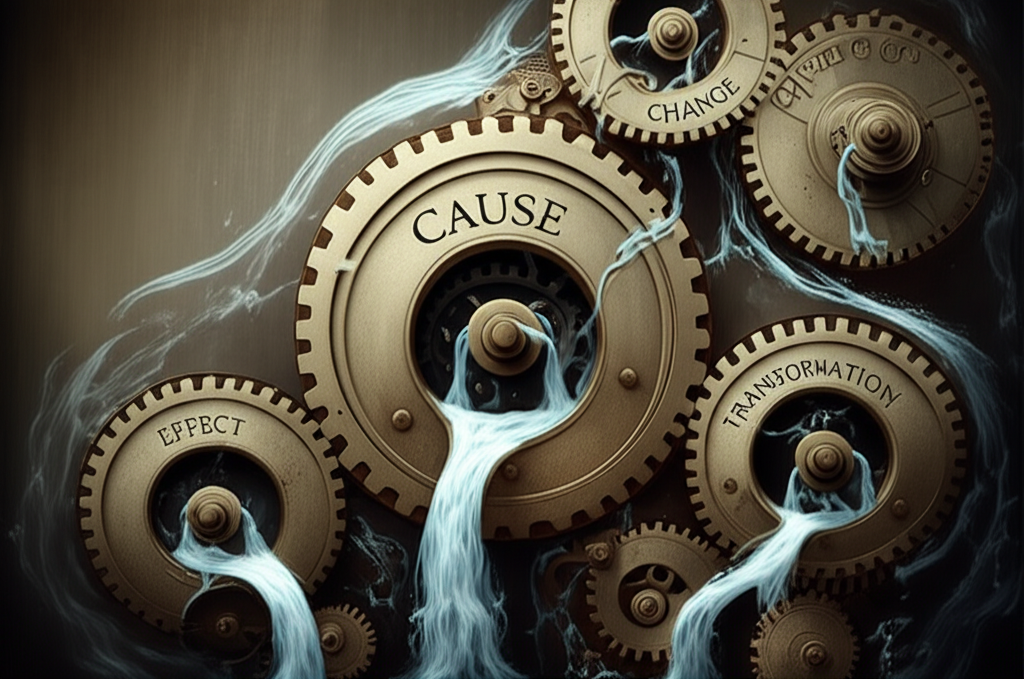
The philosophical landscape is replete with fundamental questions, yet few are as central to our understanding of reality as the relation between cause and change. At its core, this article posits that cause is the indispensable antecedent condition for any change, and conversely, change is the observable manifestation of causal efficacy. We will explore how philosophers, from antiquity to the modern era, have grappled with defining these concepts and establishing the profound principle that inextricably links them, forming the bedrock of both scientific inquiry and our everyday experience of a dynamic world.
Introduction: The Fundamental Link
From the falling apple to the shifting tides, the universe presents itself as a ceaselessly evolving tapestry. Every observable alteration, every transformation, every movement suggests a preceding impetus. This intuitive grasp of cause and change forms the basis of our interaction with the world, allowing us to predict, plan, and manipulate our environment. Yet, beneath this surface intuition lies a profound philosophical challenge: precisely defining what constitutes a cause and how it brings about change, and understanding the nature of the relation that binds them. This inquiry has occupied the minds of the greatest thinkers, shaping our understanding of everything from physics to free will.
Defining Our Terms: Cause and Change
Before we delve into the intricate relation, it is crucial to establish a working definition for each component. The clarity of our terms underpins the strength of our argument.
What is Cause?
In its most general sense, a cause is that which produces an effect, that without which a particular event or state of affairs would not have occurred. However, this seemingly simple definition masks layers of complexity. Philosophers have long debated the nature of causality, exploring whether it is a direct force, a necessary connection, or merely a constant conjunction of events.
From the tradition of the Great Books of the Western World, Aristotle offered one of the most comprehensive early frameworks for understanding cause, distinguishing between four distinct types:
- Material Cause: That out of which something is made. For example, the bronze of a statue or the wood of a table. It is the underlying subject matter that undergoes change.
- Formal Cause: The essence, pattern, or structure of a thing; its definition. For instance, the specific design or shape that makes a statue a statue, or the blueprint of a house.
- Efficient Cause: The primary source of the change or rest; the agent that brings something about. This is often what we typically mean by "cause" – the sculptor who carves the statue, or the carpenter who builds the table.
- Final Cause: The end, purpose, or goal for which something is done or exists. The reason why something is, such as the statue's purpose to commemorate a hero, or the table's purpose to hold objects.
These Aristotelian categories highlight that cause is not monolithic but operates on multiple levels, each contributing to the complete understanding of a phenomenon. The principle of causality, therefore, is the assertion that every event has a cause, or a set of causes, that precede and account for it.
What is Change?
Change is the transition from one state to another. It is alteration, transformation, movement, growth, or decay. In a philosophical context, change often refers to a shift in a thing's properties or existence. Aristotle, again, provides a foundational perspective, defining change as the actualization of what is potential. A seed has the potential to become a tree; its growth into a tree is the actualization of that potential, a process of change.
We can categorize change in various ways:
- Substantial Change: A change in the very essence or nature of a thing (e.g., a living organism dying).
- Accidental Change: A change in the non-essential properties of a thing (e.g., a leaf changing color, a person growing taller).
Regardless of its type, change is inherently dynamic, implying a beginning, a process, and an end state. It is the observable evidence that something has happened, that a new state of affairs has come into being.
The Inseparable Relation: Cause as the Engine of Change
The fundamental insight is this: change cannot occur without a cause. A state of affairs does not spontaneously transform itself; there must be an impetus, an efficient agent, a reason for the alteration. The relation between cause and change is therefore one of dependency: change depends on cause for its initiation and direction.
Consider any instance of change: a ball rolling down a hill. The change is the ball's movement from a higher to a lower position. The cause is gravity acting upon the ball, combined with the incline of the hill. Without gravity, or without the incline, the ball would remain stationary. The principle here is that the cause acts as the engine, the driving force that propels something from one state to another.
Philosophers like David Hume, while skeptical of our ability to perceive a necessary connection between cause and effect, nonetheless acknowledged their constant conjunction. We observe that event A is invariably followed by event B. It is through this repeated observation that we infer a causal relation, even if we cannot directly see the "force" of causation itself. For Hume, our belief in causation is a product of habit and expectation, a powerful principle of human nature.
Philosophical Perspectives on the Causal Principle
The relation between cause and change has been a cornerstone of metaphysical inquiry, leading to diverse and often conflicting viewpoints.
Aristotle's Four Causes Revisited
As discussed, Aristotle's framework directly addresses how different types of causes contribute to change. The efficient cause initiates the change, the material cause undergoes it, the formal cause defines the resulting state, and the final cause provides the purpose for the change. This holistic view emphasizes that a complete understanding of any change requires considering all its causal dimensions.
Hume's Skepticism and the Problem of Induction
David Hume famously challenged the notion of a necessary causal connection. He argued that we never truly observe causation itself, only the constant conjunction of events. We see one billiard ball strike another, and the second ball moves. We infer that the first caused the second to move, but we don't perceive an invisible force or inherent necessity. This skepticism led to the "problem of induction": how can we logically justify assuming that future events will resemble past ones, especially regarding causal relations? Despite this, Hume acknowledged that our practical lives and scientific endeavors rely on the principle of causality, even if its ultimate philosophical grounding remains elusive.
Kant's Synthetic A Priori
Immanuel Kant sought to rescue causality from Humean skepticism. He argued that causality is not merely an empirical observation but a fundamental category of understanding, a "synthetic a priori" principle. For Kant, our minds are structured in such a way that we impose the concept of cause and effect onto our sensory experience. We cannot experience a world without causality because our minds necessarily organize phenomena according to this principle. Therefore, the relation between cause and change is not something we learn from the world, but rather a necessary condition for our experiencing a coherent world at all.
Modern Interpretations
In contemporary philosophy and science, the discussion continues. While classical physics often embraced a deterministic view where every change had a precise, predictable cause, quantum mechanics introduced probabilistic causation. Here, events are not always strictly determined but occur with certain probabilities, challenging the traditional one-to-one relation between cause and effect. Nevertheless, even in probabilistic models, the idea that certain conditions (causes) make certain outcomes (changes) more likely remains central.
The Principle of Causality: A Necessary Assumption?
The enduring debate surrounding the relation between cause and change ultimately circles back to the principle of causality itself. Is it an empirical generalization, a psychological habit, or a necessary truth that underpins all rational thought and scientific inquiry?
Regardless of its ultimate philosophical grounding, the principle that every change has a cause is indispensable. It allows us to:
- Understand the past: By tracing effects back to their causes.
- Predict the future: By understanding causal relations, we can anticipate outcomes.
- Act effectively: By knowing what causes certain changes, we can intervene to achieve desired results.
Without this principle, the universe would appear as a series of disconnected, inexplicable events, rendering scientific investigation and even coherent thought impossible. It is a foundational assumption that allows us to construct meaning from the flux of experience.
Implications and Conclusion: A World in Flux
The exploration of the relation between cause and change reveals not just a philosophical puzzle, but the very mechanism by which our world operates. Every moment of existence, from the grand cosmic shifts to the subtle alterations within ourselves, is a testament to this profound connection. Understanding the principle of causality is not merely an academic exercise; it is fundamental to how we perceive, interpret, and navigate reality.
Whether viewed through the lens of Aristotle's teleological explanations, Hume's skeptical observations, or Kant's transcendental idealism, the dance between cause and change remains the most compelling performance on the stage of existence. It compels us to ask "why" and "how," driving both our intellectual curiosity and our practical endeavors. In a world defined by constant flux, the unwavering relation between cause and change provides the underlying structure, making sense of the ceaseless unfolding of phenomena.
📹 Related Video: ARISTOTLE ON: The Nicomachean Ethics
Video by: The School of Life
💡 Want different videos? Search YouTube for: ""Aristotle Four Causes Explained""
📹 Related Video: KANT ON: What is Enlightenment?
Video by: The School of Life
💡 Want different videos? Search YouTube for: ""Hume on Causation and Induction""