

The Pursuit of Happiness and the Good Life: An Enduring Philosophical Quest
The quest for happiness and the elusive "good life" is perhaps the most fundamental and persistent human endeavor, a thread woven through the entire tapestry of Western thought. From the ancient Agora to the modern digital forum, philosophers have grappled with what it means to live well, to flourish, and to find meaning amidst the inevitable challenges of life and death. This article delves into how the Great Books of the Western World illuminate this pursuit, examining various perspectives on pleasure and pain, the nature of good and evil, and the ultimate purpose of human existence. We will explore the diverse paths proposed by thinkers across millennia, ultimately seeking to understand the enduring relevance of these ancient debates for our contemporary lives.
The Enduring Quest: Defining Our Ultimate End
What, truly, is the good life? Is it a state of constant joy, an absence of suffering, or something far more profound? Humanity's fascination with this question is not merely academic; it is deeply personal, shaping our choices, our values, and our very understanding of success and failure. For centuries, the greatest minds have offered compelling, often contradictory, answers. The journey through their arguments reveals not a singular truth, but a rich spectrum of human aspiration.
From Ancient Wisdom to Modern Dilemmas: Mapping Happiness
The concept of happiness itself has undergone significant reinterpretation. For some, it is an internal state; for others, an external condition. The Great Books provide a crucial framework for understanding these distinctions.
The Hellenic Ideal: Eudaimonia and Virtue
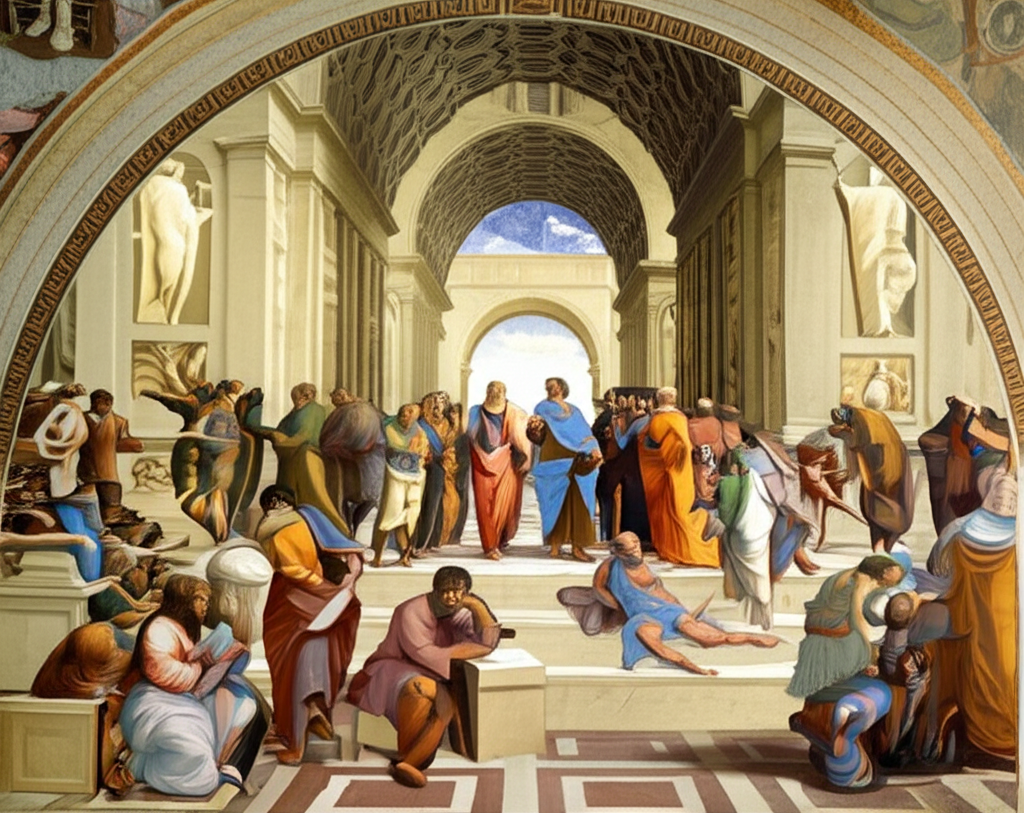
The ancient Greeks, particularly Aristotle, offered perhaps the most influential early articulation of the good life. In his Nicomachean Ethics, Aristotle posits that the ultimate human end, or telos, is eudaimonia – often translated as "flourishing" or "living well," rather than mere emotional happiness. This flourishing is achieved through the cultivation of virtue (arête) and the exercise of reason. For Aristotle, the good life is an active, rational life lived in accordance with virtue, finding the "golden mean" between extremes.
Plato, Aristotle's teacher, also linked the good life to virtue, particularly through the concept of the just soul. In The Republic, he argues that a soul ordered by reason, where the rational part governs the spirited and appetitive parts, is inherently a happy and good soul, regardless of external circumstances. The pursuit of the Good, a transcendent Form, guides this internal harmony.
Pleasure, Pain, and Tranquility: Epicurus and the Stoics
In contrast to the rigorous virtue ethics of Aristotle and Plato, Epicurus proposed a philosophy centered on pleasure as the ultimate good, but with a crucial nuance. For Epicurus, the highest pleasure was not sensual indulgence, but ataraxia – a state of tranquility, freedom from disturbance, and the absence of pain in both body and mind. The good life, therefore, involved prudent choices, moderation, and the cultivation of friendship to minimize suffering and achieve inner peace.
The Stoics, on the other hand, while also seeking tranquility, approached it through a radical acceptance of fate and a focus on what is within one's control: one's judgments and reactions. For thinkers like Seneca and Epictetus, the good life was about living in accordance with nature and reason, cultivating virtue (wisdom, justice, courage, temperance), and maintaining indifference to external events, including pain and even death. Happiness was not found in external circumstances, but in the internal fortress of a virtuous mind.
Here’s a brief overview of key philosophical approaches to the good life:
| Philosophical School | Core Concept of the Good Life | Role of Happiness | Key Focus |
|---|---|---|---|
| Aristotelianism | Eudaimonia (human flourishing) | Achieved through virtue and reason | Virtue, rational activity |
| Platonism | The just soul, communion with the Good | Internal harmony, alignment with Forms | Reason, justice, the Good |
| Epicureanism | Ataraxia (tranquility), absence of pain | Derived from moderate pleasure and peace | Prudence, friendship, minimizing suffering |
| Stoicism | Living in accordance with nature and reason | Internal, independent of external events | Virtue, acceptance, control over judgments |
| Utilitarianism | Greatest good for the greatest number | Maximizing pleasure, minimizing pain | Consequences, collective well-being |
The Moral Compass: Good, Evil, and Duty
The pursuit of the good life is inextricably linked to our understanding of good and evil. Is the good life simply one that maximizes personal pleasure, or does it demand adherence to a higher moral code?
Immanuel Kant, a towering figure in the Great Books, argued vehemently against grounding morality in happiness or inclination. For Kant, the good life is fundamentally a moral life, driven by duty and the categorical imperative – acting only according to maxims that one could universalize. Good is defined by the purity of the will, by acting out of reverence for the moral law, not by the consequences or the pleasure it might bring. Doing one's duty, even if it brings no personal happiness, is the mark of a truly moral, and thus truly good, life.
Earlier, St. Augustine, deeply influenced by Platonism, posited that ultimate happiness and the supreme Good could only be found in God. Evil, for Augustine, was not a substance but an absence of good, a privation. The good life, therefore, was a life lived in devotion to God, seeking the beatific vision, understanding that true joy transcends earthly pleasure and pain.
In stark contrast, Friedrich Nietzsche challenged conventional notions of good and evil, arguing that these concepts were often tools of the weak to control the strong. For Nietzsche, the good life was about the "will to power," the striving for self-overcoming, the creation of one's own values, and the affirmation of life in all its tragic beauty. Happiness was not comfort, but the feeling of power, of growth, of overcoming resistance.
The Shadow of Mortality: Life, Death, and Meaning
Ultimately, the quest for the good life is framed by the undeniable reality of life and death. How we conceive of our finite existence profoundly shapes our pursuit of happiness and meaning.
For many philosophers, from the Stoics who meditated on memento mori (remember you must die) to existentialists who grappled with the absurdity of existence, confronting death is not morbid but essential for living well. It sharpens our focus, urging us to consider what truly matters. Does the good life require us to leave a legacy, to make a lasting impact, or is it sufficient to live fully in the present?
The ultimate questions of meaning, purpose, and value arise most acutely when we face our own mortality. Is there an inherent meaning to life, or must we create it? The answers offered by the Great Books vary wildly, from divine providence to radical self-creation, each providing a profound lens through which to view our own brief flicker of existence.
Synthesizing the Good Life: A Planksip Perspective
The rich, often conflicting, perspectives on happiness and the good life found within the Great Books of the Western World remind us that there is no single, universally accepted blueprint. Instead, we are presented with a toolbox of concepts: the importance of virtue, the pursuit of tranquility, the demands of duty, the courage to create one's own values, and the profound impact of confronting life and death.
Perhaps the true "good life" is not a destination, but an ongoing process of inquiry, self-reflection, and engagement with these enduring questions. It requires us to weigh pleasure and pain, to define our own good and evil, and to forge a path that is both authentic and meaningful in the face of our finite existence. The pursuit is not merely intellectual; it is the very essence of what it means to be human.
YouTube Suggestions:
-
📹 Related Video: ARISTOTLE ON: The Nicomachean Ethics
Video by: The School of Life
💡 Want different videos? Search YouTube for: "Aristotle Eudaimonia explained"
-
📹 Related Video: STOICISM: The Philosophy of Happiness
Video by: The School of Life
💡 Want different videos? Search YouTube for: "Stoicism and the Good Life"