

The Psychological Basis of Emotion: A Journey Through the Human Mind
Summary: The intricate tapestry of human experience is woven significantly by emotion. Far from being mere fleeting sensations, emotions possess a profound psychological basis, deeply rooted in the mind of man. This article delves into how philosophers, from ancient Greece to the Enlightenment, have grappled with understanding these powerful internal states, exploring their origins, their impact on our rational faculties, and their fundamental role in defining what it means to be human. We examine how the "Great Books" reveal a persistent inquiry into emotion, touching upon its internal mechanics and its observable "physics" within the human condition.
The Elusive Nature of Emotion: A Philosophical Quest
For millennia, thinkers have pondered the wellsprings of our feelings. What is emotion? Is it a disturbance of the soul, a dictate of the body, or a sophisticated product of our cognitive faculties? The quest to understand its psychological basis has been a central pillar of philosophical inquiry, revealing that these powerful internal states are not simply reactions but complex phenomena that shape our perceptions, decisions, and very identity. To understand man, one must first understand his passions, his joys, his sorrows, and his fears.
Ancient Wisdom: Mapping the Inner Landscape
The earliest philosophers, as captured in the Great Books of the Western World, laid crucial groundwork for understanding the human mind and its emotional life. They recognized that emotions were not monolithic but stemmed from various parts of our inner being.
-
Plato's Tripartite Soul: In his Republic, Plato famously described the soul as having three parts:
- Reason (Logistikon): The rational part, seeking truth and wisdom.
- Spirit (Thymoeides): The spirited part, associated with honor, courage, and anger.
- Appetite (Epithymetikon): The appetitive part, driven by desires for food, drink, and sensual pleasures.
This allegory, often depicted as a charioteer (Reason) guiding two horses (Spirit and Appetite), illustrates how emotions arise from the interplay and potential conflict between these internal forces. A well-ordered soul, for Plato, was one where Reason held the reins, guiding the spirited and appetitive parts towards harmony.
-
Aristotle and the Ethics of Emotion: Aristotle, in his Nicomachean Ethics, provided a more detailed analysis, viewing emotions (or "passions") as responses to perceived good or evil, and crucial components of moral life. He believed that emotions like anger, fear, pity, and joy were natural to man, and the key was not their eradication, but their proper management – feeling them "at the right times, with reference to the right objects, towards the right people, with the right motive, and in the right way." For Aristotle, understanding the physics of these internal reactions was vital for cultivating virtue.
-
The Stoic Discipline: In stark contrast, the Stoics, like Epictetus and Seneca, advocated for the mastery of emotions. They posited that emotions (or pathe) were irrational judgments that disturbed the tranquility of the mind. True wisdom lay in recognizing what is within our control (our thoughts and judgments) and what is not (external events). By reshaping our judgments, they believed, one could achieve apatheia, a state of freedom from disturbing passions, leading to a profound inner peace for man.
The Cartesian Divide: Mind, Body, and the Seat of Emotion
With the advent of modern philosophy, particularly through René Descartes, the discussion around emotion took a new turn, emphasizing the distinct nature of the mind and the body.
- Descartes' Dualism: In his Passions of the Soul, Descartes attempted to provide a mechanistic explanation for emotions. He viewed emotions as "passions of the soul" caused by the movements of "animal spirits" within the body, which then affected the mind via the pineal gland. While his physiological explanations were later superseded, his work highlighted a critical philosophical problem: how do the immaterial mind and the material body interact to produce subjective emotional experience? This question profoundly influenced subsequent investigations into the psychological basis of emotion, prompting inquiries into the very physics of their interaction.
Emotion: The Dynamic Physics of the Human Condition
To speak of the "physics" of emotion might seem an unusual juxtaposition, yet it captures an essential truth: emotions are not static. They are dynamic forces, internal reactions, and powerful determinants of human action, akin to the forces that govern the natural world.
- Internal Forces and Reactions: Just as physics describes the forces and movements of matter, we can conceptualize emotions as internal forces acting upon the mind of man. Fear propels us to flee, anger to confront, joy to celebrate. These are not merely abstract feelings but powerful impulses that manifest in physiological changes (heart rate, adrenaline) and behavioral responses.
- The Interplay of Mind and Body: The philosophical journey reveals that the psychological basis of emotion is inextricably linked to our physical existence. Our bodily sensations inform our emotions, and our emotions, in turn, affect our bodies. This constant feedback loop underscores a profound unity, despite historical attempts to separate mind and body. The "physics" here is the intricate dance between neurons firing, hormones surging, and the subjective awareness that emerges.
The Enduring Inquiry: A Continuing Journey
From Spinoza's geometric analysis of passions to Hume's assertion that "reason is, and ought only to be the slave of the passions," and Kant's emphasis on moral feeling, the philosophical dialogue on emotion has continuously evolved. These thinkers, building on the foundations of the Great Books, have deepened our understanding of the complex interplay between reason and feeling, highlighting that emotions are not mere obstacles to rationality but integral components of the human mind.
The psychological basis of emotion remains a fertile ground for exploration. It demands that we look beyond superficial expressions to the profound internal mechanisms that govern our experiences, reminding us that to understand man is to understand the intricate, powerful, and often mysterious world of his emotions.
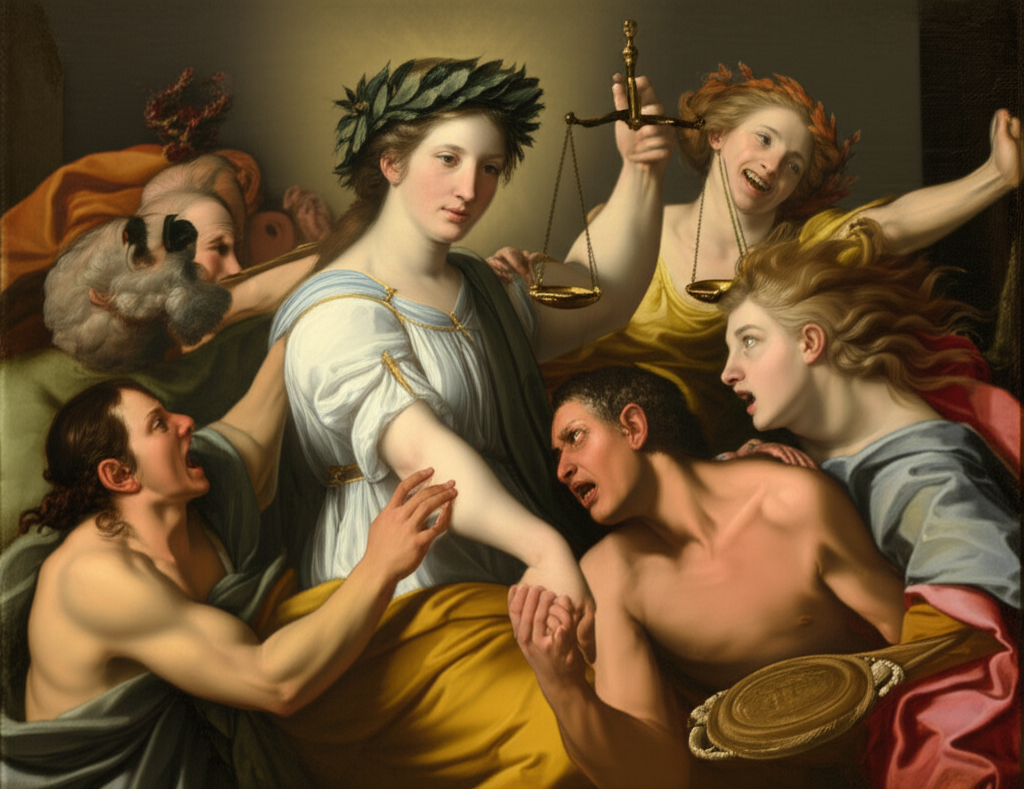 , Fear (cowering), and Joy (dancing, exuberant). The background could show a turbulent landscape contrasting with a serene, ordered temple, symbolizing the internal struggle within the human mind.)
YouTube Video Suggestions:
-
📹 Related Video: PLATO ON: The Allegory of the Cave
Video by: The School of Life
💡 Want different videos? Search YouTube for: ""Plato's Chariot Allegory Explained Philosophy""
2. ## 📹 Related Video: STOICISM: The Philosophy of Happiness
Video by: The School of Life
💡 Want different videos? Search YouTube for: ""Stoicism and Emotion Control Philosophy""