

The Psychological Basis of Emotion: A Timeless Inquiry into the Human Mind
Summary: From the ancient Greeks to modern neuroscience, the nature of emotion has perplexed and enlightened thinkers across the ages. This article explores the philosophical and psychological underpinnings of our feelings, tracing how great minds have grappled with the interplay between the Mind, the body, and the external world. We delve into classical concepts of the soul, the Cartesian dualism, and the emerging understanding of how the very physics of our being contributes to the rich tapestry of human affect, ultimately seeking to understand the psychological basis that defines Man's experience.
The Enduring Riddle of Emotion: A Core Human Experience
What is emotion? Is it a fleeting sensation, a disturbance of the soul, or a complex physiological response? For millennia, philosophers have pondered the origins and functions of our feelings – joy, sorrow, fear, anger, love. These subjective states, while deeply personal, exert profound influence over our thoughts, actions, and very perception of reality. Understanding their psychological basis is not merely an academic exercise; it is an endeavor to comprehend the essence of being Man. The journey through the Great Books reveals a persistent fascination with this internal landscape, offering diverse perspectives that continue to shape our contemporary understanding.
Classical Foundations: Soul, Body, and Passion
The earliest systematic attempts to understand emotion often intertwined with theories of the soul and the human constitution.
- Plato's Tripartite Soul: In works like The Republic, Plato posited a soul divided into three parts:
- Reason (λογιστικόν): The rational, governing part, seeking truth.
- Spirit (θυμοειδές): The spirited, courageous part, often allied with reason but capable of independent passion (e.g., anger, honor).
- Appetite (ἐπιθυμητικόν): The desiring part, driven by bodily needs and pleasures.
For Plato, emotions often arose from the interplay or conflict between these parts, with reason ideally guiding the others to achieve harmony and virtue.
- Aristotle's Integrated View: Aristotle, particularly in Rhetoric and Nicomachean Ethics, offered a more integrated perspective. He saw emotions (πάθη) not merely as irrational disturbances but as complex states involving:
- A specific object or situation: We are angry at someone or fearful of something.
- A cognitive judgment: Our assessment of that object or situation (e.g., perceiving an injustice).
- A physiological change: A bodily sensation accompanying the emotion.
For Aristotle, emotions were crucial for moral action and practical wisdom, bridging the gap between thought and action, and deeply rooted in the nature of Man as a rational animal.
- The Stoic Emphasis on Reason: Philosophers like Seneca and Epictetus, drawing from earlier Greek thought, viewed emotions as "passions" (pathos) that arose from false judgments and could disrupt rational tranquility. Their ideal was apatheia – not apathy in the modern sense, but freedom from irrational passions, achieved through rigorous application of reason over the dictates of unexamined feelings.
These classical views laid the groundwork for centuries of philosophical inquiry, establishing the core tension between reason and passion that continues to define discussions about the Mind and its emotional life.
The Cartesian Divide and Its Aftermath: Mind, Body, and the Machine
The dawn of modern philosophy brought new challenges to understanding emotion. René Descartes, a pivotal figure in the Great Books, introduced a radical dualism that profoundly impacted the study of the Mind.
- Descartes' Dualism: In Meditations on First Philosophy and Passions of the Soul, Descartes argued for two distinct substances:
- Res cogitans (thinking substance): The immaterial Mind, the seat of consciousness, thought, and will.
- Res extensa (extended substance): The material body, governed by the laws of physics.
For Descartes, emotions (passions) were primarily affections of the soul caused by movements of the "animal spirits" within the body, which then influenced the Mind via the pineal gland. This view, while attempting to explain the interaction, also created a significant philosophical problem: how could an immaterial Mind interact with a material body?
- Spinoza's Monistic Counterpoint: Baruch Spinoza, in his Ethics, offered a powerful critique of Cartesian dualism. He proposed a monistic system where God (or Nature) is the only substance, and Mind and body are merely two attributes of this single substance. For Spinoza, emotions (or "affects") are "affections of the body by which the body's power of acting is increased or diminished, aided or restrained, and at the same time the ideas of these affections." In this view, Man is not a separate Mind inhabiting a body, but an integrated whole, and emotions are natural phenomena, understandable through rational inquiry, much like any other aspect of physics in the natural world.
These divergent perspectives highlighted the fundamental problem of bridging the gap between subjective experience and objective reality, setting the stage for subsequent psychological and philosophical investigations.
The Material Turn: From Humors to Neurons – The Physics of Feeling
While classical thinkers often spoke of the soul, there was always an implicit, and sometimes explicit, recognition of the body's role in emotion.
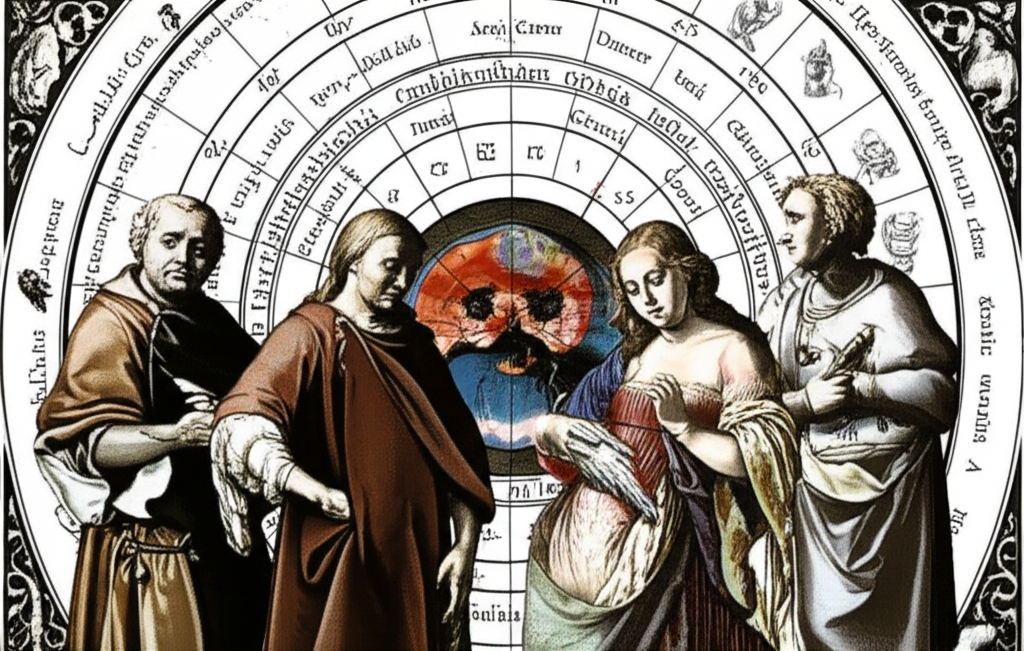
- Ancient Physiological Theories: Early attempts to link bodily states to temperament, such as the theory of the four humors (blood, phlegm, yellow bile, black bile) championed by Hippocrates and Galen, were rudimentary forms of understanding the physics of the body's influence on the Mind. A preponderance of one humor was thought to lead to specific emotional dispositions (e.g., sanguine, phlegmatic, choleric, melancholic).
- The Brain as the Seat of Emotion: Modern science, building on centuries of anatomical and physiological discovery, has firmly established the brain as the primary organ of Mind and emotion. While philosophers once debated where the soul resided, contemporary neuroscience actively maps the neural circuits and chemical processes that underpin our feelings. The physics of neural impulses, neurotransmitter release, and brain region activation (e.g., the amygdala for fear, the prefrontal cortex for regulation) provides a concrete, material basis for the psychological basis of emotion. This shift doesn't negate the subjective experience but seeks to explain its genesis in the complex, dynamic system that is the human brain. The physical laws governing the brain's operation, from electrochemical signals to intricate network dynamics, are now seen as fundamental to the emergence of our emotional lives.
Emotion as a Bridge: Connecting Inner and Outer Worlds
Ultimately, emotion serves as a vital bridge between our internal subjective experience and the external world. It is through our emotions that we appraise situations, form attachments, navigate social complexities, and find meaning. The Mind uses emotions as a sophisticated warning system, a motivator, and a connector.
- Appraisal and Action: Emotions are not merely passive states; they are active processes involving cognitive appraisal of stimuli and a readiness for action. Fear prepares Man for flight or fight; anger for confrontation; joy for engagement.
- Social Cohesion: Shared emotions foster empathy and build communities. They are fundamental to our understanding of others and our ability to cooperate.
- Moral Compass: Many philosophers, from Hume to Kant (albeit with different conclusions), recognized the role of feeling in moral judgment. Our capacity for empathy, compassion, and indignation is deeply rooted in our emotional architecture.
The ongoing philosophical and scientific exploration of emotion continues to reveal the profound intricate ways in which our subjective inner lives are inextricably linked to our physical being and our interactions with the world. The psychological basis of emotion is a testament to the enduring complexity and richness of the human Mind.
YouTube: "Aristotle on Emotion Philosophy"
YouTube: "Descartes Mind Body Problem Explained"
📹 Related Video: What is Philosophy?
Video by: The School of Life
💡 Want different videos? Search YouTube for: "The Psychological Basis of Emotion philosophy"